When I stepped into that Omaha courtroom wearing my Army dress uniform, my mother leaned in close and hissed, “Sit in the back, Rachel, and try not to embarrass us,” but ten seconds later, the judge looked up, went still, and said my name like she had seen it somewhere important — and for the first time in my life, the people who raised me understood the room no longer belonged to them. The courthouse smelled like old wood, floor polish, and anxiety. My parents were already standing near the front row with their attorney, dressed the way people dress when they want the world to confuse money with character. My mother gave me the same tight smile I had grown up with, the one that never reached her eyes. My father barely looked at me at all. He looked past me, around me, like I was just another inconvenience to handle before the hearing began. That part was not new. I had spent most of my life being treated like the daughter they wished had turned out differently. Too serious. Too stubborn. Too blunt. Too much in every way that never mattered when my younger sister did it and never stopped mattering when I did. By seventeen, I already knew the rules of our house. Melissa got softness. Melissa got celebration. Melissa got the version of my mother that knew how to glow and fuss and say, Isn’t she lovely? I got instruction. I got correction. I got told to stand straighter, speak quieter, want less. The first time it truly landed, I was a senior in high school asking for a prom dress. My mother did not even look up when she told me to wear my sister’s old one. She said I was not the kind of girl who cared about all that anyway. So Melissa got something new and blue and soft beneath the department store lights, and I stayed home in my room on prom night with a history book in my lap and the taste of humiliation sitting bitter at the back of my throat. That was the year I began planning my way out. Then came graduation. I crossed that stage with honors and searched the crowd for my family, hoping for one clean moment where I would feel chosen. Their seats were empty. They arrived late, blamed traffic, and somehow by dinner that night, the conversation had already moved to Melissa’s European trip, which my parents were paying for early because she had “so much potential.” That was the night I stopped confusing neglect with misunderstanding. I enlisted the next year. My father laughed like I had announced a joke. My mother cried, not because she was scared for me, but because she did not know how she would explain it to the neighbors. In their world, the Army was what girls like me did when they could not make something softer, prettier, more acceptable out of themselves. So I left. And for the first time, I found a world where effort mattered. Basic training did not care whose daughter I was. Law school did not care whether my mother approved of my tone. The JAG Corps did not ask me to shrink myself into somebody else’s polished little family portrait. It asked me to work. It asked me to stand straight, think clearly, and tell the truth without flinching. So I did. And that is exactly how I ended up back in Omaha in a courtroom my parents thought would remind me where I belonged. They had called me home for what they described as a small legal nuisance involving one of their tenants. They expected me to sit in the back, watch quietly, and play my old part — the daughter who could be summoned, placed, and silenced. My mother even pointed toward the last row near the door. So I sat there for a moment and watched them. Watched my father lean toward his expensive attorney. Watched my mother smooth her jacket with those perfect, careful hands. Watched the clerk organize files while the room filled with that familiar pre-hearing hush. Then the bailiff called everyone to rise. Judge Hullbrook stepped in. The hearing began. My parents’ lawyer stood to present their side. And that was when I rose from the back row, picked up my leather briefcase, and started walking forward in the kind of silence that makes every footstep sound like a warning. I passed my parents without looking at them. Reached the defense table. Set my briefcase down beside the tenant they had dragged in there alone. Then I looked directly at the bench and introduced myself..(I know you’re curious about the next part, so please be patient and read on in the comments below. Thank you for your understanding of the inconvenience. please leave a ‘YES’ comment below and give us a “Like ” to get full story ) 👇
The courthouse smelled like old wood, floor polish, and nerves. My parents were already standing near the front row with their attorney, dressed the way people dress…
On the midnight of my 18th birthday, I quietly transferred my late father’s $45 million inheritance into a protected trust structure. Thank God I did, because the next morning my mother slid a manila folder across the marble kitchen island in our Pacific Palisades mansion and smiled: “Just sign, sweetheart.” My influencer half-sister was already planning a Porsche and a luxury brand launch with my money… but they had no idea I’d spent the night updating everything with my father’s attorney… I was 17 years old, living inside a mansion in a coastal neighborhood that looked perfect from the outside, but felt colder than any small apartment I had ever imagined. My mother smiled for charity luncheons. My stepfather talked like a successful venture capitalist. My half-sister Serena posed online as a rising lifestyle founder. Everyone around us saw glass walls, ocean views, imported marble, and money. But inside that house, I was not treated like a daughter. I was treated like someone connected to something valuable. My biological father had built his fortune in a major tech valley before he died. He left behind a trust for me, one that would become mine when I turned 18. It was worth $45 million. To everyone else in that house, that number was not my future. It was something they had already started planning around. Two weeks before my birthday, my mother canceled the only dinner I had asked for all year. Not because of an emergency. Not because she forgot. Because Serena needed the main floor and terrace for a skincare brand launch mixer. My birthday dinner was moved aside like an inconvenience. Serena barely looked up from her phone when she thanked me for being “flexible.” My mother praised me for being “practical.” They expected me to smile, stay quiet, and disappear back into my room. So I did. I had learned long ago that crying in that house only gave them another way to shape the situation. While Serena got the best bedroom, the praise, the cars, and the spotlight, I got the guest room near the laundry area and a quiet role in the background. I studied data science. I kept my grades high. I stayed out of their way. They thought I was weak because I was silent. They never understood I was paying attention. Then one afternoon, I came home early and saw my stepfather’s tablet sitting on the kitchen island. A message flashed across the screen. It was from an estate attorney, with a subject line about a capital execution draft. Paul was my father’s name. I opened the file. Forty-two pages. By the time I finished reading, my hands were still steady, but something inside me had gone completely cold. The document was designed to move 80% of my inheritance into a new family holding company. My stepfather would oversee it. My mother would help manage the structure. Serena’s struggling brand would receive funding from it. My stepfather’s struggling tech business would rely on my father’s legacy for support. They were not planning a family discussion. They were planning major financial changes around money that belonged to me. At dinner that night, they sat across from me as if nothing had changed. Serena complained about needing more capital. My stepfather smiled and said the family would soon have all the support she needed. My mother told me to keep my head down and let them handle the complicated things. I looked at all three of them and realized the truth. They had been unusually kind to me because they were waiting for me to become old enough to sign documents. So I did not confront them. I photographed every page. I saved every timestamp. I took the information to the one man my father had trusted before he died: Elias Thorne. He read the documents in silence. Then he told me exactly what they were. A serious mistake waiting to happen. On the night before my 18th birthday, while everyone else in that mansion slept, I sat alone in my room with my laptop open. At 12:01 a.m., the moment I was legally old enough, I transferred every dollar of my inheritance into a protected corporate trust. By morning, they were waiting for me at the kitchen island. A birthday pastry sat beside a thick manila folder. My mother smiled and said, “We need to talk about that money.” My stepfather placed a cheap blue pen beside the papers and told me to sign where the tabs were. I did not shout. I did not cry. I opened the folder, read page after page, and let the silence make them nervous. Then I placed my phone on the granite counter, tapped the speaker button, and said calmly: “Mr. Thorne, you’re on speaker.” The room went silent. And when the voice on the phone explained what had happened at 12:04 that morning, my stepfather’s face lost all color. READ THE FULL STORY IN THE 1ST COMMENT BELOW 👇👇👇
The night before my eighteenth birthday, I sat alone in a guest room near the laundry and watched a clock. Not with fear. Not anymore. With the…
On my husband’s deathbed, he didn’t ask for forgiveness. He didn’t ask me to remember him kindly. He asked for one thing: “Never go to Cypress Hollow.” The stroke had taken most of his voice. Machines hummed beside the bed, doing what his body no longer could. But when he said that name, his hand tightened around mine with a strength that didn’t belong to someone fading away. “Erase it,” he whispered. “Don’t ask questions. Don’t look into it. Just stay away.” Cypress Hollow was six hundred acres of swampy Arkansas land—trees, water, and isolation—something he’d bought decades earlier and always brushed off as a mistake. In forty-four years of marriage, he never once took me there. Said it wasn’t worth the drive. Said there was nothing to see. So at 3:17 a.m., in a hospital room that smelled like antiseptic and endings, I promised the man I loved that I would never go near it. Eight months later, I was alone in a small apartment in Memphis, buried under grief and paperwork. I closed accounts, donated clothes, packed away a lifetime. Everything… except one folder. Cypress Hollow. Twice a year, tax notices still came. $847.28. Land I had never seen. Land I had sworn to ignore. “Leave it alone,” I told myself. “You made a promise.” Then the phone rang. “Mrs. Whitmore?” a man said. “This is Sheriff Cooper from Cross County, Arkansas.” My stomach tightened. “I’m calling about your property—Cypress Hollow. We need you to come out here.” “I can’t,” I said quickly. “My husband made me promise—” “Ma’am,” he said gently, “there’s a woman living on that land. She says she knows you. And she’s not doing well.” The silence that followed felt heavier than anything I had carried since his death. Three hours later, I was driving down empty Arkansas roads, passing fields and trees that stretched forever, telling myself there had to be a mistake. Cameron had always said the place was abandoned. Then I took the final turn. An ambulance sat idling near the drive. Sheriff’s cars lined the road. And instead of decay, there was a white farmhouse. Fresh paint. Lace curtains. Smoke curling from the chimney like someone had been living there all along. The sheriff met me before I reached the steps. “She’s been asking for you,” he said quietly. “By name.” On the porch sat an elderly woman wrapped in a blanket, silver hair neatly brushed, her eyes sharp despite her condition. When she saw me, something in her expression broke. “Daisy,” she whispered. “You came.” “I’m sorry,” I said carefully. “Do we know each other?” She smiled—a tired, knowing kind of smile. “No,” she said. “You wouldn’t recognize me. But I’ve known you for over thirty years.” My chest tightened. “Your husband told me everything,” she continued. “About Memphis. About your life together. About… your daughter.” Every nerve in my body went cold. Then she said my daughter’s name—the one no one outside our family ever used. And in that moment, I understood something I wasn’t ready to face: Cypress Hollow wasn’t just land. It was a secret. And whatever my husband had hidden there… hadn’t been waiting by accident. 👇 Full story continues in the first comment…
The promise came with Cameron’s dying breath, whispered through lips that could barely form words after the massive stroke had stolen half his body and most of…
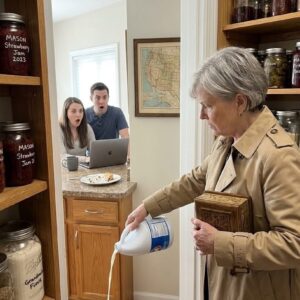
I forgot to tell my mother-in-law about the hidden camera at our country house. When I finally checked the footage, I watched her calmly pour bleach over my grandmother’s pantry… and slip a stolen jewelry box into her coat. I didn’t confront her. Instead, I set a trap, gave the police the real video, and waited. At 8 a.m. the next morning, my husband’s phone rang—and on the other end was… I heard her before I saw her. Her voice drifted through the half-open kitchen window, mixing with the crunch of gravel under her heels and the faint clink of the chicken-feed scoop near the porch. I stood in my grandmother’s kitchen, one hand wrapped around a warm mug, the scent of lavender detergent still lingering from the curtains Ana used to wash every spring. “Oh, don’t worry,” Margaret said. “She won’t notice if a few eggs go missing. She’s too busy pretending this place matters.” Then she laughed. That was the sound that did it. Not the insult. The laugh. Cold. Controlled. The same laugh she used at family dinners when she wanted everyone to know she had just said something cruel—without raising her voice. “That farm shack,” she continued into her phone, “is perfect for dumping trash.” A pause. Then softer: “Meaning her, apparently.” I stood frozen in the middle of my grandmother’s kitchen while the refrigerator hummed and a nervous hen clucked outside. Margaret was standing on land my grandmother had protected with two bad knees and grocery-store coffee, calling it trash. That “old woman” had a name. Ana. She taught me how to knead bread, label jars, prune roses, and listen for the soft cluck that meant an egg was coming. When she passed, she left me the house, the pantry, the chickens—and the cedar jewelry box hidden behind the flour tin. This place mattered. I had been married to Daniel for four years—long enough to understand that his mother’s approval wasn’t love. It was control. At our wedding, Margaret kissed my cheek and whispered, “Keep him interested, dear. Men get bored.” In photos, she looked warm. If you looked closer, you could see her fingers pressing into my shoulder. Daniel always called it “Mom being Mom.” He saw the best in people—especially her. That was one of the reasons I loved him. It was also why she knew exactly how to use him. So when a neighbor mentioned “strange activity” near the property, Daniel suggested asking Margaret to check on the chickens. “She’ll feel trusted,” he said. I wanted to believe that too. That weekend, we installed two small motion cameras. One faced the back door. The other sat high on a pantry shelf, angled toward Ana’s labeled jars and recipe boxes. “The cameras are probably unnecessary,” Daniel said. “Probably,” I replied. Then life got busy—and I forgot to tell Margaret about the pantry camera. I forgot… until Monday morning. At 6:14 a.m., while Daniel was still asleep, I opened the camera app with a cup of cold coffee beside me. The first clips showed nothing unusual. Curtains moving in the breeze. Shadows near the porch. Margaret walking through the kitchen like she owned the place. Then the clip labeled Sunday 4:38 p.m. opened. Margaret stood in the pantry with a bottle of bleach in her hand. At first, my mind searched for a normal explanation. Cleaning. A spill. Anything. There wasn’t one. She unscrewed the cap and calmly poured bleach across the pantry shelf. Over the flour tin. Over Ana’s handwritten labels. Over sealed jars of peaches. She moved slowly, carefully—like destruction could pass for housekeeping if done neatly enough. Then she reached behind the flour tin, pulled out the cedar jewelry box… and smiled. I stopped breathing. Inside were Ana’s wedding band, a rose pin, silver earrings from my childhood, and a folded recipe card in her handwriting. Margaret slipped the box into her coat pocket. Then she glanced toward the hidden camera—without seeing it—and said into her phone, “She’ll blame the house. Old places go bad. That’s what happens when people refuse to let go.” Cruelty doesn’t always look obvious. Sometimes it wears perfume and a polite smile. I replayed the clip three times before waking Daniel. He watched it once in silence. The second time, he covered his mouth. By the third, something in his expression changed. Recognition. “That’s Mom,” he said quietly. “Yes.” “She took the box.” “Yes.” “And she poured bleach on your grandmother’s pantry.” I didn’t answer. I didn’t need to. For one brief moment, I wanted to call her and say everything I had held back for years. But anger is only useful if you don’t waste it too early. So I made copies. By 7:03 a.m., the footage was saved to a flash drive. By 7:18, I had printed still images. By 7:41, I had written a list for the police: stolen jewelry, property damage, contaminated food. Then I texted Margaret. “Daniel and I found something strange at the house. Police suggested we make an inventory. Can you meet us there tomorrow at 8? Since you were the last one checking on things, we may need your help clarifying the timeline.” She replied two minutes later. “Of course, dear. Happy to help. That house has always needed better supervision.” I stared at the message until the words blurred. Then Daniel asked quietly, “You’re calling the police?” I looked at him across the kitchen. “No,” I said. “I already did.” By lunchtime, the officer had the real footage. By midnight, Daniel had barely spoken. At 7:52 the next morning, we sat at Ana’s kitchen table. The smell of bleach still lingered beneath the lemon cleaner. Daniel’s phone rested beside his coffee. The empty space behind the flour tin looked like a missing tooth. At 7:59, Margaret’s SUV pulled into the driveway. She stepped out smiling. At exactly 8:00, Daniel’s phone rang. He looked at the screen, swallowed, and put the call on speaker. Then the voice on the other end said… 👇 (I know you’re curious to see what happens next, so please be patient and continue reading in the comments below. Thank you for understanding the inconvenience. Please leave a “YES” below and give us a Like to get the full story.)👇
I heard Margaret before I saw her. Her voice slipped through the half-open kitchen window, carried on the crunch of gravel under her heels and the metallic…
During my wedding vows, a woman in a wheelchair rolled in holding a baby and said, “Please, listen before you marry him.” I almost did not wear white because my fiancé Daniel once said very casually that he preferred ivory. “More elegant,” he said. “More classic.” So I bought ivory. I remember thinking how thoughtful he was, how lucky I was to have a man who noticed details. I understand now what kind of details he was actually noticing. Daniel entered my life like something carefully arranged. Flowers on the third date. He met my parents on the sixth. By the fourth month, he was talking about children. He asked about my brothers once, and when I told him I had four of them—that I was the only girl in three generations on my father’s side—something shifted behind his eyes that I mistook for warmth. Everyone loved Daniel. My mother called him a gift. His family was polished and formal and a little cold—but I told myself that was simply their way. His mother, Margaret, called me the week before the wedding. “I just want you to know,” she said carefully, “that we are very pleased with this match.” Not happy. Not excited. Pleased. I should have pulled at that thread. Instead, I walked down the aisle, heart full, ivory dress catching the light exactly the way Daniel had imagined it. Every seat was filled. The ceremony was almost over. Daniel had just taken my hand. The ring was hovering at the tip of my finger. The priest smiled. “Almost there,” he said. And that was when the doors at the back of the church opened. The sound reached us before anything else—the soft mechanical roll of wheels against old stone floors. I saw a young woman in a wheelchair. In her arms, wrapped in a pale yellow blanket, was a newborn so tiny it barely seemed real. She looked straight at me and said: “Please. Listen before you marry HIM and HIS FAMILY.” Then Margaret’s voice sliced through the silence. “How on earth did you find us? I thought I got rid of you.” The woman in the wheelchair did not flinch. She simply looked at Margaret for one long, steady moment. Then she turned back to me. I watched the color drain from Daniel’s face. And her next words made me pull my hand out of Daniel’s. I know many of you want the next part, so please wait a moment and check the comments below for the continuation. Thank you for your patience and understanding. Comment “YES” and give us a Like to receive the full story.)👇
I almost bought a white wedding dress. Then Daniel told me he preferred ivory. More elegant, more classic, he said, scrolling through wedding photos online with that…

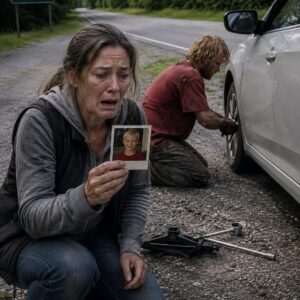
A homeless man helped me change a flat tire on Route 9, the same road where my son disappeared 20 years ago—what he left on my passenger seat brought me to my knees. I’m 50. My son Daniel vanished from a rest stop on that exact highway in 2006. He was 7. I was buying him a Sprite. I turned around, and he was gone. The police searched for six weeks. Then six months. Then the file was placed in a drawer and stayed there for twenty years. I stopped driving Route 9 after the first anniversary. I could not breathe on that road. But last Tuesday, my GPS rerouted me through it, and twenty miles in, my back tire blew. I was sitting on the shoulder, crying—not because of the tire, but because of everything—when a man in worn-out clothes came walking out of the trees. Tattered coat. Hands like leather. He did not say much—just nodded and started working on the tire like he had done it a thousand times. When he finished, he wiped his hands and looked at me with the saddest eyes I had ever seen. “You take care now, Margaret,” he said softly. I froze. I had never told him my name. Before I could speak, he turned and walked back into the pines. I got in my car, still trembling… and that was when I saw it. On the passenger seat. A faded Polaroid. 2006. A little boy in a red shirt, smiling at someone behind the camera. My son. A photo I had NEVER seen before in my life. And on the white border, in shaky handwriting, was AN ADDRESS. Only 40 miles away. I video-called the sheriff—the same man who closed Daniel’s case, now the mayor of our town. I showed him the Polaroid. His face turned white. Then he said something that made my stomach drop— “Margaret, whatever you do… DO NOT go to that address.” But it was too late. Because I was already there. And as I reached for the door— it creaked open from the inside. I dropped to my knees. I know many of you want the next part, so please wait a moment and check the comments below for the continuation. Thank you for your patience and understanding. Comment “YES” and give us a Like to receive the full story.)👇
I am fifty years old, and my life has been split in two since 2006. Before Daniel. After Daniel. Before, I was a mother driving down Route…
At my graduation, my father announced he was cutting me off. “You’re not my real daughter anyway.” The room gasped. I smiled, walked to the podium, and said, “Since we’re sharing DNA secrets.” I pulled out an envelope. His wife’s face turned white as I revealed… …because he chose the one moment I could not walk away from: cap on, tassel brushing my cheek, UC Berkeley still applauding while the Bay breeze shifted the banners above us. My name is Natalie Richards. I am 22, and I used to believe a diploma might finally make my father look at me like I mattered. He flew in from the Chicago suburbs at the last minute, sat four rows back in a dark suit that looked wrong in the sunlight, and watched me like I was a decision he could still undo. When my friends shouted my name, he clapped exactly three times. When strangers smiled and said, “You must be proud,” he nodded like he was approving a formality. Then the dean invited “a few words from family,” and my father stood. “I won’t be supporting her anymore,” he said, smooth as glass. “And she should stop telling people she’s a Richards. She’s not even my real daughter.” You could feel the air shift. People stared. Phones rose. My cheeks stayed dry, but my stomach dropped like an elevator. I looked at my mother. Because my mother—Diana—had spent my entire life softening his sharp edges, calling cruelty “stress,” treating silence like it was safer than the truth. In that moment, her hand froze on her purse strap, and her face went pale in a way I had only seen once before. When I was seventeen. That was the summer I stumbled across a truth that made our house feel staged. I did not understand every detail, but I understood enough to know my father’s love had always come with conditions—and that one day he would use those conditions like a weapon. So I built my own life anyway. Jobs, scholarships, and a small circle of people who showed up without needing to be begged. And one sealed envelope I saved for the day he decided to humiliate me in public. Standing on that stage, listening to him erase me with one sentence, I felt something inside me become quiet and steady. I walked to the podium, wrapped my fingers around the microphone, and let the silence stretch just long enough for him to feel it. “If we’re doing honesty today,” I said, calm, “then let’s do all of it.” My father’s jaw tightened. My brothers stared down at the floor. My mother did not blink. I reached into my gown and pulled out the envelope. Paper in the sunlight, the kind that changes what people believe they know. “For years,” I said, looking straight at him, “you’ve held one story over my head.” I turned the envelope so the front rows could see it, then let my eyes land on my mother’s face. Because she recognized it. Her lips parted like she was about to stop me, but no sound came out. I slid my thumb beneath the seal. And right before I pulled the page out—right before I said the name printed at the top—my father took one step toward the aisle like he might actually lose control in front of everyone. That was the first time I had ever seen fear flicker across his face. If you think you know what was inside that envelope, you are not even close. (I know you’re curious about the next part, so please be patient and read on in the comments below. Thank you for your understanding of the inconvenience. please leave a ‘YES’ comment below and give us a “Like ” to get full story ) 👇
My name is Natalie Richards. I am twenty-two years old, and I used to believe a diploma could finally make my father look at me like I…
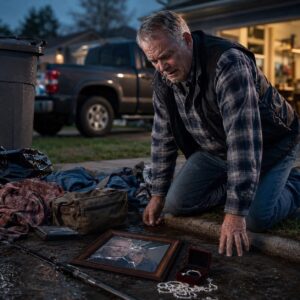
I Came Home From Three Quiet Days of Fishing to Find My Wedding Photo, My Late Wife’s Jewelry, and Every Piece of My Life Dumped Beside the Trash—Then My Son’s Wife Looked Me in the Eye and Said, “You’re Not Needed Here Anymore,” Like I Had Been Nothing but a Bill They Finally Finished Paying When I pulled into the driveway after three days at Lucky Peak, the first thing I noticed was a stack of boxes beside the dumpster. Not moving boxes. Not charity boxes. My boxes. The truck engine was still running when I saw Martha’s jewelry box lying in the dirt, half open, with her mother’s ring beside a crushed soda can. A moment later, I saw our wedding photo. Forty-two years old. The glass was cracked straight across her smile. I sat there with both hands on the steering wheel, staring as if maybe my eyes could find a kinder explanation than my brain already had. They couldn’t. My tackle box was broken open. My work shirts were soaked from the sprinkler. My Timex anniversary watch was face down in a puddle. Somebody had not simply packed up my life. Somebody had tossed it away. I walked to the front door and slipped my key into the lock. It stopped halfway. I tried again. Harder. Nothing. They had changed the locks. I called my son Floyd first. Straight to voicemail. Then Pamela. Same thing. I crossed the yard and knocked on my neighbor Simon’s door. He opened it just enough to look at me, then over my shoulder at the mess near the curb. “Simon, what happened?” He gave me that weak little shrug people use when they do not want to be caught knowing too much. “Didn’t really notice anything, Otis.” That told me everything. By the time Floyd and Pamela came home, I had been sitting beside my own belongings for four hours in a bent lawn chair I found near the pile. The sun had dropped low. The streetlights had come on. Nobody on that block had asked if I needed help. Pamela got out of the car first. No apology. No surprise. No shame. She looked at me, then at the boxes, then back at me like she was checking whether the garbage had been fully taken out. “Because you’re not needed here anymore, Otis.” I stood up slowly. “What are you talking about?” “The mortgage is paid off,” she said. “Your job here is done.” For a second, I honestly thought I had heard her wrong. Then Floyd stepped out from the passenger side and would not even look at me. That hurt worse than her voice. “This is my home,” I said. Pamela gave me a thin smile. “Lived here. Past tense.” I looked at my son. “Floyd?” He kept staring at the driveway. “Dad… it’s just not working anymore.” Not working. Eight years earlier, after Martha died, they had sat across from me at that same kitchen table and asked for help buying the house. Floyd’s credit was bad. Pamela was between jobs. They promised we would all live together. Said I would always have a place there. Said family should stay beneath one roof. So I helped. I signed what needed signing. I paid what needed paying. Mortgage. Utilities. Groceries. Repairs. When the furnace broke, I covered it. When Floyd fell behind, I covered that too. I kept telling myself I was not just helping them keep a house. I was helping us keep a family. Now I was standing in the street beside my late wife’s broken picture frame while my daughter-in-law spoke to me like I was an old appliance they had finally replaced. “Where am I supposed to go?” I asked. Pamela lifted the grocery bags from the trunk. “That’s not our problem.” Then she walked inside my house. My son followed her. And the door closed in my face. I stood there for a long time after that. Long enough for the hurt to cool and something harder to take its place. They thought I was finished because I was old. They thought I was helpless because I was quiet. They thought I had spent eight years paying bills with my eyes shut. That was their mistake. I loaded what mattered into my truck. Martha’s jewelry box. The photo. My tools. My folder of papers. Then I drove to a cheap motel off the highway, sat on the edge of a bed that smelled like bleach and old air-conditioning, and spread those papers beneath a yellow lamp. Every check stub. Every tax receipt. Every loan document from the day we bought that house. I had kept all of it. My hands were steady when I found the closing file. Steady when I flipped past the bank forms. Steady when I saw the signatures. Then I picked up my phone and made one call. The attorney who handled that house closing answered on the third ring. I gave him my name. I told him what had happened. I told him I needed one question answered right now. There was a pause while he pulled the file. Then he cleared his throat and said, very carefully, “Mr. Riley… before I answer that, I need to ask you something.” I tightened my grip on the phone. “Did your son and his wife ever actually read the deed?” (I know you’re curious about the next part, so please be patient and read on in the comments below. Thank you for your understanding of the inconvenience. please leave a ‘YES’ comment below and give us a “Like ” to get full story ) 👇
The first thing I noticed wasn’t the house. It was the pile. My pickup truck coughed to a stop in front of what used to feel like…
“My father promised he would walk me down the aisle, then vanished to my sister’s baby shower with the rest of my family, and by the time I walked through a garden full of empty chairs with our gray-haired landlord beside me, I had already stopped begging for people who only remembered I existed when they believed I had something they wanted.” “You can have a wedding anytime, Phoebe.” That was what my sister told me six weeks before my wedding, as if she were rescheduling brunch, not my life. Then she arranged her baby shower for the exact same day. Same date. Same hour. Same choice. And one by one, my family chose her. My mother. My aunts. My cousins. Even my father, who had held my hand and promised he would walk me down the aisle. I want to say I fought harder. I didn’t. I called. I asked. I gave them every chance to show me I mattered. What I received back was silence, vague excuses, and the kind of soft, careful voices people use when they have already chosen to disappoint you. My father worked at a bank in Hartford for most of his life. My mother kept a spotless colonial home in Glastonbury and cared deeply about appearances. My sister Brittany married rich five years ago, and from that moment on, the whole family began orbiting her like she was the sun. Her husband paid their mortgage. Bought my mother gifts. Covered dinners, vacations, little luxuries nobody wanted to lose. So when Brittany became pregnant and decided her shower mattered more than my wedding, nobody said no. I was the easier daughter to disappoint. I’m Phoebe. I’m the younger one. The illustrator. The one with paint on her sleeves and freelance checks that arrived unevenly. The one engaged to Ethan, a painter my family politely treated like a talented inconvenience. At Thanksgiving, my father looked directly at him over the turkey and asked when he planned to get a real job. Brittany laughed. Chad smirked. Ethan just reached under the table and squeezed my hand. That was Ethan. Quiet. Steady. Never loud enough for my family to understand him. We planned our wedding ourselves. A small garden ceremony near Mystic. Wildflowers. Handmade invitations. An arch Ethan built from salvaged wood. Nothing flashy. Nothing borrowed from anyone else’s money or approval. I loved every part of it. Maybe that was what bothered Brittany most. Three weeks before the wedding, my aunt accidentally let it slip. “Are you going to Brittany’s shower too,” she asked, “or just the wedding?” That was how I found out. When I called Brittany, she acted confused, sweet, innocent. She said the club only had that day available. She said maybe people could attend both. They couldn’t. She knew that. Then she said, in that syrupy voice she uses when she is being cruel on purpose, “This is my first baby, Phoebe. You can have a wedding anytime.” I called my mother. She asked whether I could postpone. I called my father. He said, “Let me see what I can do.” Three days later, I texted him: Are you still walking me down the aisle? He left me on read. The night before the wedding, I sent one final group text with the address, the time, and one line at the end: I hope to see you there. Not one person replied. The next morning, while my best friend Jessica was doing my makeup in the bathroom, my father called. I knew before I answered. “Phoebe,” he said, already sounding smaller than himself, “your mother and I don’t think we can make it to Mystic after the shower.” I stood there in my half-buttoned dress, mascara drying beneath my eyes, and listened to my father choose finger sandwiches and pink balloons over the moment he was supposed to place my hand into the hand of the man I loved. “You promised,” I said. “I know,” he answered. “But this is Brittany’s first baby. You’ll have other moments.” My voice did not shake. “This is my only wedding day.” Then I hung up. By the time we reached the garden, the chairs were already arranged. Forty-two white chairs with lavender tied to the backs. Thirty-five of them empty. I stood at the end of the aisle in a vintage lace dress from a consignment shop in Mystic and felt every empty seat like a hand pressed flat against my chest. Jessica offered to walk me down. I told her no. Then, just before the music started, I heard footsteps behind me. It was Arthur. Our landlord. Sixty-seven years old. Quiet. Always smelling faintly of coffee and old books. He was wearing a navy suit I had never seen before, and he held out his arm like it was the simplest thing in the world. “Your father should be here,” he said. “Since he isn’t, someone who values you should.” So I took his arm. Seven people watched me get married that afternoon. Seven. And somehow, it was still beautiful. That night, after the last pizza boxes had been cleared and the lavender had been brought home in jars, I opened Instagram and saw my sister’s post from the shower. My father was in the background smiling with one hand on her stomach. The caption said: Family is everything. I stared at it for a long time. Then I put my phone down and made myself a promise. I would never again beg people to love me correctly. The next morning, I posted one single honeymoon photo. Nothing dramatic. Just me, Ethan, blue water behind us, and one quiet caption. Within an hour, my phone lit up with 417 messages from the same family who could not send a single one on my wedding day…(I know you’re curious about the next part, so please be patient and read on in the comments below. Thank you for your understanding of the inconvenience. please leave a ‘YES’ comment below and give us a “Like ” to get full story ) 👇
“You can have a wedding anytime, Phoebe.” That’s what my sister said six weeks before I walked down the aisle in a garden full of empty chairs….