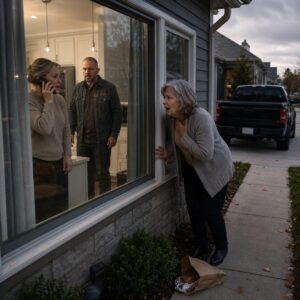
I stopped by my son’s house and saw his truck in the driveway, even though he was supposed to be out of town. When I walked to the side window and heard his wife on the phone, the words coming from her mouth left me frozen where I stood. I stopped by my son’s house just after five on a cold Thursday afternoon in Ohio, carrying a paper bag with banana bread wrapped in foil. My son, Daniel Whitaker, was supposed to be in Denver for a three-day construction conference. His wife, Melissa, had told me that herself the night before. So when I turned onto Pine Hollow Drive and saw Daniel’s black Ford F-150 sitting in the driveway, my foot eased off the gas. At first, I smiled. Maybe his flight had been canceled. Maybe he had returned early to surprise Melissa. Maybe he had simply forgotten to tell me. Daniel was thirty-six, a grown man, but he still forgot small things when work became busy. I parked along the curb instead of pulling into the driveway. I do not know why. Something about the house felt wrong. The curtains were half-closed. The porch light was off even though the sky had turned gray. Melissa’s white sedan was in the garage, visible through the narrow window. I walked up the side path with the bread tucked under my arm. Before I reached the back door, I heard Melissa’s voice through the slightly open side window near the kitchen. “No, he doesn’t suspect anything,” she said. I froze. Her tone was not casual. It was low, sharp, and impatient. I stepped closer, my shoulder almost brushing the brick wall. Melissa laughed softly. “His mother? Please. Patricia still thinks Daniel hung the moon. She would believe anything I told her.” My fingers tightened around the paper bag until the foil inside crinkled. Then Melissa said something that made the air leave my lungs. “Listen, the insurance paperwork is already in the safe. Once Daniel signs the revised beneficiary forms, we’re done. After that, he can have his little accident on the job site, and nobody will question it.” The world narrowed to the window, her voice, and my own heart pounding in my ears. A man replied from inside the kitchen, not through the phone. “Are you sure he’ll sign?” I knew that voice. Evan Moore. Daniel’s business partner. Melissa answered, “He signs whatever I put in front of him. He thinks I’m saving his company.” I wanted to scream Daniel’s name. I wanted to run inside. But then I heard a chair scrape. Evan said, “And the truck?” Melissa replied, “In the driveway so it looks like he came home early. He’s in the basement. He won’t be going anywhere until he agrees.” The banana bread slipped from my hand and hit the concrete. Inside, silence fell. Then Melissa whispered, “Did you hear that?” I backed away, barely breathing, as footsteps moved toward the window. (I know you’re curious about the next part, so please be patient and read on in the comments below. Thank you for your understanding of the inconvenience. please leave a ‘YES’ comment below and give us a “Like ” to get full story ) 👇
I stopped by my son’s house just after five on a cold Thursday afternoon in Ohio, carrying a paper bag with banana bread wrapped in foil. Daniel…
After the family reunion, I opened my bank account — it was empty. My brother-in-law laughed, “we needed it more than you.” Shaking, I grabbed my bag and said, “then you won’t mind what happens next.” As they laughed, a loud bang echoed through the house. The door slammed open — and… “Are you actually upset about this?” Seth leaned against the fridge, a beer in his hand, that smug half-smile stuck on his face. “Relax. We needed it more than you.” I blinked, my thumb hovering over the refresh button on my banking app. I had already pressed it three times. It still showed the same number: $4.87. That couldn’t be right. Yesterday, I had over $14,000. “$14,000? You… what?” My voice broke. Sarah, my sister, laughed from the couch. She looked completely at ease, legs tucked under her, sipping wine like this was just another casual evening. “Oh, don’t be so dramatic,” she said. “It’s not like we stole it. We’re family.” “You emptied my account.” “It’s not ‘emptying’ if we plan to pay it back,” Seth added with a shrug. “Eventually.” My mouth opened, but no words came out. I looked at Mom, sitting across the room knitting. She didn’t even look up. “Mom,” I said, louder now. “Did you know about this?” She sighed, like I had just complained about something trivial. “Sweetheart, you’re always so sensitive. You have a good job, no mortgage, no kids. You live alone. You’re fine.” “So that makes stealing okay?” “Language, Mason,” Dad muttered, still focused on his phone. I turned to Sarah. “How did you even get access?” “You left your info on the family computer,” she said without any guilt. “Maybe next time don’t log in and walk away. Honestly, it’s your own fault.” My own… I stopped myself, my hands tightening into fists, my breathing shallow. “You’re blowing this out of proportion,” Seth said. “It’s not like we wasted it. We paid rent, bought groceries. You know, survived.” “You didn’t ask.” “We didn’t think we had to!” Sarah snapped. “You’ve been paying for things for years. What’s the difference if it goes through you or comes from you?” I slowly picked up my bag. No one moved. No one apologized. No one even looked surprised. “You’re leaving already?” Mom asked. “Yep,” I said, zipping my coat. “But don’t worry. I’ll be in touch.” “Don’t act like that,” Sarah rolled her eyes. “We needed it more than you. That’s just reality.” I reached for the door and paused. “Then you won’t mind what’s coming next.” They laughed. But outside, something had already begun. This wasn’t new. For years, I had been the responsible one, the one with the steady job, which somehow turned me into the family’s wallet. It started small. Sarah forgot her phone bill; I paid it. Seth lost his job; I lent him money to get through the month. “You’re lucky, Mason,” Mom would say, her voice sweet but sharp underneath. “God gave you ease so you could share it.” “Family means supporting each other,” Dad would add. Translation: We gave you life, now give us your paycheck. Full in the first c0mment 👇…….. Posted onMay 28, 2026 ByadminNo Commentson After the family reunion, I opened my bank account — it was empty. My brother-in-law laughed, “we needed it more than you.” Shaking, I grabbed my bag and said, “then you won’t mind what happens next.” As they laughed, a loud bang echoed through the house. The door slammed open — and… “Are you actually upset about this?” Seth leaned against the fridge, a beer in his hand, that smug half-smile stuck on his face. “Relax. We needed it more than you.” I blinked, my thumb hovering over the refresh button on my banking app. I had already pressed it three times. It still showed the same number: $4.87. That couldn’t be right. Yesterday, I had over $14,000. “$14,000? You… what?” My voice broke. Sarah, my sister, laughed from the couch. She looked completely at ease, legs tucked under her, sipping wine like this was just another casual evening. “Oh, don’t be so dramatic,” she said. “It’s not like we stole it. We’re family.” “You emptied my account.” “It’s not ‘emptying’ if we plan to pay it back,” Seth added with a shrug. “Eventually.” My mouth opened, but no words came out. I looked at Mom, sitting across the room knitting. She didn’t even look up. “Mom,” I said, louder now. “Did you know about this?” She sighed, like I had just complained about something trivial. “Sweetheart, you’re always so sensitive. You have a good job, no mortgage, no kids. You live alone. You’re fine.” “So that makes stealing okay?” “Language, Mason,” Dad muttered, still focused on his phone. I turned to Sarah. “How did you even get access?” “You left your info on the family computer,” she said without any guilt. “Maybe next time don’t log in and walk away. Honestly, it’s your own fault.” My own… I stopped myself, my hands tightening into fists, my breathing shallow. “You’re blowing this out of proportion,” Seth said. “It’s not like we wasted it. We paid rent, bought groceries. You know, survived.” “You didn’t ask.” “We didn’t think we had to!” Sarah snapped. “You’ve been paying for things for years. What’s the difference if it goes through you or comes from you?” I slowly picked up my bag. No one moved. No one apologized. No one even looked surprised. “You’re leaving already?” Mom asked. “Yep,” I said, zipping my coat. “But don’t worry. I’ll be in touch.” “Don’t act like that,” Sarah rolled her eyes. “We needed it more than you. That’s just reality.” I reached for the door and paused. “Then you won’t mind what’s coming next.” They laughed. But outside, something had already begun. This wasn’t new. For years, I had been the responsible one, the one with the steady job, which somehow turned me into the family’s wallet. It started small. Sarah forgot her phone bill; I paid it. Seth lost his job; I lent him money to get through the month. “You’re lucky, Mason,” Mom would say, her voice sweet but sharp underneath. “God gave you ease so you could share it.” “Family means supporting each other,” Dad would add. Translation: We gave you life, now give us your paycheck. Full in the first c0mment 👇…….. The familiar weight of family obligation settled on my shoulders as I entered my childhood home for what I thought would be another routine family gathering. The scent of my mother’s cooking filled the air, and the sounds of casual conversation drifted from the living room where my relatives had assembled for our monthly reunion. Nothing about the evening seemed unusual—until I checked my bank account and discovered that my entire financial foundation had been systematically destroyed. “Are you seriously upset about this?” Seth asked, leaning casually against the kitchen refrigerator with a beer in his hand and that characteristic smug expression plastered across his face. “Just relax. We needed it more than you do.”
The Shocking Discovery My thumb hovered over the refresh button on my banking app, my mind struggling to process the numbers displayed on my phone screen. I…
My Daughter-in-Law Invited Me To Her Anniversary Dinner But Wrote “Seat Vivian In The Foyer — No Main Course” On My Invitation, So I Smiled, Deleted The $800 Monthly Transfer To My Son, And Made One Quiet Call To The Restaurant Before Walking In Alone… The invitation looked expensive enough to be framed. Thick cream cardstock. Elegant calligraphy. My son Holden’s name printed beside his wife Sloan’s like they were hosting the social event of the year. A fifth wedding anniversary dinner at an upscale suburban restaurant. Then I saw the handwritten note at the bottom. “For Vivian, seating in the foyer. No main course service.” I read it twice. Not because I didn’t understand it. Because I wanted to make sure my daughter-in-law had really taken the time to write those words with her own hand. I was not being forgotten. I was being separated from the dinner itself. Outside the main room. Away from the guests. Close enough to witness the celebration, but clearly not intended to sit with everyone else or be served dinner. For a long moment, I just stood in my kitchen with the invitation between my fingers while the refrigerator hummed beside me. I didn’t cry. I didn’t call Holden. I didn’t rehearse some dramatic speech about respect, family, or basic decency. I simply folded the invitation back along its perfect creases and slid it into the envelope. That was the thing about Sloan. Her behavior never arrived all at once. It came wrapped in tiny, polished gestures. A look at my curtains. A sigh when I served dinner in my own home. A casual request for me to iron her dresses, pick up her errands, loan her my SUV, or help “just this once” while she acted like my time had no value of its own. And Holden always stood nearby, silent. My son, the man I had raised, the man whose mortgage I quietly helped with every single month, had learned to let his wife speak for both of them whenever it benefited him. So I walked into the living room, opened my laptop, and logged into my banking portal. Every month, $800 left my account and landed in Holden’s. A little cushion, I used to call it. A mother’s help. I clicked recurring transfers. Then I clicked delete. The green confirmation message appeared on the screen, calm and final. For the first time in years, I took a full breath without feeling like I owed someone an apology for needing air. The next morning, I drove to the restaurant venue. It was a beautiful place, warm and rustic, the kind of restaurant where the lighting made everyone feel richer than they were. The smell of roasted meat and fresh coffee met me at the door. Julian, the general manager, was behind the hostess stand with paperwork in his hands. His face brightened the moment he saw me. “Vivian. So great to see you.” He poured me coffee without asking. He had known me long enough to understand when I wanted business before conversation. “There’s a reservation for Saturday,” I said. “Holden and Sloan.” He pulled out the floor plan. “Private party of fifty. Holden asked us to apply the usual family discount. Everything is ready.” He slid the paper toward me. I saw the banquet hall first. The head table. The guest tables. The floral notes. The service stations. Then I saw the small table drawn in the foyer. My name was written beside it. I tapped one finger on the page. “Leave that table exactly where it is,” I said. Julian looked at me carefully. “But remove the family discount. Bill the event at full price. And at the end of the night, hand the invoice directly to Holden.” He raised one eyebrow. Only one. Then he nodded. “You got it, Vivian.” By the time Saturday arrived, Sloan had already tried to borrow my SUV and drop two baskets of laundry on my porch. I left the laundry outside. I kept the SUV in the garage. I let both of them discover that my property was no longer automatically available to them. That evening, I put on a navy dress, pinned up my hair, and drove myself to the venue corridor. The parking lot was full. Inside, the banquet hall glowed with string lights and flowers. Soft jazz floated over the room. Sloan stood near the entrance in full hostess mode, champagne flute in hand, surrounded by people who laughed at the right moments. Then she saw me. Her smile tightened. “Vivian,” she said, walking over. “You actually showed up.” “Of course,” I said. “I received an invitation.” Her eyes flicked toward the foyer. “Well, as the invitation stated, your seat isn’t in the main dining room. This is for our invited dinner guests. We set up a spot for you out here. You can have drinks, but dinner service is for the banquet hall.” She gestured toward a tiny table near the coat check. A table for one. A table clearly arranged to send a message. I looked at it, then back at her. “I understand,” I said. No argument. No scene. I walked to the little table, sat down, and placed my purse neatly beside me. A young waiter approached, nervous enough that I almost felt sorry for him. “Ma’am, can I get you anything?” I smiled. “Just iced water, please. And could you let Julian know I’m sitting out here now?” He hurried away. From inside the banquet hall, glasses clinked. Someone tapped a microphone. Sloan’s laugh rose above the music, bright and satisfied. I took one sip of water and waited. Then the kitchen doors swung open. Julian stepped out, his face completely serious. But he didn’t walk toward my little table in the foyer. He walked straight into the banquet hall. (I know you’re curious about the next part, so please be patient and read on in the comments below. Thank you for your understanding of the inconvenience. please leave a ‘YES’ comment below and give us a “Like ” to get full story ) 👇
The invitation was thick cream cardstock with deckled edges, silver calligraphy, the kind of thing you frame rather than recycle. My son Holden’s name beside his wife…
My Mother Texted Me From Costa Rica Saying She Had “Used The Inheritance”—But She Didn’t Know I Had Already Moved My Half Three Weeks Earlier, And When Their Condo Deposit Failed, The Secret My Grandmother Hid In The Lakehouse Was About To Change Everything I was standing on my grandmother’s cedar deck, pouring sunflower seeds into the bird feeder she had built with her own hands, when my phone buzzed against the railing. The November air in North Carolina was cold enough to sting my fingers. A pair of cardinals sat in the dogwood tree, waiting like they did every morning. Then I looked down. The text was from my mother. “We’re off to Costa Rica. Used the inheritance.” Six words. That was all it took to confirm what I had known for months. My name is Marlo Brennan. I am thirty-four years old. And for most of my life, my parents believed I was the kind of daughter who would stay quiet, take the hit, and call it love. They were wrong. I stared at that message for a few seconds, feeling the birdseed spill through my fingers onto the deck boards. Then I typed back: “Funny. I moved it three weeks ago.” I set the phone face down. And I finished filling the feeder. Because this did not begin in Costa Rica. It began in a lawyer’s office in downtown Asheville, on a rainy Tuesday after my grandmother, Eudora Brennan, passed away at ninety-one. Grandma had been the only person in my family who ever made me feel seen. She taught fourth grade for forty-one years. She made biscuits without measuring. She drank black coffee and read her Bible with a pencil in her hand. And she once told me, when I was fifteen and crying in her kitchen, “Every woman needs a door that locks from the inside.” I did not understand what she meant then. I understand now. When her will was read, she left behind a trust worth $412,000. Half was for my parents, Dean and Corali Brennan. The other half was for me. My grandmother had written a note herself. “For Marlo to buy a home of her own, because every woman deserves a door that locks from the inside.” I cried so hard in that office the attorney had to stop reading. My parents did not cry. They just sat there. Still. Careful. Too quiet. At the time, I thought maybe they were grieving in their own way. By February, I knew better. My half was supposed to be transferred to me within ninety days. January came and went. Then February. Then March. Every time I asked my mother about it, she brushed me off. “The market is unstable.” “We’re protecting your interests.” “Don’t be difficult, Marlo.” That was my mother’s favorite word for me. Difficult. I was difficult when I asked questions. Difficult when I remembered promises. Difficult when I refused to smile through disrespect. Then one morning, I walked past my father’s laptop on the kitchen table while he was outside taking a phone call. The screen was still open. There was a condo listing in Tamarindo, Costa Rica. Circled in red. Below it, in a note window, were the words: “Act before Marlo finds out.” I stood there for a long time. Not crying. Not shaking. Just looking at the sentence that finally explained my entire childhood. They were not confused. They were not delaying. They were planning. What they did not know was that I had spent the last eight years working as a paralegal at an estate planning firm in Asheville. I had watched families tear each other apart over money. I had seen siblings drain accounts, parents hide paperwork, cousins rewrite stories with straight faces. I had learned the quiet language of legal theft. So I did not confront them. I did not beg. I went silent. The next morning, I sat across from Patricia Halverson, the attorney who had handled my grandmother’s estate, and I told her exactly what I had seen. She listened. Then she pulled out a yellow legal pad. It turned out Grandma had been smarter than all of us. Buried inside the trust was a clause my parents had apparently missed. If my mother failed to transfer my half within ninety days, I had the legal right to move it myself. No permission needed. No family meeting. No begging. Just paperwork. So I signed everything. Patricia mailed the documents herself. And on March 14, 2025, $206,000 moved into an account in my name only. Different bank. Different email. Different password. Two-factor authentication. A locked door. Then I waited. Because I knew my parents would eventually try to spend what did not belong to them. And on that cold November morning, with cardinals landing on my grandmother’s feeder, they finally did. My phone started ringing at 7:17 a.m. I let it ring. Again. And again. And again. My mother called from a number I did not recognize, probably some hotel landline in Costa Rica. My father texted: “Marlo, call your mother immediately. There has been a misunderstanding.” I almost laughed. A misunderstanding. That was what people called it when the truth arrived before they were ready. Another text came. “Marlo. This is not a game. We are at the property agent’s office and they need the deposit transferred today. Pick up the phone.” I poured myself coffee. Black. No sugar. The way Grandma taught me. There was still a small, tired part of me that wanted to answer and fix everything. That part had lived in me since I was seven years old, trying to earn warmth from people who only gave it when it cost them nothing. That part wanted my mother to finally say she was proud of me. That part wanted my father to choose me without being forced. But I was done feeding that part of me. So when I finally picked up the phone, my mother’s voice came through sharp and panicked. “Marlo, what have you done?” I looked out at the lake, silver under the morning sky. “I moved my half,” I said. “The half Grandma left me.” There was silence. Then the sound of a woman crying in public. She told me they had already wired part of their money. She told me the condo would be gone by tomorrow. She told me they would lose the deposit. She told me I had to send the money back. Then my father got on the phone. His voice was low. “You are tearing this family apart over money.” And that was when something in me finally went cold. “No,” I said. “You tore this family apart when you opened that laptop in February. I just made sure you couldn’t finish the job.” Then I hung up. For the rest of the day, I let the calls pile up. Twenty-seven voicemails. I did not listen until the sun went down. When I finally did, I heard crying, shouting, bargaining, threats, and panic. But the last few messages were different. That was when my mother admitted they had not just put money down on a condo. They had also put money into a beachfront timeshare. They had already spent far more than they should have. And they had expected my inheritance to save them. That night, I called my brother Tobin in Denver. I told him everything. The laptop. The trust. The transfer. The Costa Rica text. The phone call. When I finished, he was silent for so long I thought the line had dropped. Then he started laughing. Not cruelly. Not loudly at first. Just the kind of shocked laugh that comes when someone finally sees justice walk into a room wearing work boots. “Marlo,” he said, “Grandma would be doing cartwheels right now.” I cried then. Not because of the money. Because for the first time, somebody saw exactly what had happened and did not ask me to make it smaller. Then Tobin’s voice changed. “Marlo,” he said quietly, “there’s something else.” I sat up straight. “What?” He exhaled. “There’s another account.” The room seemed to tilt. He told me our parents had done something years ago. Something with my name. Something I had been paying for without even knowing it. Something Grandma had discovered long before she died. And then he said one sentence that made the entire lakehouse feel suddenly too quiet. “Go upstairs to Grandma’s cedar closet. Top shelf. There’s a wooden box she told me you would open when you were ready.” I did not move for a long time. The next morning, I climbed the narrow stairs to my grandmother’s bedroom, opened the cedar closet, reached toward the top shelf, and pulled down a wooden box I had never seen before. It had her initials carved into the lid. E.B. My hands were shaking when I set it on the kitchen table. And when I lifted the latch, I realized the inheritance was only the beginning. (I know you’re curious about the next part, so please be patient and read on in the comments below. Thank you for your understanding of the inconvenience. please leave a ‘YES’ comment below and give us a “Like ” to get full story ) 👇
Sunflower seeds were spilling through my fingers onto the cedar deck when the phone buzzed against the railing, and the message that lit up the screen made…
My husband’s whole family rolled their glossy suitcases out to the car for a Bahamas vacation and left me alone in that cold, oversized house to care for his half-paralyzed father, but at two in the morning I heard a sound from his room, opened the door, and found him sitting upright in bed with a ten-million-dollar file in his hands and a look that made me realize I had never truly known the family I married into. When Martha, my mother-in-law, left that afternoon, she stood in the doorway in a linen set that probably cost more than my old monthly paycheck and pointed a finger at me like I was hired help. “You take good care of him,” she said. “If anything happens to Arthur, you answer to me.” My husband didn’t defend me. David just dragged his suitcase down the front walk, glanced back once, and said, “This is your responsibility, Sarah. Don’t make it into drama.” Then they left for the airport laughing. I stood there holding a damp towel from my father-in-law’s sponge bath, listening to the sound of the car disappear down the street, and felt something settle in my chest that had nothing to do with sadness anymore. It was recognition. I had been living in that house long enough to understand what I was to them. Not a daughter-in-law. Not really a wife. A solution. I came from an ordinary family. I had worked as an accountant before marriage, kept my own bills paid, minded my own business, and thought marrying into money would at least mean security. Instead, it meant being slowly folded into a life where every dollar, every hour, and every ounce of energy started belonging to someone else. Once Arthur Kensington got sick, the whole house quietly shifted his care onto me. Meals. Medication. Laundry. Night checks. Sponge baths. Changing dressings. Lifting him when he slid sideways in bed. Listening for every cough after midnight. Martha stayed busy with church ladies and lunch dates. David stayed busy being “under pressure.” And I became the one person expected to be endlessly available. The strangest part was Arthur himself. Most days he lay still, one side of his body weak, his speech trapped somewhere behind his teeth. But his eyes were never empty. They followed me. Watched me. Sometimes when I adjusted his blanket or helped him sip water, he’d grip my wrist with surprising force and stare at me like he was trying to say something he could not safely say out loud. Once I found a bruise on his arm that didn’t make sense. Another time I noticed one of his pills looked slightly different from the usual prescription. When I called David about it, he cut me off so fast it left me cold. “Stop trying to play doctor,” he snapped. “Just do what you’re told.” That should have been the moment I understood how wrong everything was. But when you live inside a bad situation long enough, you start calling your fear exhaustion and your instinct overthinking. So I kept going. The first two nights alone in that house were awful. I slept on the long sofa outside Arthur’s room with one lamp on and a blanket over my legs, drifting in and out because the silence felt too sharp to trust. The whole place sounded different without Martha’s heels on the floor or David’s voice carrying from another room. Just the low hum of the respiratory machine and the wind finding a crack somewhere in the old window trim. On the third night, Arthur had a rough spell after dinner. His hand trembled so badly he could barely finish half a bowl of soup. I cleaned him up, changed his shirt, adjusted his pillows, and told him softly, the way I always did, “I’m here, Dad. Try to rest.” He held my hand longer than usual. His eyes were red. I didn’t understand it then. I do now. Sometime after 2:00 a.m., I woke with my heart already racing. There had been a noise. Not loud. Just wrong. A dull sound from Arthur’s room, like wood knocking lightly against something solid. I was off the sofa before I was fully awake. The hallway felt colder than it had a second earlier. I reached his door, pushed it open, and froze. Arthur Kensington was sitting up in bed. Not halfway. Not slumped. Sitting upright. His hands were braced against the mattress. His eyes were open and sharp, not clouded, not drifting, not helpless. He looked straight at me and lifted one hand in a quick, urgent motion toward the door. Close it. My fingers were shaking so badly I nearly missed the handle. I shut the door, turned back, and took a step toward him that didn’t feel real. “Dad?” I whispered. “What is happening?” He didn’t answer right away. He reached beneath his pillow, pulled out a folded sheaf of papers, and handed them to me. I unfolded the top page and saw more zeros than my brain could process. Asset transfer documents. A number in the millions. My mouth went dry. Arthur kept his eyes on me the whole time, breathing hard but steady, like a man who had been holding himself still for years and had finally decided he could not afford one more hour of silence. Then he spoke in a low, clear voice I had never heard from him before. “Lock the door, Sarah,” he said. “And listen carefully. They didn’t leave you here to help me survive.” (Details are listed in the first comment.)..
The House That Was Never Mine The day they left, the house felt bigger than it had ever been. Too big. Too quiet. Too empty. Laughter still…
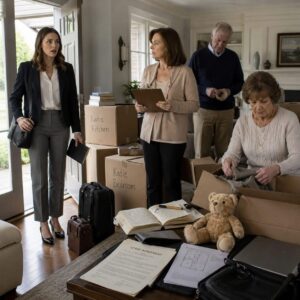
I Came Home Early From A Business Trip And Found My Parents Packing My Entire Life Into Boxes—They Said A Tiny Studio Was “Perfect For A Single Woman,” Then I Saw The Lease With My Name On It And Realized They Had Already Given My Home Away I knew something was wrong the moment I turned into my parents’ long driveway. There were boxes beside the front door. Not Amazon boxes. Not holiday decorations. Moving boxes. Large brown cardboard boxes stacked in neat, careful rows, labeled in my mother’s handwriting. Katie kitchen. Katie books. Katie bedroom. My hands tightened around the steering wheel. I had come home two days early from a business trip, still wearing my blazer from a client presentation in downtown Chicago, still riding the small rush of landing one of the biggest accounts of my career. I thought I might surprise my family. Maybe we would order dinner. Maybe I would finally tell them I had started seriously searching for my own apartment near work. Instead, I walked through the front door and found my entire life spread across the living room like an estate sale. My mother stood in the middle of it all with a clipboard. My father had packing tape in his hand. My Aunt Sylvia was folding one of my sweaters like she had every right to touch it. And on the coffee table sat my childhood teddy bear beside a lease agreement I had never seen before. My name is Catherine Parker, but everyone calls me Katie. I am twenty-seven years old. I have a degree from Northwestern, a senior marketing position at one of the most respected firms in Chicago, my own client portfolio, my own team, my own savings, and my own bills that I pay on time every single month. But in my parents’ eyes, I was still a child who needed to be managed. Directed. Protected. Moved. “Katie,” my mother said, her face shifting too quickly into a smile. “You’re home early.” That was all she said. Not, “Congratulations on your presentation.” Not, “Why didn’t you call?” Not even, “This looks bad, but let me explain.” Just that tight, polished smile I had spent my whole life trying to understand. I looked around the room. My bookshelves were empty. My dresser drawers had been pulled out. Framed photographs were wrapped in newspaper. A box of journals sat open on the dining table. My private journals. The ones I kept in the nightstand of the guest house where I had lived for five years. “Mom,” I said slowly, “what is going on?” She beamed like this was a celebration. “Surprise. We found you the perfect apartment.” For a moment, I genuinely could not process the words. Apartment? Perfect? Found? She picked up the papers and held them out like a gift. “It’s a darling studio in Oakbrook. Very safe. Very quiet. Sylvia lives five minutes away, so she can check in on you.” Check in on me. At twenty-seven years old. With a full-time career and an income my parents loved bragging about whenever it made them look good. I took the papers from her hand. The lease had my name typed into the tenant line. The apartment was barely five hundred square feet, with a kitchenette pressed against one wall and enough space for a bed if I did not mind living like a folded piece of laundry. “I never signed this,” I said. My father looked down at the tape dispenser. My mother waved her hand. “Oh, Katie, don’t be dramatic. We handled the deposit. The movers come Saturday.” Saturday. It was Wednesday. They were moving me in three days. Without asking. Without warning. Without my consent. I had lived in the guest house on their Northbrook property since college. It had started as temporary, just until I paid down student loans and figured out my next step. Then three months became five years. I paid rent. I paid my own bills. I bought my own groceries. The guest house had its own entrance, its own kitchen, its own life inside it. It was not perfect, but it was mine. Or at least I thought it was. “You went into my house?” I asked, my voice growing quieter. My mother’s smile flickered. “It’s our property, Catherine.” I heard it then. The truth beneath every argument we had ever had. Every time she criticized my haircut. Every time she questioned a man I was dating. Every time she warned me that downtown Chicago was dangerous, that photography was not practical, that I was too sensitive, too impulsive, too young, too naive. Our property. Our daughter. Our decision. I walked to the dining table and picked up one of my journals. The little ribbon bookmark was in a different place than I had left it. My stomach turned. “Did you read this?” My mother hesitated for half a second. That was all the answer I needed. A heat rose behind my eyes. “You read my journal?” “I needed to understand what’s been going on with you,” she said, as if I had forced her to do it. “You’ve been so secretive lately.” Secretive. That was what she called privacy. Then I saw my laptop bag on the chair. Open. My breath caught. “You went through my computer too?” My father finally spoke. “Katie, your mother was worried.” I laughed once, sharp and ugly. “Worried about what? That I might choose my own apartment?” My mother’s face hardened. “I saw those listings you were looking at. River North? Downtown? Those places are overpriced and unsafe. You were about to make a terrible mistake.” “So you made a decision for me.” “We helped you.” “No,” I said. “You trapped me.” The room went still. Even Aunt Sylvia stopped folding. My mother’s eyes narrowed. “You are overreacting.” There it was. The word that had followed me since childhood. Overreacting when I cried. Overreacting when I asked why she called my college roommate to check if I was studying. Overreacting when she “forgot” to mail an application for a school four states away. Overreacting when she told me a marketing job in Chicago was too demanding and I should find something closer to home. I looked at the boxes again. Then I noticed something missing. A small wooden jewelry box that had belonged to my grandmother. I kept it on the dresser in the guest house, not because it was expensive, but because inside were letters, tiny mementos, and a pressed flower from the last walk I ever took with her. “Where is Grandma’s jewelry box?” I asked. My parents exchanged a look. That look snapped something inside me. “Where is it?” My mother sighed like I was being difficult over a dish towel. “I gave it to Amber. She’ll appreciate it. You weren’t using it.” Amber. My cousin’s wife. The cousin who, I suddenly remembered, was renovating his house. A cold understanding moved through me. “Why does Amber need my things?” My mother lifted her chin. “Thomas and Amber need a place to stay while their renovation is finished. They’re moving into the guest house next month.” The guest house. My home. Given away. While they packed me into a studio apartment I had never seen. I turned to my father. “Did you know about this?” He looked ashamed, but he did not deny it. “Katie,” he said softly, “your mother put a lot of thought into this.” Those words hit harder than shouting would have. Because he knew. He knew this was wrong. He just chose peace with her over protecting me. I stood in the middle of that living room, surrounded by boxes with my name on them, and saw my whole life clearly for the first time. They had never been helping me. They had been keeping me close enough to control. My phone buzzed in my hand. Mom had called my office as my emergency contact. She had checked my schedule. She knew I was supposed to be gone until Friday. They had planned to move my life while I was not there to object. I looked at my mother. Then at my father. Then at the lease on the table. And for the first time in my life, I did not explain myself. I did not apologize. I did not cry where they could use it against me. I picked up my journal, slipped it into my purse, and walked toward the door. “Catherine Elizabeth Parker,” my mother snapped behind me, using the full-name voice that used to freeze me when I was sixteen. “Do not walk out that door.” I stopped at the threshold. My hand was on the knob. The whole house went quiet. Then I turned back and looked directly at her. “I’m twenty-seven years old,” I said. “You don’t get to tell me what to do anymore.” And then I walked out. But what my parents did not know was that I was not driving away to calm down. I was driving away to make one phone call. And by the next morning, the studio apartment was going to be the least of their problems. (I know you’re curious about the next part, so please be patient and read on in the comments below. Thank you for your understanding of the inconvenience. please leave a ‘YES’ comment below and give us a “Like ” to get full story ) 👇
I came home from my business trip two days early and walked into my own life being packed into boxes. My name is Katie Parker. I’m twenty-seven…
Homeless after getting out of prison, I found shelter in a hidden cave in the hills… and that’s when my life truly began. “Can I help you?” the man asked, wiping his hands on his jeans, his eyes sharp with suspicion. My throat was dry. My feet ached from walking. My heart pounded so hard it felt like it might burst. “My family used to live here,” I said slowly. “This was the Miller house.” He frowned, glancing at the children playing behind him before looking back at me. “We bought it eight years ago,” he replied. “From a woman named Elvira Miller.” My mother. Something inside me cracked. Not because the house was gone—I had already feared that. But because she had sold it while I was in prison. Without telling me. Without leaving anything behind. Without waiting for me to come home. “Are you sure this is the place?” he asked, his tone blunt. I pulled a worn photograph from my bag and held it out with trembling hands. “I grew up here. My grandfather planted that tree when I was nine.” He studied the picture. For a brief second, his expression softened… but not enough to offer help. “I’m sorry,” he said quietly. “There’s nothing I can do.” I nodded, holding onto what little pride I had left, and turned away before he could see my face fall apart. I walked through town feeling eyes on me. Some people recognized me—I saw it in the whispers, in the way they pulled their children closer. Eleven years later, I was still “the woman who went to prison,” not the one who survived it. At the old grocery store where my younger brother once worked, a girl stocking shelves told me my family had moved to new houses on the other side of the valley. New homes for everyone. Except me. That night, I had nowhere to go. I slept sitting up behind the chapel, clutching my bag as the cold pressed against my back. At sunrise, a thin stray dog watched me from a distance, like it recognized the same kind of loneliness. I looked toward the hills and remembered the stories the older women used to tell—about a cave hidden among rocks and brush, a place people avoided, calling it cursed. After eleven years in prison, a cave didn’t scare me. I climbed the hill with numb legs and an empty stomach. The entrance appeared behind tall stones and dry brush—a dark opening in the mountain. I stepped inside. The air was cold, heavy with the smell of damp stone and time. I dropped my bag, wrapped my arms around myself, and for the first time since leaving prison… I had something that felt like shelter. It wasn’t a home. But it was a place to disappear. I started gathering sticks and stones to build a small fire. When I shifted a flat rock near the wall, I heard a strange hollow sound. I froze. I tapped it again. The echo came back. My heart began to race. I dropped to my knees and started digging with my bare hands. Dirt packed under my nails. My fingers tore open. But I didn’t stop. Until I hit something solid. Wood. I cleared away the dirt and uncovered a small box wrapped in decayed cloth. A rusted latch held it closed… and carved into the lid were two initials that made my breath catch. T. M. My grandfather’s initials. I reached out to open it— And then I heard footsteps outside the cave. Whatever was inside that box was about to change everything. And whoever was walking toward me… was about to change it even more. 👇 Full story continues in the first comment…….
Aitana The footsteps stopped just outside the entrance. They were not the careless footsteps of someone wandering off a trail or stumbling through unfamiliar ground. They were…
When my son got married, I didn’t tell my daughter-in-law or even my son that the house they were living in was still mine. And I’m glad I didn’t—because not long after the wedding, my daughter-in-law and her mother tried to… …turn my own home into something I was supposed to “outgrow.” My name is Eleanor Lopez. I’m 70 years old, and I used to believe the hardest part of getting older was my knees aching when it rained. I was wrong. The hardest part is watching people smile at you while quietly trying to rearrange your life. Adrien is my only child. When he met Chloe, I told myself to be grateful—because a mother’s instinct is to want her son happy, even if that happiness comes with changes you don’t fully understand. Two months before the wedding, they asked if they could “stay with me for a while” to save money. I agreed immediately. That’s what mothers do when rent is high and you can hear the stress hidden in your child’s voice. What I didn’t say out loud was the part that mattered most. The deed was still in my name, filed years ago with the county recorder, and every property tax bill still arrived in my mailbox right on time. I had always planned to transfer the house to Adrien someday. But something inside me—call it instinct, call it experience—kept telling me, Not yet. After the wedding, Chloe arrived with suitcases that didn’t feel temporary. Then came boxes. Then came “improvements.” Then came small changes that felt harmless—until they weren’t. One morning, I walked downstairs and noticed my late husband’s portrait was gone from the entryway. In its place, Chloe had hung a gold-framed mirror, as if the house now needed to reflect her instead. Then Linda arrived. Chloe’s mother came for “just a few days,” but her toothbrush stayed, her opinions took over, and my kitchen started sounding like a renovation show I had never agreed to join. They measured walls. They discussed paint colors. They stood by my dining room window and talked about “opening the space” the way people talk about clearing out clutter. That Sunday afternoon, I was making coffee when I heard Chloe say my name—just my name. No “Mom.” No warmth. She smiled like she had rehearsed the moment. “Eleanor,” she said, “this house is too big for you to live in alone.” Then Linda nodded with that soft, practiced concern and added, “Stairs aren’t safe at your age… and you’ve already done your part as a mother.” That’s when I understood. This wasn’t about concern. It was about making me feel like I no longer belonged in the home I had built. I didn’t argue. I didn’t raise my voice. I set my coffee down, went to my room, and did what my friend Margaret always says when people start testing your boundaries: breathe, think, document. Because there was something Chloe and Linda didn’t know. Weeks earlier, I had already put a quiet plan in motion—paperwork reviewed, conversations saved, and one phone call made that could turn “family decisions” into “legal reality.” So later that evening, when Chloe slid a brochure across the counter—smiling like she was helping me—and said, “We found you a perfect little place,” I looked at her hand, then at Linda’s confident expression… …and I smiled back. Not because I had given up. But because I was ready.. Full in the first c0mment…
They say you can’t put a price on dignity. For a few months, I nearly let mine be taken for free. My name is Eleanor Lopez. I…
HOA Left Their SUV on Our Ranch — Grandpa Hooked It Up to the Electric Fence and Waited! If you think a ranch is just a scenic backdrop for someone else’s rules, you’ve never met my granddad—or his fence. That morning, the sky was a hard, perfect blue, the kind that makes the power lines hum like they’ve got something to say. A black SUV sat half-tilted against our cattlegate, chrome glinting in the sun like it owned the horizon. Granddad tipped his hat toward it, took a long, thoughtful sip of coffee, and murmured into the steam, “If they think this driveway is public parking, they’re about to learn what a boundary feels like.” I’d heard the tires before sunrise—a crunch that didn’t belong to any of our neighbors. By the time I stepped outside, he was already in his porch chair, boots planted steady as if he’d been waiting for this particular kind of nonsense his whole life. The SUV was parked so close to the hot wire you could’ve measured the gap with a dime. Tinted windows. Vanity plate from Sage Hollow Meadows, that gated kingdom over the ridge. A bumper sticker in gold script that read Pride of the Neighborhood. On our gravel, it looked about as natural as a tuxedo at a branding. Before I could even make a joke, the sound of heels on rock cut across the yard—sharp, fast, and full of purpose. A woman in a thundercloud-colored blazer marched down the lane, eyeing the house like it had failed some invisible inspection. “Morning,” she said. It didn’t sound like a greeting. “This vehicle is conducting official business. We’ll be removing it shortly.” Granddad didn’t even glance her way. He tasted his coffee, squinting at the horizon. “Official business on private land,” he said at last. “That new?” He nodded toward the fence—the one with the bright yellow sign and a lightning bolt we’ve had since forever. The wire hummed lazy in the quiet. She smiled the kind of smile that usually comes stapled to a fine. “I’m Lydia Crane, president of the Sage Hollow Meadows HOA. Your gate obstructs the community’s visibility easement. Our safety officer had to park to document the obstruction. This is evidence storage.” Granddad turned his head a fraction, studying the SUV the way he sizes up a bull—trying to decide if it’s smart, mean, or just confused. “Evidence storage,” he repeated slowly. “Friendly of you to park it two inches from a live fence.” Lydia’s eyes flicked toward the wire, dismissive. “I’m sure your line is turned off while we’re here,” she said. “Given the complaints we’ve received about stressed animals.” Her perfume smelled like citrus and paperwork. Granddad leaned back in his chair. “I don’t take orders from emails,” he said. “Barely take ’em from people.” That was usually my cue to translate, but Lydia was one of those folks who only heard the echo of their own voice. “We’ll have the SUV removed after our inspection,” she said briskly. “I recommend moving your gate to align with the HOA access apron. I’ll send an official notice.” Then she turned on her heel, satisfied, and strode back to the sedan idling by the road—two men in reflective vests waiting inside, the kind who wear authority like a Halloween costume. They didn’t get out. They didn’t need to. The HOA convoy disappeared in a spray of gravel that fell short of our boots. For a full minute, we listened to the quiet retake its claim. The hawk over the cottonwoods made a slow pass. The power regulator clicked. The cattle moved like slow thunder across the pasture. Granddad set his mug down on the arm of the chair and rose—slow, deliberate, the way he always did before doing something that would end up sounding like a lesson. Continue below👇…
The Fence That Hummed Back If you think a ranch is just a scenic backdrop for someone else’s rules, you’ve never met my granddad—or his fence. That…