
Man Thinks He Found “Hornets” Nest In Attic – Turns Pale When He Realizes What’s Inside Check Comment Below👇

James never expected that a quiet afternoon at home would uncover something remarkable—something that would completely change the way his family saw their house and the land…

Young woman puts both babies inside the fir… See below

A young woman’s quick instincts became far more important than she could have anticipated. What started as a completely ordinary day changed the moment she noticed subtle…
My mom marries my boyfriend, 10 days later She discovers… See below😯👇

When my mother married my boyfriend, the shock alone was enough to tear our relationship apart. We stopped speaking, and she believed she had found someone who…
One Unforgettable Dinner Encounter Uncovered a Million-Dollar Secret👇PART2👇

Life has a way of surprising us when we least expect it. A few years ago, I was working long hours as a waiter in a busy…

I had no idea about this…!👇

 Apple cider vinegar ( ACV) is a common household product that many people use as a natural remedy, especially for skin and scalp concerns. Although it is often promoted…

I was nudged away from my grandmother’s 80th birthday table, relocated to the bar as if I didn’t belong, laughed at by thirty guests, and left holding a $3,270 bill—then I overheard my cousin murmur, “We just need her gone before Grandma’s attorney does anything,” and my grandmother silenced the entire room with three calm words: “Just a moment, please”… My name is Annabelle. I’m 29, a registered nurse in Crestwood, Georgia, and I rent a small apartment above the laundromat on Cherry Street. I was five when my parents passed away, and my uncle Richard brought me into the Everett household like an obligation. Diane—his wife—made certain I understood I was the extra addition. There were no bruises. Just exclusions: three settings instead of four, family portraits without me, holidays where I was handed the camera so I’d stay out of the frame. By sixteen, I was working evening shifts to cover my own essentials. I pushed myself through nursing school on loans and back-to-back shifts, because expecting help in that house was laughable. The only person who ever made me feel genuinely included was my grandmother Eleanor. Every Sunday, she placed a setting for me without hesitation, as if it was the most natural thing in the world. So when Richard called in late March and said, “Maybe it’s better if you skip Mom’s birthday dinner this Saturday,” I knew Diane had started hovering around Eleanor’s finances. I called Eleanor anyway, and her voice turned urgent: “You must come, Annabelle. Promise me.” She told me to wear something that made me feel powerful, so I chose a simple navy dress and my mother’s pearl earrings—the final piece of her I still owned. Eleanor’s celebration was held at The Magnolia Room, and Diane had reserved the main dining space for thirty guests. Eleanor sat at the head, slimmer than the previous Sunday but still mentally sharp. When she saw me, she clasped my hand and whispered, “Sit next to me.” I did—and noticed the man seated on her other side. Gray suit, silver hair, a leather briefcase tucked beneath his chair. He barely spoke, but he observed everything. Diane rose to “present the family.” Kyle, Madison, Richard—her flawless lineup. When someone asked who I was, Diane smiled lightly and said, “Oh, that’s Annabelle. She grew up around us.” Around us. As if I’d never truly been part of it. Moments later, Madison’s elbow “accidentally” tipped, and red wine splashed across my dress. She pressed a napkin to her lips and said, “Oops. White might’ve been safer for you.” A few guests laughed softly. Kyle grinned. I blotted the stain and kept my expression neutral. Beneath the table, Eleanor squeezed my hand—once, firmly. Then Diane said in a breezy tone, “We need to shift seats. Uncle Harold requires space.” She turned toward me. “Annabelle, sweetie, why don’t you move to the bar?” Kyle leaned back in his chair. “Yeah, not like you’re giving a speech.” No one objected. Richard stared down at his plate. So I stood, picked up my water glass, and walked to the bar with my posture straight. From the bar I had a clear view: Diane laughing and topping off glasses, Kyle boasting loudly, Madison shielding her phone beneath the table. Eleanor remained at the head like she was bracing herself, and the man in gray stayed still. Twenty minutes later, Madison paused in the hallway near me, acting as though I wasn’t there. Into her phone, she whispered, “It’s working. She’s at the bar. One more nudge and she’ll leave for good.” “We just need her out of the picture before Grandma’s lawyer does anything.” Lawyer. So this wasn’t tension. It was a scheduled removal. A deliberate effort to push me out before legal matters surfaced. Near the end of the evening, a waiter approached with a leather check holder. Inside: $3,270, billed under my name because Diane had used the secondary card she’d added me to at seventeen “for emergencies.” Kyle watched me with a satisfied smile. Madison aimed her phone in my direction, recording. Diane lifted her glass in a subtle toast like she had won. I took out my own debit card—my actual savings—and handed it over. I paid. I signed the receipt, added a tip, set the pen down, and began to rise. “Just a moment, please.” Eleanor’s voice carried across the room. Every head turned. The man in gray stood first and offered her his arm. Eleanor rose, steady and unwavering. “Before anyone leaves,” she said, “I have something to say.” Diane attempted to interject. Eleanor didn’t flinch. “Sit down, Diane.” Diane complied. Then Eleanor extended her hand to me. “Annabelle, come back to the table, sweetheart.” My legs hesitated—decades of conditioning—but I returned until I stood beside her once more. Eleanor rested her hand on my arm and declared clearly, “You belong here more than anyone at this table.” The silence thickened. The man in gray placed his briefcase on the tablecloth, unclasped it, and slid a substantial manila envelope beside Eleanor’s untouched dessert plate. Eleanor laid her palm over the envelope, looked directly at Diane, and began, “You just told this room Annabelle’s parents left nothing. I’d like to correct that—” Part 2 is where the envelope finally opened.And its in the first comment…….

My mother said it with a smile. That was always the worst part. Not the words themselves, but the warmth wrapped around them — the careful performance…

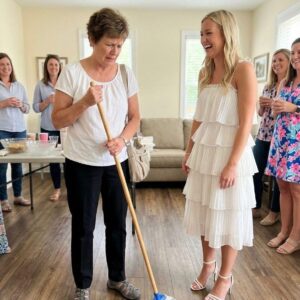
My future daughter-in-law handed me a mop in front of twenty guests at her bridal shower and told me to “earn my meal” — the gift I pulled from my purse made the entire room go completely silent. I have one son. I raised him on my own after his father passed away. I work as a janitor. It’s not glamorous, but it’s honest, steady work. So when he told me he was getting married, I was truly happy for him. Emily always seemed… polite. A little distant, maybe, but I told myself that’s just how some people are. When I received the invitation to her bridal shower, I took it as a positive sign. The event was held in a rented hall, decorated like something straight out of a magazine. Around twenty women, all perfectly dressed, holding drinks, laughing like they naturally belonged there. I didn’t. But I tried. I greeted a few people, kept to myself, and waited for my son to arrive like he said he might. Emily barely acknowledged me. Then, halfway through the afternoon, she clapped her hands to get everyone’s attention. “Before we eat,” she said sweetly, “let’s do something fun.” A few guests laughed. Moments later, she “accidentally” knocked over a full glass. It shattered across the floor, liquid spreading over the tiles. Emily looked straight at me. Then she picked up a mop and held it out. “Since you didn’t really contribute much,” she added with a smile, “you can at least earn your meal. You should be used to this anyway.” The room fell quiet. Some women exchanged glances. Others looked away, pretending not to notice. I felt the heat rise to my face. But I didn’t argue. I didn’t defend myself. I simply reached into my purse… (I know you’re curious about the next part, so please be patient and read on in the comments below. Thank you for your understanding of the inconvenience. please leave a ‘YES’ comment below and give us a “Like ” to get full story ) 👇

The invitation arrived on a Tuesday, slipped between a water bill and a furniture catalog, and I held it for a long time standing at the mailbox…

Dad Came to Pick Up My Son for the Weekend. He Opened the Fridge, Saw Nothing but a Bottle of Ketchup, and Went Still. “You earn three thousand a month… so why is my grandson hungry?” Before I could answer, my husband walked out proudly and said, “I transferred her entire paycheck to my mom.” My father slowly took off his jacket. That single sentence changed everything. It looked like any other Friday in our quiet suburban neighborhood—the kind where lawns are neatly cut, flags hang from porches, and neighbors wave while buckling kids into their SUVs. But inside my small apartment, nothing about that moment felt normal. The refrigerator door creaked open, spilling a pale, cold light onto nearly empty shelves and a lonely bottle of ketchup sitting in the corner. My son stood nearby in his red Spider-Man hoodie, clutching his toy truck, watching the adults the way kids do when they know something serious is happening but don’t fully understand it. My stomach tightened as I saw my dad’s gaze move from the empty fridge down to my boy’s thin wrists. “Explain this,” he said quietly. His voice carried that same firm tone he used years ago when I tried to skip homework. “Three thousand dollars a month… and there isn’t a single meal in this house?” I took a breath, ready to say something—anything—to soften the humiliation rising in my chest. But my husband stepped out of the bedroom before I could speak, acting like nothing was wrong. “Oh, I transferred her entire salary to my mom,” he said casually, almost proud of himself. “She needed help. That’s what family does.” The room fell into a heavy silence. The refrigerator hummed softly. A school bus released its brakes outside. The kitchen light buzzed faintly above us. My dad slowly folded his jacket and set it over the back of a chair. The calmness in that movement felt heavier than any shouting. “So,” he said, looking directly at my husband, “your mother gets taken care of… and your son doesn’t.” It wasn’t a question. It was a line being drawn. My husband shrugged. “My mom sacrificed everything raising me. Medical bills aren’t cheap. The kid will survive. People here overreact about food anyway.” My father’s jaw tightened. This was the man who once worked double warehouse shifts, attended night classes, and still made sure there was always a snack tucked into my backpack before school. He didn’t need to raise his voice to make a point. Instead, he turned toward me. “Did you know he was moving your paycheck?” he asked. My throat burned. “No. He changed the email on our joint account. I only found out when my card got declined at the store. I was trying to buy milk.” My husband scoffed. “You’re being dramatic. My mom needs help. She matters more than your ego.” That was the moment something shifted in my father. It was like a switch flipping back to the version of him who once told a landlord, “You don’t get to disrespect my family,” and meant every word. Dad pulled out his phone, scrolled to a contact, and said quietly, “This isn’t about pride. This is about a child standing in front of an empty refrigerator while his mother’s income is sent to someone who doesn’t even live in this house.” My husband laughed nervously. “Who are you calling? Come on. You’re not actually going to do anything.” But my father was already walking toward the door, rolling up his sleeves, calm and focused. And in that moment I realized this wasn’t just a simple weekend pickup anymore. It was the day my father decided to show my husband what real responsibility—and real family—actually looks like. 👉 To be continued in the comments….

When my father arrived to pick up Ben for their weekend together, he did what grandfathers do—he went straight to my refrigerator to check if his grandson…

At my mother’s 60th birthday dinner, my cousin casually asked why a hospital wing carried my last name—and my parents froze mid-bite. They still thought I had a “small medical job.” In front of forty guests, the truth came out: I’m chief of pediatric surgery, I donated $2.5 million, and an entire children’s center bears my name. Minutes later, a stranger approached our table in tears and whispered, “You saved my daughter’s life…” The evening was supposed to be about my mother. She sat glowing at the center of the private dining room, the kind of place where chandeliers softened the atmosphere and waiters moved like they’d rehearsed. I was seated nearby, my place card written in looping gold script: Dr. Sophia Hartwell The title looked almost accidental—like it didn’t belong there. An afterthought at best. Two seats down, my brother’s card read simply: Jonathan Hartwell. No title needed. In our family, Jonathan had always been the headline. I’d learned long ago how to exist as background text. He’d planned the party meticulously. I knew this because he’d reminded me—often. “We’re really doing it right for Mom,” he’d said on the phone weeks earlier, when he finally called to check whether I could attend. “Private room at the Wellington, live quartet, custom cake. I’ve been coordinating with the planner nonstop. You know how I get.” I’d been standing in my Back Bay brownstone at the time, still in wrinkled scrubs after a twelve-hour surgery day, surgical loupes hanging loose around my neck. “I’m sure it’ll be wonderful,” I’d replied. There was a pause. Then, lightly: “We weren’t even sure you’d make it. You’re always busy with your little hospital job.” My little medical job. I remember staring at my reflection in the window—exhausted, focused, steady. In the next room sat stacks of medical journals with my name printed inside. On the coffee table lay the program from a recent dedication ceremony, the embossed words Hartwell Children’s Center catching the light. I smiled anyway. “I’ll be there,” I said. Now, at the dinner, I watched my mother unwrap gifts. She wore a pale blue dress chosen specifically to match the orchids Jonathan had ordered—“to bring out her eyes.” Pearl earrings. Perfect curls. The glow of someone being celebrated exactly the way she preferred. The gifts were extravagant. A limited-edition designer bag from Jonathan. A luxury spa retreat for my father. A diamond tennis bracelet that scattered chandelier light in sharp, eager flashes. My gift rested at the bottom of the stack—simple, quiet. A cream envelope containing a handwritten letter and a donation receipt to her favorite children’s charity, made in her name. I knew she’d like the idea of it. “Evelyn, you look stunning,” my aunt said, lifting her glass. “Sixty has never looked better.” My mother smiled broadly. “I’m so fortunate,” she said. “Jonathan did all of this. He’s always been so thoughtful.” Jonathan waved it off with practiced modesty, though he leaned back like a man well aware of his audience. “You deserve it, Mom.” I took a sip of sparkling water and said nothing. I’d been doing that for decades. I watched my brother—the tailored suit, the confident posture, the ease with which he occupied space—and felt that familiar mix of affection and quiet fatigue. He was my brother. We’d shared a childhood. But somewhere along the way, the balance had shifted. There were old photos that proved it hadn’t always been this way. Both of us at the kitchen table, finger paintings held high. Both praised. Both seen. But slowly, subtly, the scales tipped. And I’d learned to carry success quietly. Until my cousin leaned over, scanning the room, and said with genuine curiosity: “Wait… Aunt Evelyn, isn’t that new pediatric wing downtown named Hartwell? Like… Sophia?” The sound of forks hitting plates was sharp. My parents went still. My mother blinked. My father’s smile faltered. Jonathan turned slowly toward me. And before I could answer, the truth—my truth—began to surface in a room that had never expected to hear it. 👇 Don’t miss the emotional ending — the rest of the story is in the first comment

The private dining room at the Wellington smelled of old money—aged wine, polished mahogany, and lilies that cost more than most people’s weekly groceries. Crystal chandeliers hung…

My husband divorced me at seventy-eight and kept our $4.5 million home, telling me, “You’ll never see the grandkids again.” He even laughed as I walked away. I didn’t say a word. One month later, an unknown number called me: “Ma’am, there’s an urgent matter regarding your husband…” At seventy-eight, I stepped out of a Fairfield County courthouse with a suitcase in my hand, a folded court order, and a silence that made everything feel distant. The house on Oakridge Drive—with its wide porch, its maple tree, and a lifetime of memories—was no longer mine. My husband looked satisfied, as if fifty-two years could be erased with signatures and stamps. Our children stayed quiet. I drove north to my sister’s farm in Vermont, trying to steady my breathing. Weeks later, a call from a 203 area code lit up my phone—and once again, everything shifted. I used to believe our marriage lasted because of patience and shared mornings over coffee. The truth was simpler. I showed up every day. By late October, small details began to feel wrong. A billing address quietly changed to a P.O. box in Stamford. A laptop that snapped shut whenever I walked into the room. Weekend “errands” that ended with empty hands. A scent on his jacket that wasn’t mine. I didn’t confront him. I watched. In December, I found a card tucked inside his coat pocket. Plain. White. Careful handwriting. Signed with a single letter. “K.” That one initial made my stomach drop. When I finally spoke, I stayed calm. He didn’t. He looked at me across the breakfast table and said, “I want out. My lawyer will contact you.” No emotion. No hesitation. Just a decision. The divorce moved faster than I expected—and quieter than it should have been. The house had already been transferred to a company I didn’t recognize. Accounts that once felt shared were suddenly separate. I sat through the hearing, listening to numbers that didn’t reflect the life I had lived. When it ended, he leaned in and whispered, “You’ll never see the grandkids again. I made sure of it.” I didn’t respond. I stood up, picked up my bag, and walked away. Vermont smelled like wood smoke and dried lavender. My sister Joan didn’t ask questions—she simply held me. For weeks, I slept in silence and made lists, because lists gave me a sense of control. Then one afternoon, I stopped asking what had happened— and started asking how. I called my former lawyer. He sounded polite, but when I asked about the timing of the transfers, he hesitated. “I didn’t look closely at that,” he admitted. That was the moment something inside me shifted. I arranged a meeting in Hartford with a firm known for complex financial cases. The attorney didn’t treat me like I was fragile. She asked for dates. Records. Details. Then she said, “We start with when the company was created.” I signed immediately. Not out of anger— but for clarity. A few days later, my son called, his voice careful. “Mom… Dad says this will wear you down.” “I’m fine,” I replied. My daughter came by with flowers and gentle talk about peace. I listened, then answered quietly, “If anything needs to be discussed, it will go through my lawyer.” Six weeks later, a thick envelope arrived. Inside were records. Dates. Messages. Patterns—not coincidences. I read until one line made me stop cold: “I want to make sure the property is moved out of the marital estate before filing.” I read it again. Slower. Then I closed the folder, lifted my head, and understood exactly what I needed to do next. (I know you’re curious about the next part, so please be patient and read on in the comments below. Thank you for your understanding of the inconvenience. please leave a ‘YES’ comment below and give us a “Like ” to get full story ) 👇

At seventy-eight years old, I walked out of a Fairfield County courthouse carrying a suitcase, a folded court order, and a silence so complete it made the…