I walked into my mother-in-law’s will reading… and found my husband sitting there with his mistress and their newborn. They looked so confident, like they had been waiting for me to fall apart. But then the lawyer opened her final letter… and my husband’s face completely lost its color. I expected grief at my mother-in-law’s will reading. I did not expect humiliation. And I definitely did not expect an audience for it. Two weeks after Margaret Caldwell passed away, I stepped into the conference room at Harlan & Pierce in downtown St. Louis wearing a black dress I had already worn too many times that year and carrying the kind of exhaustion that settles deep and refuses to leave. The room was cold, quiet, and painfully ordinary. Muted carpet. Stale coffee in the air. A slightly crooked framed print of the Gateway Arch hanging behind the head of the table. And sitting at the far end, like they already belonged there, were my husband and the woman I had spent the last year trying not to believe existed. Ethan didn’t stand. He didn’t even look surprised to see me. He just sat there with one arm draped across the chair beside him, like he was saving it for someone important. For her. Lauren Whitaker lifted her eyes to me and gave a small smile—the kind of calm that made my stomach twist. She looked polished, comfortable, almost glowing in a pale blue wrap dress, her hair styled just enough to look effortless. And in her arms was a newborn baby wrapped in a soft gray knit blanket. For one second, my mind refused to process what I was seeing. Then the baby moved. A tiny hand opened against her chest. And the entire room seemed to shift. “You brought a baby?” I heard myself say, my voice thin and unfamiliar. Lauren’s smile didn’t change. “It’s Ethan’s son,” she said, as casually as if she were commenting on the weather. I looked at my husband. At the man I had built a life with. At the gold wedding band still on his finger. At the face that showed no guilt, no shame, not even the smallest hint of discomfort. Only irritation. Only that distant expression people wear when they’ve already decided your pain is inconvenient. “We didn’t want you hearing it from someone else,” he said. I actually let out a short laugh. Just once. A sharp sound that didn’t feel like it belonged to me. “At my mother-in-law’s will reading?” I said. “How thoughtful.” Before either of them could respond, the door opened behind me. James Harlan, Margaret’s attorney, walked in carrying a folder against his chest. He was an older man with silver hair, precise posture, and the look of someone who had delivered life-changing news for decades and understood exactly how heavy a single sentence could be. His eyes moved to the baby. For just a moment, even he seemed caught off guard. Then his expression settled back into professionalism. “Mrs. Caldwell requested that everyone be present,” he said, glancing at me, then at Lauren. “Miss Whitaker is… included.” Included. That word landed harder than I expected. Margaret knew. Not just about the affair. Not just about the betrayal. She knew enough to make sure this woman was in the room. Which meant whatever was about to happen had been set in motion long before Margaret ever passed. My legs suddenly felt unsteady, so I sat down before they gave out completely. Across from me, Lauren adjusted the baby while Ethan leaned back in his chair like a man already calculating what he was about to gain. Like he had already won. Like this was just paperwork standing between him and the next version of his life. Harlan opened the folder and cleared his throat. “Margaret Caldwell signed her final will and testament on March third,” he began. “She also left a personal letter to be read aloud before the distribution of her estate.” Ethan barely reacted. Lauren looked almost amused. And I sat there trying not to fall apart in front of people who seemed to have planned every moment of my humiliation. Then Harlan unfolded a single page. His voice changed when he began reading. Slower. More deliberate. As if even he understood the weight of what Margaret had left behind. “To my daughter-in-law, Claire,” he read, “if you are hearing this, then Ethan has finally shown you who he really is.” Everything in the room stopped. Ethan’s shoulders stiffened. Lauren’s faint smile faltered. Even the baby seemed to go quiet. Harlan continued. “And if that has happened, then it is time for you to understand what I have done, so that you will never again believe you are powerless.” No one moved. No one spoke. The air itself felt frozen. I could hear the soft breathing of the newborn. The low hum of the lights overhead. The rapid pounding of my own heart. And for the first time since I walked into that room, Ethan looked uncertain. Not angry. Not confident. Uncertain. The color drained from his face so quickly it was almost unsettling. Lauren turned toward him, confused now, like this wasn’t the story she had been promised. I stared at the attorney, barely breathing. Because Margaret Caldwell—the woman I had spent years believing simply tolerated me—had known everything. The affair. The lies. The double life. Maybe even the plan they thought they had built against me. And judging by the look on Ethan’s face… she hadn’t left him what he expected. Not even close. And as James Harlan turned to the second page of Margaret’s letter, I realized my mother-in-law hadn’t invited that woman there so I would suffer. She had invited her to witness exactly what happens when a man like Ethan mistakes silence for weakness… 👉 Full story in the first comment……

The Crooked Arch Two weeks after Margaret Caldwell died, I walked into the conference room at Harlan and Pierce in downtown St. Louis wearing a black dress…

My husband burst through the door shouting, “Why is the card getting declined? My mom didn’t get your paycheck!” I just smiled and said, “That’s interesting.” What he didn’t realize was that this “card issue” was only the first crack—and the real shock was seconds away. Lily jumped as his voice echoed down the hallway. Cheryl woke instantly, crying. “Lily!” Alex’s footsteps pounded toward the nursery. She lifted her daughter and stepped out, holding the baby close. “Lower your voice,” she said, trying to stay calm. “You woke her.” Alex stood in the living room, chest heaving, face flushed with fury. “What did you do to the card?” he demanded, barely glancing at the crying baby. “My mother just called.” “She couldn’t withdraw your salary.” Lily pressed Cheryl against her shoulder, rocking her gently. She’d known this moment would come—but not like this. “I got promoted,” she said evenly. “And I have a new card now.” Alex stared at her as if she’d spoken nonsense. “A promotion? What promotion?” “I’m now a key account manager. My salary increased by thirty percent.” For a second, he went still. Then suspicion crept across his face. “So you hid it. You planned this.” “I wanted it to be a surprise,” Lily said softly, rocking Cheryl as her crying eased. “Something good for all of us.” “A surprise,” Alex repeated, stepping closer. “Then why couldn’t my mom access the money? Why is the card blocked?” “I told you. I was issued a new one. The old card doesn’t work.” “Then give me the new card,” he snapped. “She’s already out. Her friends are waiting.” Lily laid Cheryl back in her crib, waited until she was asleep, and closed the nursery door carefully. Then she turned to Alex. “I have the new card,” she said calmly. “And I’m not giving it to you.” Alex blinked, stunned. “What do you mean you won’t give it? Are you serious?” “This is how we’ve always done it,” he said. “My mom manages your paycheck for the family.” “For the family,” Lily repeated quietly. “Alex, let’s be honest. Your mother spends my money on herself.” “Skincare, dinners out, clothes—none of that is for us.” “I’m wearing old clothes and can’t even buy myself shoes because there’s never anything left.” “She takes care of us,” Alex shot back. “So do I,” Lily replied. “I work full-time. I cook. I clean. I raise our child.” “But somehow my salary is ‘family money,’ and yours is only yours.” “You don’t even explain where your money goes.” Alex’s face darkened. “I’m the man. I provide.” “No,” Lily said, surprised by how calm she felt. “I do.” “My income is higher than yours.” “The rent, groceries, clothes—we pay for all of it with my salary.” “And your money? I don’t even know what you spend it on.” “That’s disrespect,” Alex snapped, stepping closer. “You’ve forgotten your place. Hand over the card. Now.” “No.” The word hung in the air. Even Lily was surprised by how firmly it landed. Something had shifted during those months she’d fought for that promotion. She wasn’t the woman who quietly handed her paycheck to her mother-in-law anymore. Alex wasn’t used to hearing no. His face twisted with rage. He grabbed her hair and yanked. “Where is it?” he hissed. Pain flared, but Lily didn’t scream. She tore free, leaving strands of hair clenched in his hand. “Don’t ever touch me again,” she said firmly. Her voice stopped him mid-movement. Before he could react, Lily slipped into the bathroom and locked the door. Her heart slammed against her ribs. What had she just done? What would happen next? 👇 The full story continues below

The office of MediaStream had fallen into the particular quiet that only comes after everyone else has gone home, when the hum of computers and the click…

On a cold Monday morning, my key wouldn’t turn, and through the new velvet curtains I saw my mother-in-law calmly drinking tea from my wedding china—she looked at me and said, “You don’t live here anymore,” so I didn’t argue. I walked away, made one call, and by the time her family lawyer met me in a motel parking lot, his face drained of color at a single line on a notarized page. Late January brings a certain chill to a Savannah cul-de-sac—the kind that makes HOA mailbox lids rattle and the air feel uneasy. I came home from St. Joseph’s Hospital wearing the same jeans I’d slept in for two nights, my overnight bag digging into my shoulder. A bouquet of roses from Ethan’s coworkers sagged on the passenger seat like it already knew how this would play out. At 8:12 a.m., my key wouldn’t turn. I tried again, then used the spare hidden behind the loose porch stone, and my stomach dropped when neither worked. Through a slim opening in the curtains, I spotted boxes stacked in my living room and a pink velvet pillow resting on my reading chair—like someone had moved in while I was saying goodbye. The door finally opened, and Diana stood there, perfectly composed. She tilted her head, eyes scanning me like I was paperwork. “Didn’t expect you back so soon,” she said. “Why can’t I open my own door?” My voice trembled, but I kept my hands steady. Diana didn’t flinch. “Because, dear, you don’t live here anymore.” Behind her, Joseline drifted past carrying two of my serving plates as casually as if she were browsing a store aisle, treating my grief like something disposable. I should have yelled. I should have pleaded. But I’d spent every ounce of emotion under fluorescent hospital lights, watching a monitor fall silent, so I swallowed and said the only thing that mattered: “I’m his wife.” Diana’s smile tightened as she listed reasons I didn’t “count,” as if marriage were something you could calculate on a spreadsheet. I didn’t argue. I walked away. In the driveway, my hands shook around useless keys, but my thoughts stayed clear, already planning the next move. By noon, I was in a motel off Highway 204 that smelled of bleach and stale coffee, sipping an iced coffee I couldn’t taste. Tuesday morning, with interstate noise hissing past the window, I called St. Matthews Memorial and asked for one small change to Ethan’s service. The woman on the phone lowered her voice, and I ended the call before my emotions surfaced. Two years earlier—almost to the day—I’d sat on that same porch beside Ethan as his startup fell apart, his eyes locked on cracked concrete like it held answers. I refinanced, transferred the mortgage into my name, and took on freelance work while quietly carrying the house on my shoulders. It wasn’t romantic, but it was real, and it cost me more effort than money. Tuesday afternoon, I circled the block and parked behind the hedges, watching for Diana’s car like I was studying my own life. The side door latch had always been unreliable, and I knew exactly how to open it silently. Inside, the house smelled wrong—lavender air fresheners everywhere—and my framed photos had disappeared from the hallway. Ethan’s office remained untouched, the small windowless room Diana used to mock. Cables, manuals, receipts stacked like he intended to come back and finish organizing them. I opened drawers carefully, searching for anything that proved I still had a place there. That’s when I found the slim black folder wedged between two manuals. On the cover, in Ethan’s block letters, were four words that made my pulse jump: POSTNUP. DO NOT DISCARD. In the quiet, I finally understood why Diana had sounded so confident. By Wednesday afternoon, I was seated across from Angela Flores—my college roommate turned real estate attorney—in a lobby where the elevator chime felt oddly cheerful. She slid a visitor badge toward me and reviewed the pages with practiced calm. When she reached one paragraph, her face went pale, and she lowered her voice. “Rachel,” she said, hovering over the notary seal, “please don’t leave until I read the final section.” At the back of the folder, behind the legal pages, was a single folded notebook sheet in Ethan’s slanted handwriting—four lines I had never seen. Under the fluorescent lights, the ink looked darker than it should, like it had been waiting for the moment Diana changed the locks. What do you do when the only person who could defend you is gone… and his last words are suddenly in your hands? Full version is in the first comment.

My Key Wouldn’t Turn, and Through New Curtains I Saw My Mother-in-Law in My Kitchen—So I Made One Call I knew something was wrong the second the…

My husband called me “dead weight” at Thanksgiving—right in front of our children. So I set the serving bowl down, wiped my hands, walked out of my own house… and by sunrise, I was buying fifty acres of Alaskan wilderness to see if he was right. The cranberry sauce is still warm in my palms when my marriage ends in a single sentence. “Maggie’s always been useless to this family.” Dead weight. The bowl slips from my hands and shatters across the hardwood, red spreading over the Persian rug I’ve cleaned twice a year for decades. The same rug where our kids learned to walk. Where birthdays happened. Where I convinced myself I mattered. They laughed. My son snorted into his wine. My daughter covered her mouth, shaking. My youngest reached for more stuffing. My daughter-in-law tilted her head back and said, “Oh wow… that’s harsh. But kind of true.” The turkey I’d been tending since before dawn sat perfect on the counter. Rolls warm. Sweet potatoes steaming in my grandmother’s crystal dish. I was still wearing the apron I embroidered myself—little fall leaves stitched by hand, hoping to look useful. Welcome. Needed. “Dead weight,” Tom repeated, enjoying the sound of it. “Always dragging us down with her little ideas.” The idea he meant was my bed-and-breakfast plan. A small Victorian I’d found in Vermont. Something I could finally build with the hospitality degree I earned at thirty-eight—between PTA meetings and dinner deadlines and making sure everyone else’s life ran smoothly. They dismantled it in minutes. By the time he finished, I was standing in a pool of cranberry sauce, surrounded by people who thought my entire existence was a punchline. “Maggie,” Tom said, not even glancing up, “are you going to clean that, or just stand there?” Something inside me broke—but quietly. “I think I’ll leave it,” I said. I untied the apron and dropped it into the mess. I grabbed my navy wool coat—the one he said made me look desperate. My son asked where I was going. My daughter stared like I’d lost my mind. “I’m going to find out if I really am dead weight,” I told them calmly. “Or if you’ve all just forgotten how to stand on your own.” I didn’t go back. I checked into a roadside hotel and lay on a generic bed while his texts stacked up: This is ridiculous. Come home. You’re humiliating yourself. Fine—pay for this tantrum yourself. At 2 a.m., with the sky just starting to pale, I opened my laptop and typed: Remote land for sale — Alaska. Fifty acres. A frozen lake. A cabin hours from the nearest road. By 4 a.m., I wired the deposit from an account he didn’t know existed. By sunrise, a bush pilot was yelling over the engine, “You sure about this, ma’am? That place is isolated. Winters are brutal.” I looked down at endless white, pine forests stretching to the horizon, silence so deep it felt like a beginning. “I’ve never been more certain of anything,” I said. And as the wheels touched down, I realized something important— Dead weight doesn’t disappear. 👉 Full story continues in the first comment..……

Dead Weight The cranberry sauce is still warm in my hands when my husband ends thirty-five years of marriage with seven words I’ll never forget. “Maggie always…

I went to my wife’s company gala expecting dry chicken, polite smiles, and one proud night beside the woman I loved. Sarah had worked too hard to stand in that room with anything less than confidence. Then I heard her voice in a quiet hallway—tight, careful, not like herself. A senior executive stood too close, smiling like the rules belonged to him. “Making a scene will hurt her career,” he said. He thought I would back down. He had no idea I understood systems better than he did. The Grand Meridian ballroom looked like the kind of place where powerful people rehearsed being charming. Crystal lights. Polished glasses. Soft music. The kind of laughter that sounded warm until you noticed how carefully everyone was using it. Sarah stood near the bar in a navy dress, speaking with people from her department. For a moment, I forgot the room completely. She looked like she belonged there because she did. She had earned it. Every late night, every early call, every quiet win no one applauded had carried her into that ballroom. I was simply proud to stand beside her. “There you are,” she said when I reached her. “I was starting to think you’d let me suffer through this alone.” “Never,” I said. “I came ready to smile at people with titles.” She laughed, and for a few minutes, everything felt normal. Then she introduced me to Derek Hoffman. Regional vice president. Expensive suit. Easy smile. The kind of man who had heard yes so often that he confused it with character. “So,” Derek said, shaking my hand a little too long, “you’re the lucky man who snagged our Sarah.” Our Sarah. Two words. Small enough to brush off. Sharp enough to remember. I smiled anyway. “I’m the lucky one.” Something flickered behind his eyes. Irritation, maybe. Or the first sign that he did not like being corrected in public, even gently. Dinner came and went. Sarah leaned close and translated the room for me the way she always did at work events. Who mattered. Who wanted to matter. Who was pretending not to care. Derek sat near the center table, laughing too loudly, already receiving attention like a man who expected even more of it. “He thinks he’s getting the CFO role,” Sarah whispered. “Does he deserve it?” She gave me a look. That was answer enough. Later, as people drifted toward the bar and the terrace, Sarah stepped away. I went into the corridor to answer a work message. I run a cybersecurity consulting firm, which means my clients have a special talent for creating emergencies at inconvenient times. I was halfway through typing when I heard Sarah’s voice. Not laughing. Not casual. Strained. “Derek, please. I need to get back.” I moved before I had fully processed the words. The hallway near the restrooms was quieter than the ballroom, softly lit, tucked just far enough away from the crowd to make people believe no one was watching. Derek had Sarah backed near the wall, blocking her way with the kind of ease that comes from practice. His face was close to hers. Too close. Sarah’s expression was controlled, but I knew my wife. I knew the difference between composure and fear. “Get away from my wife,” I said. My voice came out calm. Too calm. Derek turned, surprise crossing his face before irritation replaced it. Sarah moved toward me the second she had room. “Hey,” Derek said, raising one hand. “You’ve got the wrong idea.” “I don’t think I do.” His smile thinned. “We were talking.” “What I saw was my wife asking to leave, and you making that difficult.” For a second, the hallway held its breath. Then Derek leaned closer, lowering his voice like we were two reasonable men discussing a scheduling mistake. “You don’t want to embarrass her,” he said. “A scene like this could hurt her future here.” There it was. Not an apology. A warning. Sarah’s hand touched my sleeve. Her fingers were shaking. That told me more than Derek ever could. He looked at me and smiled, confident again. “My position is safe.” I held his gaze. “You’re right,” I said. His shoulders relaxed. “Making a scene would be unprofessional,” I added. His smile widened. “Smart man.” I nodded once. “I have a better idea.” He walked away thinking he had won. Men like Derek often do. They mistake silence for surrender because silence has protected them for so long. When Sarah and I returned to the ballroom, she sat at a small table near the side. Only then did I see how badly her hands were trembling. “Was that the first time?” I asked quietly. She looked down. That pause broke something in me. “No,” she whispered. “Not exactly.” She told me about comments. Closed-door meetings. Standing too close. Little moments that were always small enough to deny but heavy enough to change how she moved through the office. Then she told me there had been others. Rebecca. Melissa. Patricia. Women who transferred, left, stayed quiet, or learned to avoid certain rooms. Everyone knew enough to whisper. No one had been able to make the whispers matter. I took out my phone. “I need names,” I said. Sarah hesitated for only one second. Then she gave them to me. I did not storm across the ballroom. I did not grab Derek by the collar. I did not give him the dramatic confrontation he could twist into a story about an emotional husband ruining a corporate event. I went to work. That is what men like Derek never understand. Rage is loud, but discipline is dangerous. I knew systems. I knew how carelessness leaves a trail. I knew that powerful people often hide behind polished policies while leaving ordinary records everywhere. So I began looking at the room differently. The company email habits. The devices. The event setup. The way executives moved through secure things as if rules were for lower floors and smaller titles. By the time the CEO stepped up for closing remarks, I had what I needed. Derek sat at the center table, relaxed and ready to be praised. Sarah looked at me from across the room. I gave her the smallest nod I could. Trust me. The lights dimmed. The company logo appeared on the screens. The CEO thanked everyone for leadership, integrity, growth, and respect. All the beautiful words companies love to say before proving whether they mean any of them. Then he turned toward Derek. “And finally, I’d like to recognize Derek Hoffman, whose leadership in the Western region has been exceptional…” I touched my phone. The screens went dark. For one second, the ballroom did not understand what had happened. Then every display turned white. A new title appeared. A documented timeline. Names removed where they needed to be. Dates. Reports. Messages. Patterns. The kind of quiet truth no one in that ballroom could politely laugh away. Derek rose from his chair so fast his drink nearly tipped over. “What is this?” he snapped. No one answered. The next page appeared. The room went still. Sarah made a small sound beside me, not fear this time. Recognition. Then the first woman stood up. I know many of you are curious about what happens next, so check the comments below for the continuation. Thank you for your patience. Comment “YES” and leave a Like to get the full story. 👇

The Grand Meridian Hotel ballroom glittered with crystal chandeliers and the kind of cultivated polish that large corporations like to mistake for character. Light pooled in the…

I CAME HOME UNANNOUNCED TO SURPRISE MY PARENTS IN THE HOUSE AND ON THE LAND I BOUGHT THEM AFTER YEARS OF SACRIFICE… AND THE FIRST THING I SAW MADE MY BLOOD TURN COLD The first thing I saw when I pulled into the driveway after six years of working myself to exhaustion in Houston was not the white house with the red roof I had paid for so my parents could finally grow old without fear. It was not the long front porch my mother used to talk about, the one where she said she wanted to sit in the evenings with a cup of coffee, a thin blanket over her knees, and the sunset warming her face. It was not the little field behind the house I bought so my father could grow what he wanted instead of breaking his back for someone else’s table. It was my father sweeping the yard under a brutal Texas sun like a man who had forgotten anyone was allowed to be gentle with him. His T-shirt was soaked through. Dust clung to his work boots. His back looked smaller than I remembered, bent in a way that made my hands tighten around the steering wheel until my knuckles hurt. And up on the porch, sitting in the shade like they owned every board beneath their feet, were my sister-in-law Ashley and her mother, Irma, drinking soda from glass cups, their wrists bright with bracelets and rings I knew my parents could not afford. For a second, I did not move. The truck engine ticked softly in the heat. The vinyl seat stuck to the backs of my legs. Somewhere near the mailbox, a small American flag snapped in the hot wind, and all I could hear was that broom scraping dust across the yard. That could not be my father. Not the man who used to carry feed sacks over one shoulder and lift me with the other when I was little. Not the man who taught me how to read a bill, count change twice, and never trust anyone who smiled too hard while asking for money. But it was him. Thinner. Quieter. Worn down. Every time dust lifted near the porch, Irma clicked her tongue like she was watching an animal work too close to her shoes. “Careful, old man,” she snapped. “You’re getting dirt all over my sandals.” I still did not get out. Something inside me knew I needed to watch first. Houston had taught me that when something smells rotten, you do not rush in screaming. You stay still. You look closer. You figure out who gave the orders, who took the money, and who stayed silent because they were afraid. Then my mother came around the side of the house carrying a blue plastic laundry basket full of wet clothes. My mother. The same woman with chronic back pain. The same woman I had bought a new washer and dryer for, sending the receipt in a text at 8:12 p.m. on a Friday because I wanted written proof that the delivery had been made. She was hunched over the basket, walking slowly, her jaw tight with pain. Behind her came Ashley, holding her phone in one hand and a glass of ice in the other. “Don’t leave my blouses smelling damp,” she said, not looking up. “And keep my black dress separate. Don’t ruin it.” My mother nodded. Just nodded. That was when the anger moved into me. Not hot. Not loud. Not the kind that makes you throw open a door and ruin your own proof before you understand the room. Cold anger is different. It listens. It counts. It remembers. For six years, I had wired money home from Houston. Every transfer had a note: medicine, repairs, electric bill, washer, property tax. I had screenshots saved in a folder on my phone from the credit union app. I had the deed transfer from the county clerk’s office. I had the delivery confirmation for that washer and dryer. I had Ashley’s message from last Tuesday at 6:47 p.m., saying my parents were “not doing too well” and asking if I could send a little extra for medicine. That was what made my stomach turn. Because the medicine was sitting on Irma’s hand. My father leaned the broom against the porch post and picked up a glass of water to carry to them. He kept his eyes down, shoulders tight, moving like one wrong step would cost him more than dignity. When he reached the first porch stair, the glass tilted. A little water splashed onto the floorboards. Irma shot out of her chair and slapped the glass straight out of his hand. It shattered at his feet. “Useless!” she barked. “All you do is get in the way.” The yard froze. My mother stopped with the laundry basket cutting into her arms. Ashley’s thumb paused over her phone. My father lowered his eyes and began bending toward the broken glass like he was the one who had done something wrong. Nobody moved to help him. That was when I saw the ring on Irma’s hand: a chunky gold band with a fake ruby set high in the middle. I had seen it before. One week earlier, Ashley had posted a photo online with that same ring shining beside a paper coffee cup and a shopping bag, right after calling me with her sweet little voice about “medicine and house repairs.” There was the repair. There was the medicine. Shining on the hand of a woman who had just humiliated my father on the porch I paid for. Every sacrifice I had made came back at once. The double shifts. The factory floor smell that stayed in my hair. The nights hemming uniforms for cash while my fingers cramped. The weekends cleaning other people’s bathrooms. The Christmases I missed because I chose wire transfers over plane tickets. I had gone without so they could rest. Instead, my parents were being worked like servants while Ashley and Irma enjoyed a life built out of my absence. I opened my phone with my thumb still shaking and pulled up the last wire receipt. $1,200. Sent for medicine. Then I opened Ashley’s photo, zoomed in on Irma’s hand, and took a screenshot while my father reached for the first piece of broken glass. Only then did I open the truck door. The hinges creaked loud enough for all of them to turn. My mother’s face went white. My father froze with one hand inches from the shards. Ashley stood up so fast her glass tipped over on the porch table, ice scattering across the wood. And Irma, still wearing that ruby ring, looked straight at me like she had just realized the woman in the driveway was not a visitor. I stepped into the heat, held up my phone, and said, “Ashley, before anyone lies to me, I want you to explain why the money I sent for my parents’ medicine is on your mother’s hand.” For the first time since I arrived, nobody spoke. Then my father looked at me with broken glass at his feet, and the thing he whispered made Ashley’s smile disappear before I even reached the porch… I know many of you are curious about what happens next, so check the comments below for the continuation. Thank you for your patience. Comment “YES” and leave a Like to get the full story. 👇

The first thing I saw when I came home was not the house. For six years, that house had lived in my head like a promise I…

At the will reading, my parents glowed as my sister was awarded $18 million—then slid a wrinkled five-dollar bill toward me and muttered that I was “good for nothing.” They didn’t expect what happened next. I didn’t react. Not even when my mother leaned back in her chair—a designer cream leather one in a glassy law office high above downtown Atlanta—and said, loud enough for nearby attorneys to hear, “Well, at least she can buy herself lunch.” My sister, Ania, lifted her phone immediately, angling it just right to capture the Buckhead skyline behind her as she posed with the trust documents confirming her $18 million inheritance. Her husband, Marcus—hair perfectly slicked, cufflinks flashing—wore the practiced investment-banker smile he used when he wanted everyone to believe he was the smartest person in the room. And me? I stared at the five-dollar bill resting on the polished mahogany table. Crisp. Bright. Intentionally chosen—as if they wanted the insult to photograph well. My father clapped Marcus on the shoulder. “She earned it,” he announced proudly. “She understands money. Unlike some people.” Some people. Meaning me. Across the table, the attorney—Mr. Bradshaw, a man who had witnessed more family implosions than most therapists—watched quietly, that familiar half-smile on his face. The one he wore when he knew a storm was coming. Because my parents weren’t the only ones with paperwork involved that day. They thought this meeting would end with humiliation neatly wrapped up. They assumed I’d take my five-dollar “lesson,” excuse myself politely, and return to my modest museum job in Midtown. They didn’t know the real document hadn’t been read yet. They didn’t know about the instructions my grandfather had left behind. They didn’t know he’d specifically arranged for this meeting—this room—this audience. And they definitely didn’t know that the envelope Bradshaw was holding had nothing to do with my parents’ estate. I watched as Bradshaw methodically straightened a stack of papers, then reached into his briefcase with deliberate slowness—the kind lawyers use when they’re about to change the temperature of a room. He placed an aged, thick envelope on the table. Yellowed edges. Crimson wax seal. Older than anything else presented that afternoon. My mother’s smile locked in place. My father stopped mid-sentence. Ania ended her call. Even Marcus—the self-proclaimed financial authority—leaned forward, because something in the air had shifted, and he could feel it. Bradshaw cleared his throat. “This,” he said, resting two fingers on the envelope, “is the final surviving copy of Theodore Johnson’s will. Per his written instructions, it was to be opened today… with all parties present.” Silence swallowed the room. My parents still believed this was about their legacy. They had no idea it was about to become mine. What happened when Bradshaw broke the wax seal was something even Ania—with all her confidence—never anticipated. And in that moment, everything they believed they owned, everything they thought they controlled, and everything they assumed they knew about me… flipped completely upside down. The rest of the story is in the first comment..

I was thirty-four years old, sitting in a leather chair in a glass-walled law office high above downtown Atlanta, staring at a five-dollar bill someone had placed…

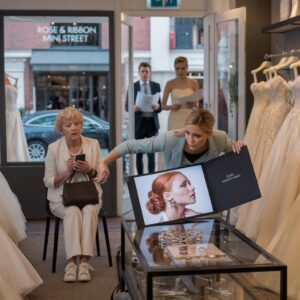
Before my daughter’s wedding, the boutique owner seized my wrist and breathed, “Please… don’t say anything.” Ten minutes later, I heard my daughter laughing near the register—and a man’s quiet voice outlining a “plan” that made my blood run cold. My name is Margaret Collins. I’m seventy-two years old, and I walked into Rose & Ribbon wearing my Sunday dress and white sneakers because my knees gave up on heels years ago. I had a list tucked into my purse: find something elegant for the rehearsal dinner, keep Lily calm, smile no matter what. I should’ve added one more line—don’t trust polished smiles in high-end boutiques. The shop sat neatly along Main Street, flag fluttering above the storefront. Inside, everything smelled faintly of perfume and pressed silk. Dresses shimmered beneath bright, flattering lights. Lily was two weeks away from her wedding. Twenty-eight. Organized. Efficient. She treats major life events like business projects with deadlines and bullet points. The appointment wasn’t for her—it was for me. She insisted the “mother of the bride cannot repeat outfits,” which meant my dependable church-blue dress wasn’t acceptable. She waited outside the fitting room, scrolling through her phone, sighing softly every time I stepped out to model something. That’s when I noticed the boutique owner. She stood near the register, posture stiff, eyes scanning the room like someone measuring distance to the exits. When her gaze met mine, something flickered across her face. Not irritation. Fear. Moments later, her hand slipped through the fitting-room curtain and wrapped around my wrist. Firm. Urgent. “Mrs. Collins,” she whispered so quietly Lily couldn’t hear, “don’t come out yet.” She guided me behind a rack of sequined gowns, shielding me from view. “Stay here. Please. Don’t say a word.” My heart thudded against my ribs as soft music continued playing, hangers clicking lightly as though nothing was wrong. Then I heard Lily’s laugh—bright, charming, the version she uses when she’s persuading someone. I edged closer to a narrow gap between dresses. Brian Hart, her wedding planner, stood at the counter in a tailored suit. Lily slid an envelope across the glass toward him. He opened it casually, like he already knew what was inside. “Perfect,” he murmured. “Once she signs, it’s finalized. There’s no backing out.” Lily’s tone remained light. “She’ll sign. She always signs. She thinks everything is for the wedding.” Brian lowered his voice slightly, but I still caught it. “Make sure your mother doesn’t connect the gown to the paperwork. If she finds out, she’ll interfere.” My throat tightened. The gown… tied to paperwork? Then Lily said something that cut deeper than the rest. “Mom’s sweet,” she said softly. “But she’s not as sharp as people think. She stays quiet. She always stays quiet.” Brian asked, “Rehearsal dinner?” “That’s when we handle it,” Lily replied. “Public. Clean. No one questions it.” I stepped back, my knees threatening to give way. I wasn’t shopping for a dress. I was being maneuvered. When Lily and Brian moved toward the front door, the boutique owner tapped once on the fitting-room wall and whispered, “Now.” She hurried me through a STAFF ONLY door into a narrow office. She locked it behind us and pulled a folder from her desk. The top page was a printed image from the store’s security camera. Lily stood beside a locked jewelry case, smiling. In her hand—a necklace lifted just enough to be suspicious. The owner’s voice trembled. “She’s setting something up, Mrs. Collins. And from what I’ve seen… she intends for it to fall on you.” My phone buzzed in my purse. A message from Lily: “Mom, don’t go anywhere. I’ll be right back.” Part 2 continues in the comments..

The boutique owner grabbed my wrist so firmly I nearly dropped my purse, pulled me behind a rack of evening gowns that rustled like birds startled from…

A divorced millionaire was driving his fiancée home when he suddenly spotted his homeless ex-wife on the street. “Michael, stop the car right now! Pull over!” Ashley’s sharp voice cut through the sealed silence of the black SUV like metal scraping glass. Michael hit the brakes before he even understood why. The tires shrieked against the cracked shoulder, and dust rose in a hot brown cloud around the doors. “Look over there,” Ashley said, leaning across the dash with that polished little smile he used to mistake for confidence. “Isn’t that your ex-wife?” Michael turned his head. And everything inside him stopped. A few yards from the roadside, under the harsh white glare of a summer afternoon, stood Emily. Not the woman he remembered walking beside him through hotel lobbies and charity dinners. Not the wife who used to leave her coffee half-finished on the kitchen island because she was always late helping somebody else. The woman on the shoulder wore a faded T-shirt, worn sandals, and jeans covered in gray road dust. Her hair was tied back unevenly, sweat clung to her temples, and exhaustion sat on her face like something permanent. But that was not what made Michael’s hands begin shaking on the steering wheel. Emily was holding two babies against her chest in soft cloth wraps. Twins. Newborns, or close to it. Their tiny faces were tucked under little knit caps, their cheeks red from the heat. And even from the SUV, Michael saw the detail that struck him like a fist to the ribs. They had his light hair. At Emily’s feet sat a plastic grocery bag half-filled with crushed cans and empty bottles. His ex-wife, the woman he had once promised to protect until his last day, was surviving by collecting recycling on the side of a rural road while carrying two children he had never even known existed. “Well, look at you, Emily,” Ashley called through the open window, her voice sweet in the way poison can be sweet. “Digging through trash. I guess everybody ends up where they belong.” Emily did not answer her. She did not even look at Ashley. She looked only at Michael, and the sadness in her eyes was so quiet it made it hard for him to breathe. “Drive,” Ashley snapped. “Don’t let this mess get on us. And those babies? Please. They’re probably from one of your little side stories, aren’t they, Emily?” The words side stories opened a door Michael had spent one year trying to keep locked. One year earlier, he had stood in the marble entryway of the house he and Emily once shared. Bank transfer printouts lay across the glass table. Hundreds of thousands of dollars, supposedly moved by Emily. Blurry photos of her entering a hotel beside a man Michael did not know. Then the final blow: his mother’s diamond necklace, gone from the safe and later found in Emily’s dresser after Ashley suggested security check her closet. Emily had dropped to her knees that night. “Michael, I didn’t do this,” she begged. “Ashley hates me. She’s lying to you. Please, listen to me. I’m—” He never let her finish. Pride can make a man feel strong while it is making him stupid. And humiliation loves an audience. He had turned away, jaw locked, heart burning with the need to punish somebody. “Get her out of my house,” he told security. “And don’t let her take a dime.” He never heard the rest of her sentence. He never asked where she went. A horn blared behind him and pulled him back to the roadside. Ashley reached into her purse, pulled out a crumpled twenty-dollar bill, balled it up, and tossed it out the window. “Here,” she said. “Buy milk. Or whatever people like you buy.” The bill landed in the dust near Emily’s sandals. Emily looked at it for one second. Then she raised her eyes to Michael again. There was no hatred there. That was the worst part. Only a devastating kind of pity, as if he were the one standing barefoot in the dust with nothing left. She covered the babies’ heads with both hands to protect them from the grit, picked up her bag of cans, and kept walking. Michael’s fingers tightened around the steering wheel until his knuckles turned pale. For one ugly heartbeat, he wanted to throw open the door, run after her, fall to his knees in that hot gravel, and beg her to say the babies were his so he could start paying for every second he had stolen from them. But Ashley was still talking. Laughing. Watching him. And in that poisonous little moment, Michael understood something. If he confronted her without proof, she would burn whatever trail was left before he could reach it. So he put the SUV back in gear. But as Emily grew smaller in the rearview mirror, Michael made a promise so cold it steadied his hands. He would find out everything. At 2:17 p.m., he dropped Ashley outside an upscale boutique. She stepped out smiling, talking about dinner reservations, a white dress, and how ridiculous Emily looked carrying babies who could never belong to a man like him. Michael did not answer. At 2:31 p.m., instead of driving home, he went straight to his downtown office. He locked the door, closed the blinds, and called David, a private investigator he had once used when a business partner tried to hide assets behind three shell companies. “I need everything on Emily,” Michael said when the line connected. “Where she has been. How she has lived. Why she disappeared. And those babies. I need to know who they are.” David went quiet for a moment. “Are you sure you want to open that door?” Michael looked out through the glass at the bright city below, moving like nothing had happened. Like a woman was not walking beneath a brutal sun with two babies who might have carried his name all along. “I should never have closed it,” he said. Then he added, “And pull the divorce file. The wire transfers. The hotel photos. The necklace. I want every crack in that story.” By 6:48 p.m., David called back. His voice had changed. “Start with this,” he said. “Eleven months ago, a pregnant woman checked into a county hospital intake desk and listed you as her emergency contact. Your name was on the form. Your old home number. Your private office line. Everything.” Michael’s stomach went cold. “Emily?” “Yes,” David said. “And someone paid to make that hospital intake record disappear.” Michael closed his eyes. For the first time in a year, he did not feel angry. He felt afraid. Because if Emily had tried to reach him while she was pregnant, and he had never received one call, then the betrayal had not started on that roadside. It had been living under his own roof… And when David slid the first scanned page into Michael’s encrypted inbox, the name on the receipt line made his blood turn cold… I know many of you are curious about what happens next, so check the comments below for the continuation. Thank you for your patience. Comment “YES” and leave a Like to get the full story. 👇A divorced millionaire was driving his fiancée home when he suddenly spotted his homeless ex-wife on the street. “Michael, stop the car right now! Pull over!” Ashley’s sharp voice cut through the sealed silence of the black SUV like metal scraping glass. Michael hit the brakes before he even understood why. The tires shrieked against the cracked shoulder, and dust rose in a hot brown cloud around the doors. “Look over there,” Ashley said, leaning across the dash with that polished little smile he used to mistake for confidence. “Isn’t that your ex-wife?” Michael turned his head. And everything inside him stopped. A few yards from the roadside, under the harsh white glare of a summer afternoon, stood Emily. Not the woman he remembered walking beside him through hotel lobbies and charity dinners. Not the wife who used to leave her coffee half-finished on the kitchen island because she was always late helping somebody else. The woman on the shoulder wore a faded T-shirt, worn sandals, and jeans covered in gray road dust. Her hair was tied back unevenly, sweat clung to her temples, and exhaustion sat on her face like something permanent. But that was not what made Michael’s hands begin shaking on the steering wheel. Emily was holding two babies against her chest in soft cloth wraps. Twins. Newborns, or close to it. Their tiny faces were tucked under little knit caps, their cheeks red from the heat. And even from the SUV, Michael saw the detail that struck him like a fist to the ribs. They had his light hair. At Emily’s feet sat a plastic grocery bag half-filled with crushed cans and empty bottles. His ex-wife, the woman he had once promised to protect until his last day, was surviving by collecting recycling on the side of a rural road while carrying two children he had never even known existed. “Well, look at you, Emily,” Ashley called through the open window, her voice sweet in the way poison can be sweet. “Digging through trash. I guess everybody ends up where they belong.” Emily did not answer her. She did not even look at Ashley. She looked only at Michael, and the sadness in her eyes was so quiet it made it hard for him to breathe. “Drive,” Ashley snapped. “Don’t let this mess get on us. And those babies? Please. They’re probably from one of your little side stories, aren’t they, Emily?” The words side stories opened a door Michael had spent one year trying to keep locked. One year earlier, he had stood in the marble entryway of the house he and Emily once shared. Bank transfer printouts lay across the glass table. Hundreds of thousands of dollars, supposedly moved by Emily. Blurry photos of her entering a hotel beside a man Michael did not know. Then the final blow: his mother’s diamond necklace, gone from the safe and later found in Emily’s dresser after Ashley suggested security check her closet. Emily had dropped to her knees that night. “Michael, I didn’t do this,” she begged. “Ashley hates me. She’s lying to you. Please, listen to me. I’m—” He never let her finish. Pride can make a man feel strong while it is making him stupid. And humiliation loves an audience. He had turned away, jaw locked, heart burning with the need to punish somebody. “Get her out of my house,” he told security. “And don’t let her take a dime.” He never heard the rest of her sentence. He never asked where she went. A horn blared behind him and pulled him back to the roadside. Ashley reached into her purse, pulled out a crumpled twenty-dollar bill, balled it up, and tossed it out the window. “Here,” she said. “Buy milk. Or whatever people like you buy.” The bill landed in the dust near Emily’s sandals. Emily looked at it for one second. Then she raised her eyes to Michael again. There was no hatred there. That was the worst part. Only a devastating kind of pity, as if he were the one standing barefoot in the dust with nothing left. She covered the babies’ heads with both hands to protect them from the grit, picked up her bag of cans, and kept walking. Michael’s fingers tightened around the steering wheel until his knuckles turned pale. For one ugly heartbeat, he wanted to throw open the door, run after her, fall to his knees in that hot gravel, and beg her to say the babies were his so he could start paying for every second he had stolen from them. But Ashley was still talking. Laughing. Watching him. And in that poisonous little moment, Michael understood something. If he confronted her without proof, she would burn whatever trail was left before he could reach it. So he put the SUV back in gear. But as Emily grew smaller in the rearview mirror, Michael made a promise so cold it steadied his hands. He would find out everything. At 2:17 p.m., he dropped Ashley outside an upscale boutique. She stepped out smiling, talking about dinner reservations, a white dress, and how ridiculous Emily looked carrying babies who could never belong to a man like him. Michael did not answer. At 2:31 p.m., instead of driving home, he went straight to his downtown office. He locked the door, closed the blinds, and called David, a private investigator he had once used when a business partner tried to hide assets behind three shell companies. “I need everything on Emily,” Michael said when the line connected. “Where she has been. How she has lived. Why she disappeared. And those babies. I need to know who they are.” David went quiet for a moment. “Are you sure you want to open that door?” Michael looked out through the glass at the bright city below, moving like nothing had happened. Like a woman was not walking beneath a brutal sun with two babies who might have carried his name all along. “I should never have closed it,” he said. Then he added, “And pull the divorce file. The wire transfers. The hotel photos. The necklace. I want every crack in that story.” By 6:48 p.m., David called back. His voice had changed. “Start with this,” he said. “Eleven months ago, a pregnant woman checked into a county hospital intake desk and listed you as her emergency contact. Your name was on the form. Your old home number. Your private office line. Everything.” Michael’s stomach went cold. “Emily?” “Yes,” David said. “And someone paid to make that hospital intake record disappear.” Michael closed his eyes. For the first time in a year, he did not feel angry. He felt afraid. Because if Emily had tried to reach him while she was pregnant, and he had never received one call, then the betrayal had not started on that roadside. It had been living under his own roof… And when David slid the first scanned page into Michael’s encrypted inbox, the name on the receipt line made his blood turn cold… I know many of you are curious about what happens next, so check the comments below for the continuation. Thank you for your patience. Comment “YES” and leave a Like to get the full story. 👇

Michael had spent a year believing he was the wronged man. He had built that belief like a wall, brick by brick, because it was easier to…

My 8-year-old daughter was getting her hair cut when the hairdresser suddenly froze. “Wait a second—Mom, this is…” she said. With a tense look, she carefully lifted part of my daughter’s hair. In that moment, her face went pale. My daughter trembled and whispered in fear, “Mom… don’t look…” But a second later, I gasped and froze in shock. I knew something was wrong the instant Marisol went silent. Not normal silent. Not the gentle pause a stylist makes when she is checking a cowlick or making sure both sides match. This was the kind of silence that made the hairdryers sound too loud and made the warm shampoo scent suddenly feel sharp in the back of my throat. My daughter, Ava, was eight years old, sitting in the swivel chair with a pink cape clipped around her neck. Her sneakers barely reached the chrome footrest, and her little hands were tucked beneath the cape like she was trying to disappear inside it. She had begged for that haircut all week. “Just to my shoulders, Mom,” she had said in the kitchen on Tuesday night while I packed her lunch for school. “Like the girls in the skating videos. Please?” By Saturday morning, I had finally agreed. It was supposed to be simple. A trim. Maybe a few layers. Then hot chocolate afterward if she stayed still. The salon sat in a small shopping strip between a nail place and a dentist office, with a little American flag sticker on the front window and a bell over the door that jingled every time someone walked in. Inside, it was bright and warm. Blow dryers hummed. Foil wrappers crinkled. Women talked about school pickup lines, grocery prices, and who was hosting Thanksgiving this year. Normal sounds. Normal Saturday. Until Marisol stopped. Marisol had cut my hair twice and Ava’s once before. She was in her forties, sharp-eyed, gentle with kids, and not the kind of woman who created drama out of nothing. She had a way of speaking to children like they were people, not decorations. So when she lowered the comb and said, “Wait a second—Mom, this is…” I was already rising from the waiting chair before she finished. “What?” I asked. She did not answer immediately. Her face had tightened. Carefully—too carefully—she lifted a section of Ava’s hair near the back of her head, just above the nape of her neck. I could not see it yet from where I stood. But I saw Marisol see it. The color drained from her face so quickly it scared me more than any scream could have. “Ava?” I said. My daughter’s fingers curled around the arms of the chair beneath the cape. Her throat moved once, then again, like she was trying to swallow something too large. “Mom…” she whispered. The salon around us kept moving for one strange second. A dryer clicked off. Someone laughed near the front desk. A spray bottle hissed at the next station. Then Ava said the worst possible thing. “Don’t look.” A child does not say that unless she has been carrying something alone. And carrying something alone is how fear teaches a kid to protect the wrong person. I crossed the floor in two steps. Marisol still had one hand gently lifting Ava’s hair. Her other hand hovered near the comb, frozen in midair. “I think you need to see this,” she said quietly. Then I saw it. At first, my mind refused to understand what my eyes were showing me. Under the top layer of Ava’s hair, hidden where no teacher would notice and no parent would see during a rushed school morning, was a patch of scalp about the size of a silver dollar. The hair around it had been cut close to the skin, jagged and uneven, like someone had done it quickly and angrily. The skin beneath was red with yellow bruising at the edges. Near the center was a thin healing line. And across that bruised patch, in faint dark ink that had partly faded but was still visible, was one word. LIAR. I gasped so hard my chest hurt. My hands flew to my mouth, but the sound had already escaped me. It was not a scream. It was worse. It was the kind of broken breath a mother makes when the world in front of her stops matching the world she thought she lived in. Ava began shaking in the chair. Marisol let the hair fall back over the spot and stepped away, her eyes fixed on me now, not the mirror. “Who did that?” she asked. I wanted to say nobody. I wanted to say there had to be some explanation. A playground accident. A cruel joke. Something at school. Something I had missed but could still fix if I named it quickly enough. But Ava’s face told me the truth before her voice did. Her lower lip trembled. Her eyes went toward the floor instead of toward me. “Please don’t tell Dad I showed you,” she whispered. The whole salon changed shape around us. The woman under the dryer stopped pretending not to listen. The receptionist’s hand froze over the appointment book. Marisol’s scissors sat open on the counter, silver blades catching the overhead light like they had been dropped halfway through a sentence. I looked at my little girl in that pink cape and realized the place I had been calling home might not have been safe for her when I was not watching. My husband, Daniel, was not Ava’s father by blood, but he had been in her life for three years. He had taught her to ride her bike in our driveway. He had shown up to her second-grade spring concert with a paper coffee cup in one hand and grocery-store flowers in the other. He knew the code to her tablet, the name of her stuffed rabbit, and the way she needed the hallway light left on until she fell asleep. Trust does not usually break all at once. It breaks in one ordinary room, under ordinary light, while someone lifts your child’s hair. I crouched beside Ava’s chair and kept my voice low, even though every part of me wanted to tear the air apart. “Ava,” I said, “did Daniel do this?” She squeezed her eyes shut. That was enough. Marisol reached for her phone but did not touch it yet. “Do you want me to call someone?” she asked. My mind snapped into a place I did not recognize. At 11:17 a.m., I took a photo of the patch while Marisol held the hair up and Ava cried without making a sound. At 11:19 a.m., Marisol wrote down what she had found on a salon incident note with her name, the date, and the station number. At 11:22 a.m., I texted Ava’s pediatrician’s office and asked for the earliest appointment because I needed documentation of a scalp injury. I did not shout. I did not call Daniel from the salon. For one ugly second, I imagined walking straight home, throwing the front door open, and putting my hands on him before he could lie. I imagined his face when I said the word I had just seen beneath my daughter’s hair. Then I looked at Ava’s trembling fingers and understood something colder. Rage would make noise. Proof would make a path. I stood, smoothed the cape away from Ava’s cheek, and said, “Baby, I’m not mad at you.” She broke then. Not loudly. Not dramatically. Her chin folded down, and her shoulders began to shake beneath the cape while tiny clipped pieces of hair slid into her lap. “I told him I didn’t take it,” she whispered. “Take what?” She would not answer. Marisol and I looked at each other through the mirror. That was when my phone buzzed in my purse. Daniel. One text. Where are you two? Ava needs to learn what happens when she lies. The room tilted. Marisol saw my face change and stepped closer. “Mom?” she said. I turned the phone toward her. She read the message. Then the receptionist, still pale behind the desk, whispered, “Ma’am… there’s a police report form online if you need it. My sister had to use one last year.” The words police report seemed to move through the salon like cold air. Ava heard them too. She grabbed my wrist so tightly her little nails pressed half-moons into my skin. “No,” she whispered. “Mom, please. He said if I told, he’d make you believe I was bad.” I bent down until my face was level with hers. “You are not bad,” I said. Her eyes searched mine like she was afraid I might take it back. I did not. Then the bell over the salon door jingled. Every head turned. Daniel walked in wearing his gray work hoodie, his jaw tight, his truck keys still in his hand, and the moment he saw me standing beside Ava with Marisol’s incident note on the counter, his face changed. Not guilt. Recognition. And before I could say a word, Ava ducked behind my arm and whispered. I know many of you are curious about what happens next, so check the comments below for the continuation. Thank you for your patience. Comment “YES” and leave a Like to get the full story. 👇

I knew something was wrong the second Marisol stopped talking. Not regular quiet. Not the kind that happens when a stylist is focused on lining up the…