After my brother changed the locks and told me, “Hope you enjoy being homeless, because I made sure you get nothing,” I walked into the will reading expecting one last humiliation—until the lawyer placed a cream folder on the table, said, “There’s one final section your mother insisted be read aloud,” and the room that had always treated me like an afterthought went completely still. Two days after our parents’ funeral, Evan changed the locks on the house I grew up in. The same house where I had spent the last two years bathing my mother after chemo, heating broth she could barely swallow, sleeping in scrubs on the loveseat so I could hear if she needed me in the night. When I came home from a double shift, my boxes were stacked in the garage. Half of them were already wet from the storm. My nursing diploma was bent at the corners. Three of my textbooks were swollen with water. My mother’s recipe cards, the ones she kept in a tin with faded blue flowers, were damp and curling at the edges. I stood outside the kitchen window in my rain-soaked shoes when my sister-in-law spotted me from the living room. She lifted her wine glass toward me like she was celebrating something, then disappeared down the hall. A minute later my phone rang. “The house is legally mine,” my brother said. “Dad settled it years ago. Sons inherit. Daughters move on.” I remember gripping my mother’s old Timex watch so tightly the ridged crown pressed into my palm. I had just buried both of my parents, and somehow grief still wasn’t enough for him. While I was gathering the last of my things, I found a cream envelope tucked inside a box of my mother’s winter scarves. My name was on the front in her handwriting. For Briana, when the time comes. Inside was a short note and the business card for a probate lawyer in Hartford. When I met her the next morning, she read the note, looked at me for a long second, and said only, “Do not sign anything. Do not argue with your brother. Do not react in that room. Just wait.” So when Evan called three nights later and offered me ten thousand dollars to waive any claim to the estate, I finally understood why he had rushed me out. He wanted me frightened. He wanted me broke. He wanted me grateful for crumbs. “I’m trying to help you,” he said. “No,” I told him. “I’ll see you at the reading.” The meeting was held in a long mahogany conference room that smelled like paper, polish, and old money. Evan walked in wearing a Rolex I had never seen before and the kind of smile people wear when they think the ending already belongs to them. His wife sat beside him with a leather folder and crossed legs, like she was already deciding what color to repaint my mother’s kitchen. Then my grandmother came in. That was the first time my brother’s face shifted. The lawyer started with my father’s will, and Evan relaxed almost immediately. He smirked at the numbers, leaned back in his chair, and glanced at me like the story was finished. Then the lawyer closed that folder. Opened another one. And said, “Now we will address your mother’s estate.” My brother actually laughed. “She was a housewife,” he said. “Whatever little she had won’t matter.” The lawyer didn’t blink. She removed a deed, a USB drive, a sealed packet of financial records, and one handwritten letter on cream stationery. Then she looked directly at my brother and said, “There is one final section your mother specifically instructed me to read aloud.” The room went so quiet I could hear the air vent hum. My grandmother reached under the table and squeezed my hand. Evan still thought I was the daughter who would clean up the mess, swallow the insult, and disappear. Then the lawyer unfolded my mother’s letter and began with the words, “To my children—love does not make me blind.” And when she turned to the next page, my brother stopped smiling because my mother had spent years preparing for the day the truth would finally be heard… 👉 Full story below 👇….
The Timex Two days after my parents’ funeral, I came home from a twelve hour hospital shift and found my life stacked in damp cardboard in the…
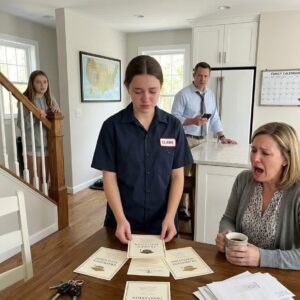
My parents called off my graduation party because of my sister’s feelings, so I walked away—and months later, they saw my Stanford success on the news. The night my parents chose Amber’s comfort over my graduation, the kitchen smelled like overcooked coffee, orange peels, and damp grocery receipts still clinging to my hands. I had just gotten back from my shift, my red name tag crooked on my shirt. The fluorescent lights had left a dull ache behind my eyes, and my fingertips were sticky from produce bags, receipt ink, and those sharp little plastic tabs no one notices until they cut you. On the counter, the cream-colored invitations were stacked neatly. Gold lettering caught the light like quiet proof that somewhere, someone thought I was worth celebrating. Claire Reynolds. My name looked almost too perfect printed like that. Mom sat at the table with both hands wrapped around a mug she hadn’t taken a sip from. That’s how I knew the decision had already been made before I walked in. In our house, discussions only started after the outcome was set. “Claire, honey,” she said in that soft voice people use when they expect you to accept something painful, “we need to talk about the party.” Ten days. That was all that stood between me and graduation. My cap and gown were hanging upstairs. My Stanford acceptance letter was taped above my desk. My scholarship folder was labeled at 1:17 a.m.—because no one else had asked to see it twice. “What about it?” I asked. Mom glanced toward the hallway, toward Amber’s closed bedroom door. Amber was sixteen, but her moods shaped the whole house like weather. Everyone adjusted to them. Everyone carried protection—except me. “Amber has been feeling left out,” Mom said. “Everyone keeps focusing on your graduation, your college plans… your future. She feels invisible.” Invisible. I almost laughed, but it caught in my throat. Because invisible wasn’t Amber behind a closed door while everyone tiptoed around her feelings. Invisible was me eating at the edge of the table while Amber cried her way into dance classes, new phones, weekend trips, and second chances. Invisible was my honor-roll certificate slipping into unopened mail while one decent report card from her got framed in the hallway. I worked weekends to pay for gas. I covered my own application fees because suddenly there were “budget concerns”—yet somehow Amber’s new phone never counted. Pride in me only showed up when other people were watching. “So what are you asking?” I said. Mom pressed her lips together. “We think it would be better to postpone the party.” “Postpone it until when?” She didn’t answer. “Or cancel it,” I said. “We’ll do something smaller,” she replied quickly. “Just a family dinner. Something more personal.” The wall clock ticked above the calendar where my graduation date was circled in blue. Mom had drawn a little star next to it weeks ago. I’d looked at that star every morning like it meant something. “People already got invitations,” I said. “Aunt Linda is driving four hours. My teachers said they might come. I’m graduating with honors.” Mom sighed, like my achievements were inconveniences. “Claire, let Amber have the spotlight for once.” For once. Some sentences don’t need volume to hurt. They just land exactly where it already aches. Dad came in with his tie loosened, phone still in hand, wearing that tired expression he used whenever my feelings required effort. He looked between us like he’d walked into a minor inconvenience. “What’s going on?” “Your daughter is being difficult,” Mom said. “Our daughter,” I corrected. “Is being told her graduation party hurts her sister’s feelings.” Dad rubbed his forehead. “Claire, we’ve already discussed this. Amber needs to feel important too.” “By taking something from me?” “You’re nineteen,” he said. “You should be mature enough to make sacrifices for your family.” Upstairs, Amber’s door creaked open just slightly. The fridge hummed. The clock ticked. A slow drip echoed from the sink. Then Amber appeared at the top of the stairs, hoodie sleeves pulled over her hands, her expression carefully arranged. “Why is everyone arguing?” she asked. No one had raised their voice. Not yet. Dad gestured toward her without looking. “Your sister’s upset about the party changes.” Amber’s eyes flicked to me—and for just a moment, I saw it. Not guilt. Not sadness. Satisfaction. A tiny flicker at the corner of her mouth before it vanished. That’s when something inside me went cold—and steady. Mom kept talking about understanding and kindness. Dad said I’d regret making this about myself. Amber stood there, wrapped in her performance. The room stilled. The invitations sat untouched. Dad hovered over his phone. Amber lingered on the stairs. The faucet kept dripping, marking time while everyone waited for me to shrink. No one moved. I looked at the stack on the counter. Cream paper. Gold letters. My name at the center. Weeks of proof that maybe, just once, this family would show up for me. Now it felt like evidence of a lie. “Fine,” I said. Mom blinked. “Fine?” “Cancel it.” Relief washed over her so quickly it almost made me sick. “Thank you, sweetheart. I knew you’d understand.” But I wasn’t finished. I picked up one invitation, holding it lightly. My hands were steady now. The anger hadn’t disappeared—it had just sharpened. “You’re right,” I said. “This did teach me something about family.” Dad frowned. Amber stopped pretending. I placed the invitation on the table, between Mom’s untouched coffee and the phone she’d probably already used to start canceling guests. “It showed me exactly where I stand.” Silence settled over the room. Not peaceful. Not regretful. The kind of silence that comes when someone finally refuses to play their role. Then I reached for my car keys. And for the first time that night, Amber’s expression faltered. What happened when I walked upstairs and opened the folder behind my Stanford letter… 👇 I know many of you are curious about what happens next, so check the comments below for the continuation. Thank you for your patience. Comment “YES” and leave a Like to get the full story. 👇
The night my family found out about the letter, I was sitting at my desk when my mother appeared in the doorway. She had come to tell…
My own daughter left me a light, almost careless voicemail saying, “Mom, maybe you shouldn’t come this summer. Kevin thinks it’s better if we keep the lake house for our family,” as if the cedar walls, the sage-green door, the dock, the porch swing—and every nail in that place—hadn’t been built from my late husband’s dream and paid for with my own money. So I said nothing, signed the papers quietly, and let them drive up for the Fourth of July with Kevin’s parents, the kids, and all their plans… and when Lorraine called me screaming about a stranger’s car in the driveway, I finally answered and said, “I made room.” The voicemail arrived on a Tuesday at 6:47 in the evening while I stood at the stove stirring chicken and dumplings. The kitchen was dim except for the soft green light above the microwave. Thyme and black pepper rose through the steam. The wooden spoon felt warm in my hand, and one dumpling had folded over where I had dropped it in too quickly. My hands were wet, so I tapped speaker with my wrist. “Hey, Mom. So… Kevin and I were talking, and we think it might be better if you skip the lake house this summer. The kids are older now, they want to bring friends, Kevin’s parents are flying in from Denver… there just isn’t enough room. You understand, right? We’ll plan another time. Love you.” A click. Then the automated voice asked if I wanted to save or delete. I stood there while steam touched my face and felt something inside me go completely still. I turned off the burner. The dumplings sat unfinished in the pale broth, and for one strange second, I thought Samuel would be upset that I had stopped halfway. Samuel believed patience mattered—in cooking and in marriage. Stir slowly. Wait. Let things become what they are meant to become. I had spent most of my life believing patience was a virtue. That evening, I realized patience could also be used against you. My name is Dorothy May Hastings. I am sixty-eight years old. I spent thirty-four years as a registered nurse at Grady Memorial Hospital in Atlanta. I delivered babies, held hands at the end of life, cleaned wounds most people couldn’t look at, and never called in sick unless I truly could not stand. I was not raised to be fragile. I was raised outside Macon, by a mother who believed idle hands invited trouble and a father who showed love through quiet repairs, sharpened pencils, and a car that never ran out of gas. By nineteen, I could cook, clean, balance accounts, and calm a frightened person just by lowering my voice. That last skill made me a good nurse. Later, it made me a very convenient mother. I retired at sixty-two when Samuel got sick. Pancreatic cancer does not bargain. It arrived suddenly, then spent fourteen months closing every door in our life one by one. After he passed, I made him a promise. In the dark, with one hand resting on the empty space he had left behind, I told him I would build the lake house. He had sketched it for years on napkins whenever we drove through Lake Oconee. Cedar walls. Pine floors. A sage-green door. A porch swing facing the sunset. A dock where the grandchildren could forget the rest of the world for a while. So I built it. I paid for it with my retirement, my pension, and the savings Samuel and I had protected for years. The taxes came to me. The insurance was in my name. The deed clearly said Dorothy May Hastings—no confusion. At first, Lorraine called it “Mom’s place.” Then she married Kevin, and it became “the lake house.” Then Kevin’s parents started visiting, and it became “our family tradition.” Ownership does not always begin with theft. Sometimes it begins with small assumptions. Leaving things behind. Moving furniture. Saying, “We’ll just keep this here for next time.” Kevin wanted a better grill. Lorraine added a linen cabinet. The kids brought friends. Kevin’s mother claimed the downstairs bedroom. Kevin’s father rearranged the dock chairs. And I said yes too many times. Because grief can make silence feel like kindness. Then came the voicemail. Telling me not to come to the house my husband had dreamed of, the house I had built, the house I had paid for piece by piece. I saved the message. Then I pulled the blue folder from my desk. Inside were copies of everything—deed, insurance, tax receipts, closing papers, even Samuel’s napkin sketch, folded so many times it had gone soft. The next morning, I documented the house. Every room. Every cabinet. Every space that had slowly filled with things that were never mine to begin with. Not anger. Not drama. Paper. Dates. Proof. By Friday, I had called the attorney Samuel and I once used. By the following week, I had signed the first documents. My jaw ached from how tightly I held it, but my hand never shook. Lorraine texted about sunscreen. Kevin asked about arrival time and boat fuel. I answered simply. Short replies. No emotion. Sometimes silence says more than words ever could. On the morning of the Fourth, I sat in my kitchen with cold coffee and the final signed file in front of me. The key ring no longer hung by my door. The copy Lorraine carried no longer opened anything that mattered. At 2:32 p.m., my phone rang. Lorraine. Her voice came through sharp and frantic. “Mom, why is there a stranger’s car in the driveway?” Behind her, everything went still. A child stopped talking. A cooler slammed shut. Kevin muttered something low. His mother asked who it was. No one laughed. No one moved. I looked at Samuel’s sketch beside me—the porch swing, the lines he had drawn by hand. Then I heard footsteps on the porch. Lorraine called my name again, louder this time. I placed my hand over the signed papers and said, very calmly— “I made room.” The key turned in the lock— 👇 I know you’re curious about what happens next, so check the comments below for the continuation. Please leave a “YES” and Like to get the full story. 👇
The voicemail came on a Tuesday at 6:47 in the evening, while Dorothy May Hastings stood in her Atlanta kitchen stirring chicken and dumplings. The green digital…
On my husband’s deathbed, he didn’t ask for forgiveness. He didn’t ask me to remember him kindly. He asked for one thing: “Never go to Cypress Hollow.” The stroke had taken most of his voice. Machines hummed beside the bed, doing what his body no longer could. But when he said that name, his hand tightened around mine with a strength that didn’t belong to someone fading away. “Erase it,” he whispered. “Don’t ask questions. Don’t look into it. Just stay away.” Cypress Hollow was six hundred acres of swampy Arkansas land—trees, water, and isolation—something he’d bought decades earlier and always brushed off as a mistake. In forty-four years of marriage, he never once took me there. Said it wasn’t worth the drive. Said there was nothing to see. So at 3:17 a.m., in a hospital room that smelled like antiseptic and endings, I promised the man I loved that I would never go near it. Eight months later, I was alone in a small apartment in Memphis, buried under grief and paperwork. I closed accounts, donated clothes, packed away a lifetime. Everything… except one folder. Cypress Hollow. Twice a year, tax notices still came. $847.28. Land I had never seen. Land I had sworn to ignore. “Leave it alone,” I told myself. “You made a promise.” Then the phone rang. “Mrs. Whitmore?” a man said. “This is Sheriff Cooper from Cross County, Arkansas.” My stomach tightened. “I’m calling about your property—Cypress Hollow. We need you to come out here.” “I can’t,” I said quickly. “My husband made me promise—” “Ma’am,” he said gently, “there’s a woman living on that land. She says she knows you. And she’s not doing well.” The silence that followed felt heavier than anything I had carried since his death. Three hours later, I was driving down empty Arkansas roads, passing fields and trees that stretched forever, telling myself there had to be a mistake. Cameron had always said the place was abandoned. Then I took the final turn. An ambulance sat idling near the drive. Sheriff’s cars lined the road. And instead of decay, there was a white farmhouse. Fresh paint. Lace curtains. Smoke curling from the chimney like someone had been living there all along. The sheriff met me before I reached the steps. “She’s been asking for you,” he said quietly. “By name.” On the porch sat an elderly woman wrapped in a blanket, silver hair neatly brushed, her eyes sharp despite her condition. When she saw me, something in her expression broke. “Daisy,” she whispered. “You came.” “I’m sorry,” I said carefully. “Do we know each other?” She smiled—a tired, knowing kind of smile. “No,” she said. “You wouldn’t recognize me. But I’ve known you for over thirty years.” My chest tightened. “Your husband told me everything,” she continued. “About Memphis. About your life together. About… your daughter.” Every nerve in my body went cold. Then she said my daughter’s name—the one no one outside our family ever used. And in that moment, I understood something I wasn’t ready to face: Cypress Hollow wasn’t just land. It was a secret. And whatever my husband had hidden there… hadn’t been waiting by accident. 👇 Full story continues in the first comment…
The promise came with Cameron’s dying breath, whispered through lips that could barely form words after the massive stroke had stolen half his body and most of…
At My Brother’s Wedding, They Gave Me A Paper Badge That Said, “Limited Access Guest.” My Mom Leaned In And Said, “That Means No Dinner Plate.” I Looked Over, Walked To The Gift Table, Retrieved My…. My name is Connie Hst, and I was thirty-two years old when my family decided I didn’t merit a seat at my own brother’s wedding. At first, nothing seemed off. The ceremony was smooth and efficient, the kind that blends into soft piano notes and polite applause. Ryan stood confidently at the altar, exactly how he always liked to be seen—steady, admired, dependable. Cara looked radiant in a way that almost made you forget weddings are stitched together with tension, budgets, and quiet disagreements over table settings. Ryan barely spoke to me that morning, but I told myself it was nerves. Weddings can make people distant. I wasn’t expecting the spotlight. I didn’t need to stand beside him or deliver a speech or be introduced like someone important. I simply assumed I was included. Family usually is. After the ceremony, everyone drifted toward the reception hall, laughing, posing for photos, trading compliments like party favors. The venue was bright with tall windows and flowing white curtains that softened the evening light. Outside, the sunset pooled over the pavement like liquid gold. I joined the check-in line behind a couple dressed in matching beige tones. The attendant smiled warmly at them and handed each a thick badge edged in gold. Their names were written in elegant script, table numbers listed beneath. Then it was my turn. She didn’t meet my eyes. She reached under the table and handed me a thin paper badge. No ribbon. No flourish. Just bold black lettering printed across it. Limited Access Guest. I stared at it, waiting for a correction. A laugh. A simple, “Oops, wrong one.” Maybe someone would fix it. Nothing. She was already assisting the next person. A tight pressure filled my ears, like I’d slipped underwater. I was about to ask if there’d been a mistake when my mother appeared beside me, almost as if she’d anticipated the moment. She leaned close, voice light and conversational. “That just means no dinner plate.” She said it casually. No apology. No discomfort. As though she were pointing out the coat check. Then she walked away. I stood there holding the badge, the flimsy paper bending under my grip. For a moment, I tried to rationalize it. Weddings are chaotic. Lists change. Someone forgets to update seating. Maybe it was an oversight. So I stepped inside anyway. The aroma hit me first—warm butter, roasted meat, hints of sugar waiting for dessert. Servers glided through the room with practiced ease, balancing trays like extensions of their hands. Tables shimmered under soft lighting. Real china sat at every place setting. Linen napkins folded neatly. Place cards upright, names written in careful calligraphy. I checked the nearest table. Then the next. Then the long family table at the front with the grander centerpiece. My parents’ names were there. Ryan and Cara. Her parents. Cousins. Friends. Not mine. I searched again, slower this time, my pulse climbing with every glance. I even checked the edges where extra chairs usually linger, where a last-minute guest might be squeezed in. Nothing. No chair. No plate. No awkward corner space. That’s when it settled in. I wasn’t forgotten. I was intentionally excluded. I looked toward the gift table. And that’s when I made a decision that would change the rest of the evening. Continued in the first c0mment ⬇️💬
Limited Access Guest Part One: The Badge My name is Connie Hart, and I was thirty-two years old when my family decided I didn’t deserve a chair…
I honestly thought my brother was joking when he pointed toward the back of the ballroom and said, “You’re not really on theme. Just sit at the kids’ table — and don’t talk to my boss.” Ten minutes later, his billionaire CEO walked past every VIP in the room, dragged a tiny chair up beside me, and said, “There you are. I’ve been trying to find you.” By sunrise, my brother’s flawless wedding, his job at Nebula, and our carefully balanced family hierarchy would be unraveling. My name is Lena. I’m twenty-eight. And last Saturday, my older brother publicly demoted me to the children’s table at his wedding. It wasn’t even the seating that hurt. It was how effortless it was for him. The ballroom looked unreal — crystal chandeliers dripping light, ivory linens layered over gold-trimmed china, towering floral arrangements that probably had their own budget line. A string quartet played something soft and expensive while servers glided between tables offering champagne. I had followed instructions precisely. I wore the pale blue dress Caleb had sent me a screenshot of with the message: “This one. No experiments.” I paid too much for my hair to fall in glossy waves instead of its usual rushed knot. I bought the exact registry item he’d “suggested” — an espresso machine that cost more than my laptop. I even arrived early, because apparently timing is part of optics. I was standing near the entrance, adjusting heels clearly designed by someone who hates feet, when I saw him. Caleb. Three years older. A lifetime ahead in self-importance. He moved through the room in his tuxedo like he was unveiling a brand, not celebrating a marriage. His posture screamed confidence. His smile was calibrated. When he spotted me, his expression tightened. He didn’t hug me. He didn’t say hello. He stepped directly in front of me and lowered his voice. “What are you doing here?” he asked. I blinked. “Attending your wedding?” “I meant here,” he said, gesturing toward the entrance. “This is where the key guests are arriving. Investors. Executives. Board members. You’re… in the frame.” “In the frame?” “Yes,” he said briskly. “Photographers are capturing arrival shots. We don’t need distractions.” I looked down at myself — the dress he chose, the neutral heels, the understated makeup. “I’m your sister,” I said quietly. “Which is why I relocated you,” he replied smoothly, pulling out the seating chart like it was a strategy document. “Table Five is now for the VP of Marketing. Her husband runs a fund. It’s strategic.” His finger slid down to the bottom corner. Table Nineteen. Near the service doors. With a balloon sticker. “That’s the kids’ table,” I said. “It’s mixed seating,” he corrected. “Great Aunt Marge is there. She won’t mind.” “You’re seating me with toddlers.” “You don’t match the room, Lena,” he snapped. “This is a high-level environment. You’re… freelance. It’ll be less awkward for everyone if you just sit, eat, and keep things low-profile.” “I have a career,” I started. He waved it off. “Your blog-writing thing isn’t exactly corporate. Just stay at Table Nineteen. And if you see Silas Vance — don’t approach him. He’s my CEO. This is important.” Then, leaning closer, he added, “Don’t make it weird.” He walked away before I could respond, already smiling at a cluster of men in tailored suits. He had no idea. The man he’d warned me about — Silas Vance, founder of Nebula, tech icon, keynote regular at global summits — was my client. The viral speech he’d delivered at the UN the week before? Drafted on my laptop at 2:00 a.m. while I sat cross-legged on my couch eating leftover noodles. To Caleb, I was just his awkward sister who “typed for a living.” He didn’t know I was the ghost behind the words his boss was praised for. I exhaled slowly. “Fine,” I murmured. “Table Nineteen it is.” The kids’ table was exactly what it sounded like. Positioned beside the swinging kitchen doors, close enough to feel waves of garlic-scented heat every time they opened. Instead of centerpieces, there was a plastic container of crayons. The tablecloth already featured colorful scribbles. A booster seat was strapped to one chair. Four boys in miniature tuxedos debated trucks. A baby fussed in a stroller. Great Aunt Marge slept upright. I stood there for a second. Then a little boy with a crooked bow tie looked up at me. “I like your dress,” he announced. “Thanks,” I said, smiling despite myself. “I like monster trucks,” he added. “Excellent taste,” I replied. The nanny beside him gave me a knowing look. “They stick you back here too?” “Apparently I’m off-brand,” I said. She laughed. “Their loss.” So I leaned into it. I poured apple juice, wrestled with impossible ketchup packets, drew dragons on napkins. I watched the “power section” from across the room like it was theater. Caleb floated from table to table, shaking hands, clapping backs, performing success. He was calculating status the way some people calculate calories. He’d been doing it his whole life. Then the room shifted. A ripple of attention moved from the entrance inward. Silas Vance had arrived. The air changed — conversations lowered, shoulders straightened, laughter sharpened. Silas greeted investors politely, nodded at board members… and then his eyes scanned the room. Past the front tables. Past the dance floor. All the way to the back. To Table Nineteen. He changed direction. Walked past every VIP. Stopped beside me. And without hesitation, pulled a tiny child-sized chair out from under the table and sat down next to me. “I’ve been looking everywhere for you,” he said warmly. The entire ballroom froze. Across the room, my brother went pale. And I smiled. Because I suddenly understood something Caleb never would. Power doesn’t always sit at the front of the room. Sometimes, it’s drawing dragons at the kids’ table. Let’s read what happened next to my very confident older brother 👇
The Kids’ Table My brother’s wedding was supposed to be the kind of event people talked about for months—the kind that ended up in glossy lifestyle magazines…
My father lifted his glass at Thanksgiving and smiled while he called me “the maid” in front of 14 guests, but when my little girl asked if that meant her mother was something to be ashamed of, the only man at the table who did not laugh was the guest my parents were desperate to impress—because he already knew exactly who I was, and he knew my father had just made a catastrophic mistake. My name is Sadie Holt. I am thirty-one, a single mother, and for six years my family has had one favorite joke. My sister Clare is the doctor. I am the maid. It started after my ex-husband emptied our checking account and vanished while our daughter was still in pull-ups. I came back to Ivy, Virginia, with two suitcases, a diaper bag, and a two-year-old on my hip, and my father allowed me to stay in the small guest house behind their property like he was doing charity for a stranger. I started cleaning houses because I needed money quickly. Eighteen dollars an hour. Bathrooms, kitchens, laundry rooms, whatever people needed. I scrubbed floors while Mia napped at a neighbor’s house and told myself it was temporary. My father never let me forget it. Every holiday, every dinner, every chance he got, he found some polished little way to remind people that Clare wore a white coat and I wore rubber gloves. When Clare finished her residency, my parents threw a dinner party. I showed up straight from a job, still smelling faintly of bleach, and my father smiled at the table and said, “Sorry Sadie’s late. She was busy scrubbing somebody’s bathtub.” That was how it always went. What nobody cared enough to notice was that I had stopped thinking like a cleaner a long time ago. I started thinking like an owner. The houses I cleaned belonged to people from D.C., Richmond, Atlanta. Big second homes sitting empty most of the year. They did not just need floors mopped. They needed landscapers scheduled, pipes checked, guest turnovers handled, contractors met, alarm systems monitored, everything. So while Mia slept at night in that tiny guest house, I built something. I registered an LLC, made a website on a dying laptop, and began signing contracts. Small ones at first. Then larger ones. A property here. An estate there. One client told another. Then another. By the time my father was still introducing me as “Sadie” and Clare as “Dr. Clare Holt,” I was running Blue Haven Property Group with sixteen employees and contracts across the Shenandoah Valley. My parents never asked what Blue Haven did. They never came to my office. They never once cared enough to look. Then my father began chasing a land deal with Langford Development Group. He wanted it badly. Too badly. Enough to start pressuring me to leave the guest house because the land had become “valuable.” Enough to serve his best bourbon and polish the silver for Thanksgiving because Victor Langford himself was coming to dinner. The funny part was, Victor Langford already knew me. He was one of my biggest clients. Every Tuesday morning, we talked about staffing, maintenance schedules, vendor delays, expansion plans. He trusted me with multimillion-dollar properties, and my father had no idea. Thanksgiving morning, I still cooked the meal. Of course I did. Turkey, sweet potatoes, green beans, the whole Virginia spread, while Clare got dressed and my mother floated around adjusting candles like she was preparing a magazine shoot. By noon, fourteen people had filled the house. Then Victor and his wife walked in, and my father practically rushed to the door to greet them. My mother introduced me with a smile so thin it could cut glass. “That’s Sadie,” she said. “She helps with cleaning.” Victor looked at me. Just for one second too long. Dinner started. Wine was poured. My father stood at the head of the table and did what he always does when he has an audience. He lifted his glass and said, “I’m thankful for my daughter, Dr. Clare Holt, who continues to make us proud.” Everyone smiled. Clare stared down at her plate. Then he turned toward me. “And of course, Sadie. One daughter is a doctor. The other is the maid.” He laughed. A few guests laughed with him. A few looked down. My mother did not correct him. She never does. Beside me, Mia tugged on my sleeve. Her voice was tiny. Confused. “Mommy… is being a maid a bad thing?” The whole table went quiet. Not one person moved. Not one person laughed that time. I looked at my daughter first. Then at my father. Then at the one man at that table who had gone completely still. Victor Langford was already staring at me like the pieces were finally sliding into place. And suddenly, after six years of swallowing it, after all the little speeches and all the quiet humiliation and all the holidays where I let them define me because keeping the peace felt easier, I realized I was done. I pushed back my chair. Took Mia’s hand. And walked straight to the guest my father had wanted most to impress. “Hello, sir,” I said. “Maybe you should tell them who I really am.” (I know you’re curious about the next part, so please be patient and read on in the comments below. Thank you for your understanding of the inconvenience. please leave a ‘YES’ comment below and give us a “Like ” to get full story ) 👇
My father raised his glass at Thanksgiving and smiled while he called me the maid in front of fourteen guests. He said it like it was a…
Saturday morning, my mom walked into my beach house with a U-Haul and said, “We’re moving in. You can take the guest room.” She thought I’d stay quiet… until the man in the suit stood up. At exactly nine o’clock on a calm Saturday morning, Alison Cole sat at the kitchen island of her beach house with a cup of black coffee, an open spreadsheet on her iPad, and the kind of quiet she had spent years building. Outside, the South Carolina coast glowed in soft light. The ceiling fan turned lazily above her. The gated neighborhood was still in that polished way—lawns trimmed perfectly, rules enforced like law. Alison liked the silence. She had earned it. Years in the Army had taught her how to function in chaos, pressure, and noise. So when she finally bought a house near the water, she didn’t see luxury. She saw safety. A place where no one else’s emergency could become hers before breakfast. Then the U-Haul pulled into the driveway. A large truck rolled over the concrete, brakes hissing, engine rumbling louder than the distant waves. Alison glanced over her mug. 9:02 a.m. Two minutes late. Then the front door unlocked. Not knocked. Unlocked. Her mother, Diane, walked in wearing oversized sunglasses, linen clothes, and the confidence of someone who had mistaken an emergency key for ownership. Behind her came Megan, Alison’s younger sister, holding iced coffee and talking into her phone like she’d just arrived at a curated location. “Guys, wait till you see this light,” Megan said, angling her camera upward. “This is literally going to fix my whole vibe.” Alison didn’t move. Diane looked around the kitchen, the clean lines, the ocean-colored decor, the hallway leading toward the main bedroom. She didn’t ask how Alison was. She pointed. “This lighting is perfect for Megan’s content,” she said. That was the first sign this wasn’t a visit. The second came when Diane turned to Alison and said it plainly: “We’re moving in today. Pack your things. You can take the smaller guest room by the garage. You’re single and deploying soon anyway.” Megan nodded, barely looking up. “Honestly, that room fits you better.” For a moment, Alison just stared. Most people would have reacted immediately. But Alison had spent too long being the calm one to give them what they expected. That had always been her role. Megan got the freedom. Alison carried the weight. When Megan opened a cupcake shop that failed within a year, Diane called her brave. When Alison invested carefully in bonds at twenty-four, Diane asked if she’d turned eighty. Megan was the dreamer. Alison was the safety net. And now, apparently, the house. Diane clapped once toward the open door. “Start with the bedroom furniture.” Movers stepped in with a dolly, then paused when they saw Alison still sitting at the island. One of them looked unsure. Alison understood. “Master bedroom first,” Megan said casually. The word landed hard. Master. Diane stepped forward. “The large bedroom down the hall,” she said. “My daughter will take that one.” Take. That was when Alison set her coffee down quietly. No noise. No anger. Just a small sound that shifted the room. “You may want to tell them to leave the furniture in the truck,” Alison said. Diane frowned. “And why would I do that?” Behind Alison, a chair scraped softly. A man in a charcoal suit stood from the dining table, closing a leather briefcase. For the first time, Megan stopped recording. Diane turned just enough to notice him. Her expression flickered for a second—but confidence has a way of ignoring warning signs. The man adjusted his cufflinks. The movers immediately relaxed. That alone should have said enough. But Diane had always relied on confidence—because it had always worked. In their family, she could turn boundaries into misunderstandings and sacrifices into obligations. Alison had seen it for years. Megan’s failed ventures becoming shared problems—the bakery, the yoga space, the wellness retreats, the podcast that somehow needed expensive gear and temporary help. Temporary always meant unpaid. Alison had learned that stability invites demands. Her income looked like a solution. Her discipline looked like extra capacity. Her silence looked like agreement. That was why she bought the house quietly. No announcement. No family tour. She purchased it through an LLC after years of saving—deployment pay, allowances, bonuses, and every careful investment decision they had once mocked. Careful worked. Careful built something real. Careful bought the house Megan now wanted to turn into content. What Diane didn’t know was that Alison already knew about the move before the truck arrived. Three days earlier, an email from the HOA had appeared on her phone. Access approved. Applicant: Megan Cole. Status: active. Length of stay: indefinite. Indefinite. That word said everything. This wasn’t confusion. It was a plan. When Alison opened the attached form, she saw her own name, address, and a signature pretending to be hers. It wasn’t. Her mother had forged it. Badly. Diane had submitted false documents, authorized access, approved a moving truck, and arranged entry into a gated community—without asking the homeowner. Most people would have called immediately. Alison didn’t. She downloaded everything. Logs. Timestamps. Forms. Access records. Every digital trace tied to Megan’s name. Then she called the HOA. Then her lawyer. Arthur Caldwell was a real estate attorney with a calm that made loud people sound foolish. By Friday, he had reviewed everything—documents, access logs, and Megan’s posts about her “big life upgrade.” By Saturday morning, he was sitting at Alison’s dining table, waiting. Diane had walked straight into it. Now he stepped forward. “Arthur Caldwell,” he said evenly. “Legal counsel for Major Alison Cole regarding this property.” Megan scoffed. “You’re serious?” Arthur met her eyes. “Completely.” Diane’s voice sharpened. “This is a family matter.” Arthur didn’t react. “Forgery and unauthorized access are legal matters.” The word forgery changed everything. One mover froze. The other looked ready to leave. Megan turned. “What forgery?” That was the first crack. Arthur opened his briefcase and placed documents on the counter, one at a time. The HOA form. The revoked access. The cease-and-desist. The trespassing notice. Each page landed quietly. That made it worse. Diane stared at them as if silence could erase ink. Alison didn’t move. For years, her mother had used pressure—guilt, tone, control—to get her way. But paperwork doesn’t respond to emotion. Arthur tapped the signature. “This authorization was submitted without consent. Access has been revoked. The truck is not permitted to unload. If you refuse to leave, the sheriff has already been contacted.” Silence fell. Diane’s face changed. Megan stepped back. “You told me she knew,” Megan said. Diane didn’t answer fast enough. That was enough. Alison watched quietly. That was Diane’s mistake. She had prepared for the old Alison—the one who kept the peace, absorbed the damage, stayed calm so others could be unreasonable. But calm is not the same as weak. And control is not surrender. Arthur slid the final document forward. “You have ten minutes to leave the property.” One mover immediately started pushing the sofa back toward the door. Diane snapped, “Don’t touch that.” He didn’t stop. Even he understood. This wasn’t a family disagreement anymore. It was a record. A timeline. Consequences. Megan’s voice dropped. “You’re really going to let Mom get in trouble over this?” Alison finally spoke. “Your mother chose to break the law over this.” No one replied. Outside, the U-Haul ramp slammed as everything was loaded back in—furniture, boxes, and the version of a life Megan had planned inside someone else’s peace. Diane stood in the kitchen, furious, exposed, looking around a house she had already claimed in her mind. For the first time, she seemed to understand that guilt couldn’t rewrite ownership. Then Arthur checked his watch. “Eight minutes.” Diane looked away first. A small moment. But in that house, it changed everything. And what happened next was the part Diane never expected anyone outside that room to hear about.(I know you’re curious about the next part, so please be patient and read on in the comments below. Thank you for your understanding of the inconvenience. please leave a ‘YES’ comment below and give us a “Like ” to get full story ) 👇
I was sitting at my kitchen island with a cup of black coffee and a spreadsheet open on my iPad when the U-Haul pulled into my driveway….
I was nudged away from my grandmother’s 80th birthday table, relocated to the bar as if I didn’t belong, laughed at by thirty guests, and left holding a $3,270 bill—then I overheard my cousin murmur, “We just need her gone before Grandma’s attorney does anything,” and my grandmother silenced the entire room with three calm words: “Just a moment, please”… My name is Annabelle. I’m 29, a registered nurse in Crestwood, Georgia, and I rent a small apartment above the laundromat on Cherry Street. I was five when my parents passed away, and my uncle Richard brought me into the Everett household like an obligation. Diane—his wife—made certain I understood I was the extra addition. There were no bruises. Just exclusions: three settings instead of four, family portraits without me, holidays where I was handed the camera so I’d stay out of the frame. By sixteen, I was working evening shifts to cover my own essentials. I pushed myself through nursing school on loans and back-to-back shifts, because expecting help in that house was laughable. The only person who ever made me feel genuinely included was my grandmother Eleanor. Every Sunday, she placed a setting for me without hesitation, as if it was the most natural thing in the world. So when Richard called in late March and said, “Maybe it’s better if you skip Mom’s birthday dinner this Saturday,” I knew Diane had started hovering around Eleanor’s finances. I called Eleanor anyway, and her voice turned urgent: “You must come, Annabelle. Promise me.” She told me to wear something that made me feel powerful, so I chose a simple navy dress and my mother’s pearl earrings—the final piece of her I still owned. Eleanor’s celebration was held at The Magnolia Room, and Diane had reserved the main dining space for thirty guests. Eleanor sat at the head, slimmer than the previous Sunday but still mentally sharp. When she saw me, she clasped my hand and whispered, “Sit next to me.” I did—and noticed the man seated on her other side. Gray suit, silver hair, a leather briefcase tucked beneath his chair. He barely spoke, but he observed everything. Diane rose to “present the family.” Kyle, Madison, Richard—her flawless lineup. When someone asked who I was, Diane smiled lightly and said, “Oh, that’s Annabelle. She grew up around us.” Around us. As if I’d never truly been part of it. Moments later, Madison’s elbow “accidentally” tipped, and red wine splashed across my dress. She pressed a napkin to her lips and said, “Oops. White might’ve been safer for you.” A few guests laughed softly. Kyle grinned. I blotted the stain and kept my expression neutral. Beneath the table, Eleanor squeezed my hand—once, firmly. Then Diane said in a breezy tone, “We need to shift seats. Uncle Harold requires space.” She turned toward me. “Annabelle, sweetie, why don’t you move to the bar?” Kyle leaned back in his chair. “Yeah, not like you’re giving a speech.” No one objected. Richard stared down at his plate. So I stood, picked up my water glass, and walked to the bar with my posture straight. From the bar I had a clear view: Diane laughing and topping off glasses, Kyle boasting loudly, Madison shielding her phone beneath the table. Eleanor remained at the head like she was bracing herself, and the man in gray stayed still. Twenty minutes later, Madison paused in the hallway near me, acting as though I wasn’t there. Into her phone, she whispered, “It’s working. She’s at the bar. One more nudge and she’ll leave for good.” “We just need her out of the picture before Grandma’s lawyer does anything.” Lawyer. So this wasn’t tension. It was a scheduled removal. A deliberate effort to push me out before legal matters surfaced. Near the end of the evening, a waiter approached with a leather check holder. Inside: $3,270, billed under my name because Diane had used the secondary card she’d added me to at seventeen “for emergencies.” Kyle watched me with a satisfied smile. Madison aimed her phone in my direction, recording. Diane lifted her glass in a subtle toast like she had won. I took out my own debit card—my actual savings—and handed it over. I paid. I signed the receipt, added a tip, set the pen down, and began to rise. “Just a moment, please.” Eleanor’s voice carried across the room. Every head turned. The man in gray stood first and offered her his arm. Eleanor rose, steady and unwavering. “Before anyone leaves,” she said, “I have something to say.” Diane attempted to interject. Eleanor didn’t flinch. “Sit down, Diane.” Diane complied. Then Eleanor extended her hand to me. “Annabelle, come back to the table, sweetheart.” My legs hesitated—decades of conditioning—but I returned until I stood beside her once more. Eleanor rested her hand on my arm and declared clearly, “You belong here more than anyone at this table.” The silence thickened. The man in gray placed his briefcase on the tablecloth, unclasped it, and slid a substantial manila envelope beside Eleanor’s untouched dessert plate. Eleanor laid her palm over the envelope, looked directly at Diane, and began, “You just told this room Annabelle’s parents left nothing. I’d like to correct that—” Part 2 is where the envelope finally opened.And its in the first comment…….
My mother said it with a smile. That was always the worst part. Not the words themselves, but the warmth wrapped around them — the careful performance…

My stepmother sold my house to “teach me a lesson” and proudly told me the new owners would be moving in the following week. But while she was still enjoying what she believed was her victory, I was already thinking about the private meeting I’d had with my late father’s lawyer—the secret trust he had created, and the evidence hidden inside the fireplace that would turn her small triumph into the worst mistake of her life. Tuesday mornings in our neighborhood were usually peaceful. The mail truck would roll quietly along the curb. Sunlight would spill through the stained-glass window on the staircase landing. My coffee was still warm in my hands when my stepmother, Eleanor, called and calmly told me she had sold the home I had grown up in. She sounded pleased with herself. Certain. Like she honestly believed she had finally taken control of everything. But what made me smile was not what she said. It was what she didn’t know. Just a few days after my father’s funeral, I had sat across from his attorney, Benjamin Vance, in a downtown office tower. That afternoon, I learned my father had prepared for this exact moment long before Eleanor ever chose to make her move. “Hello, Eleanor,” I said, keeping my voice steady. “I sold the house,” she announced, skipping any greeting. “The documents are signed. The new owners move in next week.” I turned toward the kitchen window and looked out at the back garden. The climbing roses my father had planted were beginning to bloom, and beyond them, the old cedar fence glowed softly in the morning light. “The house?” I asked. “You know exactly which house,” she snapped. “Maybe now you’ll finally understand where you belong.” She wanted the words to hurt. Instead, they moved through the room like a breeze through an open doorway. I set my mug on the oak island and leaned against the counter. A few months earlier, Eleanor had tried to strip away the house’s original charm and replace it with gray laminate, polished chrome fixtures, and cold modern surfaces. To her, the house was a payday. To my father, it had been a fortress. “That’s quite a decision,” I said lightly. “I hope everyone checked the deed carefully.” A short silence followed. “What is that supposed to mean?” “Nothing,” I replied. “Just wishing you luck.” She gave a sharp little laugh, the kind meant to make me feel smaller. “You have until Friday. The buyers are excited to begin demolition.” Demolition. That single word told me she still didn’t understand the house. And she had never understood the man who built it. “Thanks for the warning,” I said. Then I hung up before she could enjoy the moment any longer. For a while, the kitchen was completely still. Only the soft hum of the refrigerator filled the space. Then I picked up my phone again and called Benjamin. He answered on the second ring. “Harper,” he said, calm and steady. “I wondered when her patience would finally run out.” “She did it,” I told him. “She actually signed the papers.” There was a brief pause. Then I heard the faintest trace of satisfaction in his voice. “Then we begin.” “I don’t want the buyers dragged into her mess,” I said. “Please make sure their lawyer knows before they lose money.” “Already being handled.” That answer steadied me. My father had always trusted people who worked quietly, carefully, and thoroughly. Benjamin was exactly that kind of man. After the call, I walked slowly through the house. The hallway still carried the faint scent of cedar and old books. Morning light stretched across my father’s study in long, gentle lines. Every corner held a memory. Every repair had a story. Eleanor had entered our lives five years earlier with polished manners and perfect timing. At first, she was all softness—sweet smiles, gentle concern, carefully chosen compliments. But after she married my father, the mask began to crack. She pushed him away from old friends. She complained about his health. She questioned his decisions. Little by little, she reached for control over everything he owned. My father never fought her loudly. He only smiled. Back then, I thought he was exhausted. Sick. Maybe even defeated. Now I understood. He had known exactly what she was doing behind closed doors. And while Eleanor believed she was weakening him, he had been quietly building the trap that would expose her. Just after noon, a text from Eleanor appeared on my phone. Be ready to hand over the keys. I stared at it for a second, then placed the phone facedown on my father’s mahogany desk. My eyes moved toward the brick fireplace, where his final letter and the hidden USB drive were waiting—the proof that Eleanor’s crimes went far beyond a fraudulent house sale. By midafternoon, Benjamin called again. “The buyers’ attorney has been notified,” he said. “They are withdrawing. The trust is airtight.” “And Eleanor?” “She’ll know soon.” I thanked him, took my coffee, and stepped into the garden. If Eleanor wanted a confrontation, I preferred to meet her among my father’s roses.(I know you’re curious about the next part, so please be patient and read on in the comments below. Thank you for your understanding of the inconvenience. please leave a ‘YES’ comment below and give us a “Like ” to get full story ) 👇
The phone call came on a quiet Tuesday morning, cutting through the fragile peace I had spent three months trying to rebuild. I was sitting at the…