I received a midnight call from my 6-year-old niece. She whispered, “Uncle Noah, I’m scared and locked up.” I drove through the storm to my parents’ house — and when my father shouted, “She needed discipline!”, I just held my niece and said one sentence that horrified both of them. The rain was pounding frantically against the windows when the phone rang. A small, shaking voice whispered, “Uncle Noah… I’m scared… please come.” Then the line went dead. It was Lily, my six-year-old niece — the little girl my parents had taken in after my brother lost his wife. My pulse quickened. Something in her voice chilled me to the bone. I tried calling my parents. No answer. I grabbed my jacket. “It was Lily,” I told my wife. “Something’s wrong.” The drive felt endless. The house stood dark and silent beneath the storm. I knocked, then pounded. Nothing. And then I heard it — a soft, frightened whimper upstairs. I rushed inside. The air was cold, the hallway quiet. At the end of the corridor, behind a half-closed door, I saw her — small, trembling, clutching a blanket. When she saw me, she whispered, “You came.” I scooped her up and felt her heartbeat racing against mine. Moments later, my father’s voice thundered from the hallway: “She needed discipline!” I looked straight at him and said the one sentence that made both my parents go silent — and changed our family forever. 👇 Full story in the first comment.
The rain was a frantic, percussive drumming against the windows of our quiet Nashville home, a relentless assault that matched the restlessness in my own soul. It…

At the ER, my father told the doctor, “We’ll take care of this at home,” after my sister claimed I slipped off the roof. I didn’t cry. I just watched the X-ray light flicker on—because the bones were about to tell the truth my family had been hiding for months. The consultation room smelled like antiseptic and stale coffee. My mother stood beside my hospital bed, clutching her purse with both hands, smiling at the nurse like we were at one of her charity luncheons instead of an emergency room. My father, Dr. Thomas Wilson, kept his voice calm and polished—the same tone he used when donors recognized him at formal events. “She’s confused,” he said. “Trauma can affect memory.” Dr. Rivera didn’t look at him. She looked at the X-rays glowing on the wall. My mother squeezed my shoulder a little too tightly. My father added, “We’ll handle this at home.” That was the moment I stopped trying to be the daughter they could control. My name is Sarah Wilson, and by sixteen, I had learned how to disappear inside my own family. In our Boston suburb, the Wilsons looked perfect from the outside. Tudor-style house. Trimmed lawn. Seasonal wreaths. Family portraits where everyone wore carefully chosen colors that “photographed well.” My father was a respected neurosurgeon. My mother organized charity events where people complimented her décor and her children in the same breath. Lauren, my older sister, was the one they showcased. Straight A’s. Swim captain. Debate awards. Violin recitals. Yale applications stacked neatly on her desk. Tyler, my younger brother, was the charming one. If he broke something, it became a funny story. If I asked for something, it became a problem. And I was Sarah. The middle daughter. Not failing enough to worry them. Not shining enough to celebrate. At Sunday dinners, my father would glance at my grades and say, “Lauren was already preparing for her SATs at your age.” My mother would pass the potatoes like she hadn’t heard me mention the yearbook committee, the art show, the photography contest I had entered using an old Nikon my teacher loaned me. Photography was the first place I didn’t feel invisible. Behind the lens, I decided what mattered. Empty chairs. Cracked sidewalks. Rusted swings. The spaces between people when no one was performing. Then I won a local youth photography contest. For one dinner, the attention was mine. My father mentioned a client whose daughter attended a serious art program. My mother even suggested hosting a small reception for my work. Lauren sat across from me, pushing peas around her plate. “It’s just a local contest,” she said. “Not exactly Yale-level.” My mother gave her a soft warning. Lauren shrugged. “Photography is a hobby. Sarah should focus on something real.” The conversation shifted back to her swim meet before dessert. But I saw her expression. Not anger. Relief. That was when I understood something: in my family, attention worked like inheritance. If I received any, someone else believed they lost something. By senior year, Lauren was living under pressure like it was oxygen. She barely slept. Her nails were chipped. Her hair stayed tightly pulled back. She practiced until her shoulders trembled and rewrote notes until every letter looked printed. One morning, I saw a small orange prescription bottle disappear into her pocket. It wasn’t hers. I should have understood then—perfection in our house wasn’t real. It was staged. Two weeks later, she shoved me down the basement stairs while I carried laundry. When my parents rushed in, Lauren was already crying. “Sarah slipped,” she said. “I tried to catch her.” I looked at her. She looked back with a warning so quiet it froze my voice. So I said, “I guess I missed a step.” My wrist healed. My parents never asked again. Then she destroyed my photography portfolio. Water warped every print I had prepared for art school applications. My memory card vanished from my desk drawer. When I confronted her, she slowly closed her laptop. Yale essays on the screen. “You think anyone cares about your stupid pictures?” she said. “You’re nothing in this family.” I climbed out onto the roof outside my bedroom—the one place I could still breathe. Lauren followed me. At first, she apologized. Then she showed me the bottle. Then her tone changed. “You don’t understand,” she said. “I can’t let anything ruin this.” I remember the cold air. Her hands on my shoulders. The sky shifting too fast. Then the patio. After that, my family took over the story. Lauren said I slipped taking photos. My father told authorities I had always been careless. My mother told doctors I was confused from medication. I lay in a hospital bed with broken ribs, a fractured pelvis, a punctured lung, and a concussion while my parents rehearsed concern for every nurse who walked in. In private, my father adjusted his cufflinks and said, “Lauren’s future can’t be ruined by your carelessness.” “She pushed me,” I whispered. He didn’t look surprised. That hurt more than disbelief ever could. “We’ll handle this privately as a family,” he said. That sentence became the lock on everything. At home, my mother replaced my photography posters with medical school brochures. My father arranged meetings with doctors who spoke to me like my future had already been decided. My medication was controlled by them. Visitors were limited. Mia, my best friend, was told I needed “family-only support.” But Mia got in anyway. She brought my camera. “I found it in the bushes,” she whispered. “The memory card is still inside.” For the first time since the fall, I held something my family hadn’t rewritten. I started documenting everything. Bruises. Scars. Voice notes. Dates. The missing portfolio. Lauren’s prescription bottles hidden in her desk. My parents’ shifting stories. I didn’t know what I would do with it. I only knew I needed proof I wasn’t losing my mind. Then Lauren came home from Yale for spring break. While my parents hosted a dinner in her honor, I found her journal in her bag. One line stopped me cold. Problem handled. S’s parents fully aligned with the accident story. I couldn’t breathe. My mother found me and rushed me to the ER, convinced something was wrong with my recovery. That’s how we ended up with Dr. Rivera. That’s how the new X-rays went up on the lightboard. And that’s how the room finally stopped revolving around my father. Dr. Rivera studied the images longer than anyone else had. Then she asked my mother to step outside. My mother smiled tightly. “I’m her mother.” “Hospital policy,” Dr. Rivera said. When the door closed, she turned to me. “Sarah,” she said quietly, “these injuries don’t match a simple fall.” The room hummed. The X-rays glowed behind her. Then I reached into my bag and pulled out the photos, the notes, and the journal page. When my parents came back in, my father was already irritated. “This is unnecessary,” he said. Dr. Rivera didn’t lower her voice. “These injuries are consistent with deliberate force. Not an accident.” My mother reached for my hand. I pulled it away. “Sarah,” she said softly, “you’re confused again.” I looked at the X-rays. Then at my father. Then at the door. “I’m not confused,” I said. “I’m done helping you hide it.” My father’s expression went cold. Outside the room, footsteps paused. Then came the knock. 👇 The rest of the story continues in the first comment.
I’m Sarah Wilson, twenty-seven years old, the invisible middle child of what everyone called our picture-perfect family. Fifteen years ago, my sister Lauren’s accident changed everything. I…
My son froze my credit cards so I couldn’t even buy groceries. He thinks he controls our $42 million empire—but one call from the bank made me realize he has no idea what I’m about to do. First my credit card was declined. Then my debit. Then my backup card—the one that had never failed me in nearly three decades of marriage or in the years since Warren passed. The terminal let out that sharp, final beep that makes everything feel heavier. The air smelled like chilled chicken, fresh tomatoes, and expensive olive oil—the kind Warren used to choose with ridiculous care, as if a single bottle could shape the whole evening. The cashier gave me a careful, polite smile. “Do you have another form of payment?” she asked. Someone behind me shifted. A cart bumped lightly into mine. I could feel the attention, even though no one was openly staring. “Try the debit again,” I said. She did. Declined. Again. I left the cart where it was—chicken, bread, tomatoes, everything—and walked out with my head held high, even though my hands were trembling. In the car, I opened my wallet. No cash. Just a faded photo of Warren from one of our anniversaries—the smile of a man who started as a mechanic and built something extraordinary with me. Twelve dealerships. Three states. Forty-two million dollars. And that morning, I couldn’t even buy groceries. I called the bank. After the endless menu prompts and hold music, someone finally answered. “All your accounts are currently frozen, Mrs. Morrison,” the representative said. “You’ll need to visit a branch for further information.” I didn’t need more information. I already knew who had done it. My son, Desmond. My miracle after years of trying. The child I stayed up nights for. The teenager I pushed to work so he’d understand that effort mattered more than a last name. The man I trusted enough to give access—because I believed trust meant something. Because he was my son. Because I thought that still mattered. Some betrayals don’t arrive loudly. They begin quietly—with signatures given out of love, access granted out of trust, and a seat at the table that someone mistakes for ownership. I drove straight to his house—the one I helped him secure in a perfect neighborhood with trimmed lawns and quiet streets. His Range Rover sat in the driveway. Karen’s Mercedes beside it. Both tied, in one way or another, to everything I had built. Karen opened the door, dressed for tennis, composed, smiling. “Oh, Nora. What a surprise.” “My cards aren’t working,” I said. “The bank says my accounts are frozen. Where is my son?” She barely reacted. “You should have called earlier,” she said. “He handled that this morning. Boundaries.” Boundaries. It sounded almost refined coming from someone whose lifestyle depended entirely on me. Desmond stepped into view. He had Warren’s face—but none of his restraint. “Yes, I froze the accounts,” he said calmly. “We need to talk about your spending. Someone has to protect the family assets.” “The family assets?” I repeated. “Your father and I built that.” Karen sighed. “Here we go again,” she said. “Same story.” Then they laid out their plan like it was already decided. Sell the business. Cash out. Documents I supposedly signed after surgery. Legal control through power of attorney. My removal from decisions. My access gone. My voice gone. At 10:54, Desmond pulled two crisp twenty-dollar bills from his wallet and held them out. “Here, Mom. For groceries.” Forty dollars. For the woman who built everything. I didn’t take them. “I’d rather go without,” I said, “than take money from what I created.” Karen let out a quiet laugh. “You’ll come around,” she said. “When you’re ready to be reasonable, we can talk about a monthly allowance.” Allowance. They spoke about moving me somewhere else. About me stepping aside. About finishing what they had already started. The room went still. Then Desmond said the one thing he thought would break me. “If you fight this,” he said quietly, “you won’t see your grandchildren again.” I walked out. Sat in my car. Hands on the wheel. Breathing slowly. In one morning, my son had frozen my money, tried to take control of my company, and threatened to take my family with it. Then my phone rang. Unknown number. “Mrs. Morrison?” a man said. “This is Frederick Peton from private banking. We need to speak with you about unusual activity.” “Unusual?” “There were multiple transfer attempts this morning,” he said. “Approximately twenty-three million dollars.” I tightened my grip on the phone. “However,” he continued, “several accounts are protected by security layers you established years ago. The transfers were blocked. Only you can authorize access.” I looked back at the house. Karen was still standing at the window. Certain I was falling apart. And in that moment—with my cards frozen, forty dollars still sitting between us, and my son trying to move money he couldn’t reach— I finally understood something he didn’t. He thought he had taken everything from me. He had no idea what I had protected. 👇 Full story continues in the first comment
The first card was declined at the grocery store on a Tuesday morning, which is the kind of day these things happen, not on a dramatic Friday…
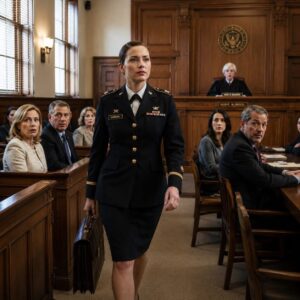
When I stepped into that Omaha courtroom wearing my Army dress uniform, my mother leaned in close and hissed, “Sit in the back, Rachel, and try not to embarrass us,” but ten seconds later, the judge looked up, went still, and said my name like she had seen it somewhere important — and for the first time in my life, the people who raised me understood the room no longer belonged to them. The courthouse smelled like old wood, floor polish, and anxiety. My parents were already standing near the front row with their attorney, dressed the way people dress when they want the world to confuse money with character. My mother gave me the same tight smile I had grown up with, the one that never reached her eyes. My father barely looked at me at all. He looked past me, around me, like I was just another inconvenience to handle before the hearing began. That part was not new. I had spent most of my life being treated like the daughter they wished had turned out differently. Too serious. Too stubborn. Too blunt. Too much in every way that never mattered when my younger sister did it and never stopped mattering when I did. By seventeen, I already knew the rules of our house. Melissa got softness. Melissa got celebration. Melissa got the version of my mother that knew how to glow and fuss and say, Isn’t she lovely? I got instruction. I got correction. I got told to stand straighter, speak quieter, want less. The first time it truly landed, I was a senior in high school asking for a prom dress. My mother did not even look up when she told me to wear my sister’s old one. She said I was not the kind of girl who cared about all that anyway. So Melissa got something new and blue and soft beneath the department store lights, and I stayed home in my room on prom night with a history book in my lap and the taste of humiliation sitting bitter at the back of my throat. That was the year I began planning my way out. Then came graduation. I crossed that stage with honors and searched the crowd for my family, hoping for one clean moment where I would feel chosen. Their seats were empty. They arrived late, blamed traffic, and somehow by dinner that night, the conversation had already moved to Melissa’s European trip, which my parents were paying for early because she had “so much potential.” That was the night I stopped confusing neglect with misunderstanding. I enlisted the next year. My father laughed like I had announced a joke. My mother cried, not because she was scared for me, but because she did not know how she would explain it to the neighbors. In their world, the Army was what girls like me did when they could not make something softer, prettier, more acceptable out of themselves. So I left. And for the first time, I found a world where effort mattered. Basic training did not care whose daughter I was. Law school did not care whether my mother approved of my tone. The JAG Corps did not ask me to shrink myself into somebody else’s polished little family portrait. It asked me to work. It asked me to stand straight, think clearly, and tell the truth without flinching. So I did. And that is exactly how I ended up back in Omaha in a courtroom my parents thought would remind me where I belonged. They had called me home for what they described as a small legal nuisance involving one of their tenants. They expected me to sit in the back, watch quietly, and play my old part — the daughter who could be summoned, placed, and silenced. My mother even pointed toward the last row near the door. So I sat there for a moment and watched them. Watched my father lean toward his expensive attorney. Watched my mother smooth her jacket with those perfect, careful hands. Watched the clerk organize files while the room filled with that familiar pre-hearing hush. Then the bailiff called everyone to rise. Judge Hullbrook stepped in. The hearing began. My parents’ lawyer stood to present their side. And that was when I rose from the back row, picked up my leather briefcase, and started walking forward in the kind of silence that makes every footstep sound like a warning. I passed my parents without looking at them. Reached the defense table. Set my briefcase down beside the tenant they had dragged in there alone. Then I looked directly at the bench and introduced myself..(I know you’re curious about the next part, so please be patient and read on in the comments below. Thank you for your understanding of the inconvenience. please leave a ‘YES’ comment below and give us a “Like ” to get full story ) 👇
The courthouse smelled like old wood, floor polish, and nerves. My parents were already standing near the front row with their attorney, dressed the way people dress…
On the midnight of my 18th birthday, I quietly transferred my late father’s $45 million inheritance into a protected trust structure. Thank God I did, because the next morning my mother slid a manila folder across the marble kitchen island in our Pacific Palisades mansion and smiled: “Just sign, sweetheart.” My influencer half-sister was already planning a Porsche and a luxury brand launch with my money… but they had no idea I’d spent the night updating everything with my father’s attorney… I was 17 years old, living inside a mansion in a coastal neighborhood that looked perfect from the outside, but felt colder than any small apartment I had ever imagined. My mother smiled for charity luncheons. My stepfather talked like a successful venture capitalist. My half-sister Serena posed online as a rising lifestyle founder. Everyone around us saw glass walls, ocean views, imported marble, and money. But inside that house, I was not treated like a daughter. I was treated like someone connected to something valuable. My biological father had built his fortune in a major tech valley before he died. He left behind a trust for me, one that would become mine when I turned 18. It was worth $45 million. To everyone else in that house, that number was not my future. It was something they had already started planning around. Two weeks before my birthday, my mother canceled the only dinner I had asked for all year. Not because of an emergency. Not because she forgot. Because Serena needed the main floor and terrace for a skincare brand launch mixer. My birthday dinner was moved aside like an inconvenience. Serena barely looked up from her phone when she thanked me for being “flexible.” My mother praised me for being “practical.” They expected me to smile, stay quiet, and disappear back into my room. So I did. I had learned long ago that crying in that house only gave them another way to shape the situation. While Serena got the best bedroom, the praise, the cars, and the spotlight, I got the guest room near the laundry area and a quiet role in the background. I studied data science. I kept my grades high. I stayed out of their way. They thought I was weak because I was silent. They never understood I was paying attention. Then one afternoon, I came home early and saw my stepfather’s tablet sitting on the kitchen island. A message flashed across the screen. It was from an estate attorney, with a subject line about a capital execution draft. Paul was my father’s name. I opened the file. Forty-two pages. By the time I finished reading, my hands were still steady, but something inside me had gone completely cold. The document was designed to move 80% of my inheritance into a new family holding company. My stepfather would oversee it. My mother would help manage the structure. Serena’s struggling brand would receive funding from it. My stepfather’s struggling tech business would rely on my father’s legacy for support. They were not planning a family discussion. They were planning major financial changes around money that belonged to me. At dinner that night, they sat across from me as if nothing had changed. Serena complained about needing more capital. My stepfather smiled and said the family would soon have all the support she needed. My mother told me to keep my head down and let them handle the complicated things. I looked at all three of them and realized the truth. They had been unusually kind to me because they were waiting for me to become old enough to sign documents. So I did not confront them. I photographed every page. I saved every timestamp. I took the information to the one man my father had trusted before he died: Elias Thorne. He read the documents in silence. Then he told me exactly what they were. A serious mistake waiting to happen. On the night before my 18th birthday, while everyone else in that mansion slept, I sat alone in my room with my laptop open. At 12:01 a.m., the moment I was legally old enough, I transferred every dollar of my inheritance into a protected corporate trust. By morning, they were waiting for me at the kitchen island. A birthday pastry sat beside a thick manila folder. My mother smiled and said, “We need to talk about that money.” My stepfather placed a cheap blue pen beside the papers and told me to sign where the tabs were. I did not shout. I did not cry. I opened the folder, read page after page, and let the silence make them nervous. Then I placed my phone on the granite counter, tapped the speaker button, and said calmly: “Mr. Thorne, you’re on speaker.” The room went silent. And when the voice on the phone explained what had happened at 12:04 that morning, my stepfather’s face lost all color. READ THE FULL STORY IN THE 1ST COMMENT BELOW 👇👇👇
The night before my eighteenth birthday, I sat alone in a guest room near the laundry and watched a clock. Not with fear. Not anymore. With the…
On my husband’s deathbed, he didn’t ask for forgiveness. He didn’t ask me to remember him kindly. He asked for one thing: “Never go to Cypress Hollow.” The stroke had taken most of his voice. Machines hummed beside the bed, doing what his body no longer could. But when he said that name, his hand tightened around mine with a strength that didn’t belong to someone fading away. “Erase it,” he whispered. “Don’t ask questions. Don’t look into it. Just stay away.” Cypress Hollow was six hundred acres of swampy Arkansas land—trees, water, and isolation—something he’d bought decades earlier and always brushed off as a mistake. In forty-four years of marriage, he never once took me there. Said it wasn’t worth the drive. Said there was nothing to see. So at 3:17 a.m., in a hospital room that smelled like antiseptic and endings, I promised the man I loved that I would never go near it. Eight months later, I was alone in a small apartment in Memphis, buried under grief and paperwork. I closed accounts, donated clothes, packed away a lifetime. Everything… except one folder. Cypress Hollow. Twice a year, tax notices still came. $847.28. Land I had never seen. Land I had sworn to ignore. “Leave it alone,” I told myself. “You made a promise.” Then the phone rang. “Mrs. Whitmore?” a man said. “This is Sheriff Cooper from Cross County, Arkansas.” My stomach tightened. “I’m calling about your property—Cypress Hollow. We need you to come out here.” “I can’t,” I said quickly. “My husband made me promise—” “Ma’am,” he said gently, “there’s a woman living on that land. She says she knows you. And she’s not doing well.” The silence that followed felt heavier than anything I had carried since his death. Three hours later, I was driving down empty Arkansas roads, passing fields and trees that stretched forever, telling myself there had to be a mistake. Cameron had always said the place was abandoned. Then I took the final turn. An ambulance sat idling near the drive. Sheriff’s cars lined the road. And instead of decay, there was a white farmhouse. Fresh paint. Lace curtains. Smoke curling from the chimney like someone had been living there all along. The sheriff met me before I reached the steps. “She’s been asking for you,” he said quietly. “By name.” On the porch sat an elderly woman wrapped in a blanket, silver hair neatly brushed, her eyes sharp despite her condition. When she saw me, something in her expression broke. “Daisy,” she whispered. “You came.” “I’m sorry,” I said carefully. “Do we know each other?” She smiled—a tired, knowing kind of smile. “No,” she said. “You wouldn’t recognize me. But I’ve known you for over thirty years.” My chest tightened. “Your husband told me everything,” she continued. “About Memphis. About your life together. About… your daughter.” Every nerve in my body went cold. Then she said my daughter’s name—the one no one outside our family ever used. And in that moment, I understood something I wasn’t ready to face: Cypress Hollow wasn’t just land. It was a secret. And whatever my husband had hidden there… hadn’t been waiting by accident. 👇 Full story continues in the first comment…
The promise came with Cameron’s dying breath, whispered through lips that could barely form words after the massive stroke had stolen half his body and most of…
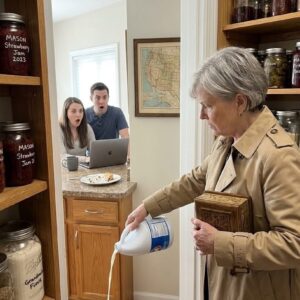
I forgot to tell my mother-in-law about the hidden camera at our country house. When I finally checked the footage, I watched her calmly pour bleach over my grandmother’s pantry… and slip a stolen jewelry box into her coat. I didn’t confront her. Instead, I set a trap, gave the police the real video, and waited. At 8 a.m. the next morning, my husband’s phone rang—and on the other end was… I heard her before I saw her. Her voice drifted through the half-open kitchen window, mixing with the crunch of gravel under her heels and the faint clink of the chicken-feed scoop near the porch. I stood in my grandmother’s kitchen, one hand wrapped around a warm mug, the scent of lavender detergent still lingering from the curtains Ana used to wash every spring. “Oh, don’t worry,” Margaret said. “She won’t notice if a few eggs go missing. She’s too busy pretending this place matters.” Then she laughed. That was the sound that did it. Not the insult. The laugh. Cold. Controlled. The same laugh she used at family dinners when she wanted everyone to know she had just said something cruel—without raising her voice. “That farm shack,” she continued into her phone, “is perfect for dumping trash.” A pause. Then softer: “Meaning her, apparently.” I stood frozen in the middle of my grandmother’s kitchen while the refrigerator hummed and a nervous hen clucked outside. Margaret was standing on land my grandmother had protected with two bad knees and grocery-store coffee, calling it trash. That “old woman” had a name. Ana. She taught me how to knead bread, label jars, prune roses, and listen for the soft cluck that meant an egg was coming. When she passed, she left me the house, the pantry, the chickens—and the cedar jewelry box hidden behind the flour tin. This place mattered. I had been married to Daniel for four years—long enough to understand that his mother’s approval wasn’t love. It was control. At our wedding, Margaret kissed my cheek and whispered, “Keep him interested, dear. Men get bored.” In photos, she looked warm. If you looked closer, you could see her fingers pressing into my shoulder. Daniel always called it “Mom being Mom.” He saw the best in people—especially her. That was one of the reasons I loved him. It was also why she knew exactly how to use him. So when a neighbor mentioned “strange activity” near the property, Daniel suggested asking Margaret to check on the chickens. “She’ll feel trusted,” he said. I wanted to believe that too. That weekend, we installed two small motion cameras. One faced the back door. The other sat high on a pantry shelf, angled toward Ana’s labeled jars and recipe boxes. “The cameras are probably unnecessary,” Daniel said. “Probably,” I replied. Then life got busy—and I forgot to tell Margaret about the pantry camera. I forgot… until Monday morning. At 6:14 a.m., while Daniel was still asleep, I opened the camera app with a cup of cold coffee beside me. The first clips showed nothing unusual. Curtains moving in the breeze. Shadows near the porch. Margaret walking through the kitchen like she owned the place. Then the clip labeled Sunday 4:38 p.m. opened. Margaret stood in the pantry with a bottle of bleach in her hand. At first, my mind searched for a normal explanation. Cleaning. A spill. Anything. There wasn’t one. She unscrewed the cap and calmly poured bleach across the pantry shelf. Over the flour tin. Over Ana’s handwritten labels. Over sealed jars of peaches. She moved slowly, carefully—like destruction could pass for housekeeping if done neatly enough. Then she reached behind the flour tin, pulled out the cedar jewelry box… and smiled. I stopped breathing. Inside were Ana’s wedding band, a rose pin, silver earrings from my childhood, and a folded recipe card in her handwriting. Margaret slipped the box into her coat pocket. Then she glanced toward the hidden camera—without seeing it—and said into her phone, “She’ll blame the house. Old places go bad. That’s what happens when people refuse to let go.” Cruelty doesn’t always look obvious. Sometimes it wears perfume and a polite smile. I replayed the clip three times before waking Daniel. He watched it once in silence. The second time, he covered his mouth. By the third, something in his expression changed. Recognition. “That’s Mom,” he said quietly. “Yes.” “She took the box.” “Yes.” “And she poured bleach on your grandmother’s pantry.” I didn’t answer. I didn’t need to. For one brief moment, I wanted to call her and say everything I had held back for years. But anger is only useful if you don’t waste it too early. So I made copies. By 7:03 a.m., the footage was saved to a flash drive. By 7:18, I had printed still images. By 7:41, I had written a list for the police: stolen jewelry, property damage, contaminated food. Then I texted Margaret. “Daniel and I found something strange at the house. Police suggested we make an inventory. Can you meet us there tomorrow at 8? Since you were the last one checking on things, we may need your help clarifying the timeline.” She replied two minutes later. “Of course, dear. Happy to help. That house has always needed better supervision.” I stared at the message until the words blurred. Then Daniel asked quietly, “You’re calling the police?” I looked at him across the kitchen. “No,” I said. “I already did.” By lunchtime, the officer had the real footage. By midnight, Daniel had barely spoken. At 7:52 the next morning, we sat at Ana’s kitchen table. The smell of bleach still lingered beneath the lemon cleaner. Daniel’s phone rested beside his coffee. The empty space behind the flour tin looked like a missing tooth. At 7:59, Margaret’s SUV pulled into the driveway. She stepped out smiling. At exactly 8:00, Daniel’s phone rang. He looked at the screen, swallowed, and put the call on speaker. Then the voice on the other end said… 👇 (I know you’re curious to see what happens next, so please be patient and continue reading in the comments below. Thank you for understanding the inconvenience. Please leave a “YES” below and give us a Like to get the full story.)👇
I heard Margaret before I saw her. Her voice slipped through the half-open kitchen window, carried on the crunch of gravel under her heels and the metallic…
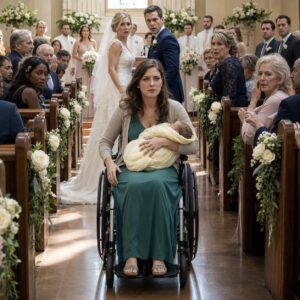
During my wedding vows, a woman in a wheelchair rolled in holding a baby and said, “Please, listen before you marry him.” I almost did not wear white because my fiancé Daniel once said very casually that he preferred ivory. “More elegant,” he said. “More classic.” So I bought ivory. I remember thinking how thoughtful he was, how lucky I was to have a man who noticed details. I understand now what kind of details he was actually noticing. Daniel entered my life like something carefully arranged. Flowers on the third date. He met my parents on the sixth. By the fourth month, he was talking about children. He asked about my brothers once, and when I told him I had four of them—that I was the only girl in three generations on my father’s side—something shifted behind his eyes that I mistook for warmth. Everyone loved Daniel. My mother called him a gift. His family was polished and formal and a little cold—but I told myself that was simply their way. His mother, Margaret, called me the week before the wedding. “I just want you to know,” she said carefully, “that we are very pleased with this match.” Not happy. Not excited. Pleased. I should have pulled at that thread. Instead, I walked down the aisle, heart full, ivory dress catching the light exactly the way Daniel had imagined it. Every seat was filled. The ceremony was almost over. Daniel had just taken my hand. The ring was hovering at the tip of my finger. The priest smiled. “Almost there,” he said. And that was when the doors at the back of the church opened. The sound reached us before anything else—the soft mechanical roll of wheels against old stone floors. I saw a young woman in a wheelchair. In her arms, wrapped in a pale yellow blanket, was a newborn so tiny it barely seemed real. She looked straight at me and said: “Please. Listen before you marry HIM and HIS FAMILY.” Then Margaret’s voice sliced through the silence. “How on earth did you find us? I thought I got rid of you.” The woman in the wheelchair did not flinch. She simply looked at Margaret for one long, steady moment. Then she turned back to me. I watched the color drain from Daniel’s face. And her next words made me pull my hand out of Daniel’s. I know many of you want the next part, so please wait a moment and check the comments below for the continuation. Thank you for your patience and understanding. Comment “YES” and give us a Like to receive the full story.)👇
I almost bought a white wedding dress. Then Daniel told me he preferred ivory. More elegant, more classic, he said, scrolling through wedding photos online with that…