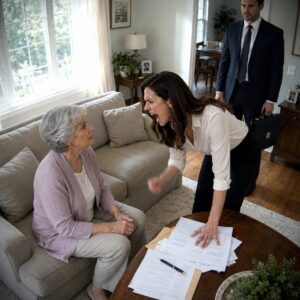
When my son got married, I never told anyone I had inherited my late husband’s ranch. And I am glad I didn’t. Exactly one week after the wedding, my new daughter-in-law, Brooke, arrived at my Seattle doorstep with a man in a navy suit carrying a black briefcase. Her heels clicked across the porch like she already owned the place. “Mom, this is Paul. He’s a notary,” she said, wearing that polished smile saved for paperwork and photographs. “We’re here to help you take care of a few documents for the house.” My stomach did not twist—it dropped. I knew what they wanted before she even sat down. What Brooke did not understand was that grief had already taught me how quickly kindness can be mistaken for weakness. And what my son did not realize was that after my husband died, I learned silence can protect more than tears ever could. My name is Suzanne. I am sixty-nine. I spent most of my life being the dependable one in a modest Seattle home—stretching every paycheck, clipping coupons, patching knees in worn jeans, convincing myself canned soup counted as dinner when money was tight. When Matthew struggled in school, I sold jewelry I had saved for years just to keep him moving forward. No one called it sacrifice. They called it what mothers do. When he brought Brooke home, I truly tried. I cleaned every corner of the house, polished the silver, baked an apple pie, made chowder from scratch, and wore my best dress with the one lipstick I saved for important days. I thought this was how families grew. But Brooke never fully touched anything—only with her fingertips. Her “ma’am” felt cold enough to leave a mark. At dinner, she answered questions like I was interrupting something more important. “I usually prefer restaurants,” she said once, glancing around my kitchen like it did not meet her standards. I told myself it was nerves. Then came the wedding. Brooke seated me in the fifth row behind strangers while her friends and relatives filled the front. At the reception, she introduced me as “Matthew’s mom” in the same tone someone might use for hired help. When I had offered weeks earlier to bake the cake myself, she laughed. “Oh no, Mom. I don’t want anything homemade.” As if love could ruin something. I had written a speech. Just a few words to welcome her, to bless them, to tell Matthew how proud his father would have been. But when the toasts began, she invited everyone except me. Her maid of honor cried. Her father rambled. Her sisters laughed into microphones. I sat there smiling until my face hurt. When someone finally asked if I wanted to speak, Brooke turned and said, “Miss Suzanne can say a few words.” Miss Suzanne. I stood anyway. My hands shook, but I managed one sentence—half of another—before Brooke started clapping. Sharp. Quick. Final. The room followed. And my words disappeared. Later, Matthew danced—with Brooke, her mother, her sisters. I stood near a table scattered with empty glasses. Around eleven, I touched his arm and said I was heading home. “Thanks for everything, Mom. Love you,” he said—already looking past me. That drive home nearly broke something in me. I could still hear my husband’s voice from his final days: Never let them walk over you. You’re stronger than you think. You have more than you realize. The next morning, I opened the safe. That was when his words truly settled. Inside were the deed, ranch records, unfinished trust documents—everything tied to nearly five hundred acres in eastern Washington. Cattle. Water rights. A main house and three smaller ones. Land that had been in his family for generations. He left it all to me. Not because I needed rescuing—but because he understood how people change when money enters the room. I said nothing. And that silence became my protection. After their honeymoon, Brooke started calling about my “future.” Her words were soft, but her intentions were sharp. Selling my home would be simpler. Consolidating assets would be smarter. Assisted living would be safer. Professionals could handle everything. Then Matthew began repeating the same lines. Almost word for word. That was when I knew. I was not imagining it. I contacted an elder-law attorney. I moved everything into a trust. I documented every conversation—every message that suggested I was confused, incapable, or in need of “guidance.” I prepared. Then I waited. So when Brooke walked into my living room with Paul the notary and a stack of papers, I poured coffee into my husband’s good china and listened as she explained how all of this was for my peace of mind. She arranged the documents like she was setting a careful trap. “Just sign here, Mom,” she said softly. “We made everything easy.” I picked up the gold pen. Paul opened his briefcase. Brooke leaned closer. I lowered the pen toward the signature line— and smiled just as the doorbell rang. Brooke’s expression shifted first. Because the people standing on my porch were not there to help her. And in that moment, she finally understood something she should have realized much sooner— the quiet widow she thought she could corner had been preparing for this far longer than she had. (I know you’re curious about the next part, so please be patient and read on in the comments below. Thank you for your understanding of the inconvenience. please leave a ‘YES’ comment below and give us a “Like ” to get full story ) 👇

My name is Suzanne. I’m sixty-nine years old, and I spent most of my life being the dependable one. Not the celebrated one. Not the one anyone…

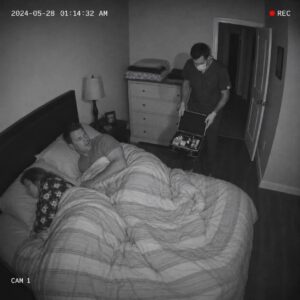
My daughter said a man came into our room every night… and that night I decided to pretend I was asleep so I could catch him. Sonia is eight. Eight. She is not the kind of child who invents shadows just to make a story sound bigger. She does not lie for attention. She does not even raise her voice when she gets excited. She is quiet, gentle, and still believes the moon follows our car because it likes her. That is why, when she said it so calmly that morning, something inside me cracked. — Dad… every night a man comes into your room after you have already fallen asleep. My hands slipped on the steering wheel. — What did you just say? She kept staring out the window on the way to school, watching shops and traffic slide past as if she were talking about the weather. — He walks very slowly, she said. — Like he does not want the floor to make noise. Mom closes her eyes, but she does not say anything. There was no fear in her voice. No confusion. Only certainty. That certainty was what made my blood turn cold. — Sonia… where did you hear that from? She shrugged. — I see him. The rest of the drive felt wrong. The air inside the car seemed too thick to breathe. I kept looking at her in the mirror, waiting for a smile, a laugh, some sign that this was a child’s strange imagination. Nothing came. She just adjusted the straps of her pink backpack and hummed quietly to herself, like she had not just opened a hole beneath my feet. Maybe she had dreamed it. Maybe she had seen something online. Maybe there was a shape in the hallway and her imagination had given it a face. Maybe. But sometimes a sentence lands in your chest and your body understands before your mind does. I dropped her off at school. She kissed my cheek, climbed out, and ran toward the gate with her pink backpack bouncing behind her. I watched her disappear into the crowd of children, and I swear the whole world tilted for a second. Then I drove straight back home. My wife was in the kitchen, exactly where she always was at that hour. Morning light spilled through the window. Coffee steamed beside the toaster. Her hair was tied back. She looked up and smiled like nothing in this world had shifted at all. — You’re back already? And for the first time since the day I married her, I did not know how to look at her. I wanted to laugh at myself. I wanted to tell her what Sonia had said and let her explain it away in ten seconds. I wanted to believe my daughter had confused a dream with a memory and that my marriage was still the safe place I thought it was. Instead, I stood there holding my keys too tightly and noticed things I had never allowed myself to notice before. The dark circles under her eyes. The way her sleeves stayed long even though the day was warm. The tiny flinch when I stepped closer, as if she had been somewhere far away and needed a second to return. She asked if everything was okay. I said yes. That entire day, I moved through the house like a stranger renting my own life. Every sound sharpened. Every silence grew teeth. When her phone buzzed on the counter, she grabbed it too quickly. When she stepped into the laundry room to answer a call, I heard only one sentence before she lowered her voice. — Tonight then… after he’s asleep. My stomach dropped so fast I had to put a hand against the wall. She came back out a moment later carrying towels, calm as ever, and asked if I wanted chicken or pasta for dinner. I said I did not care. She looked at me for a second too long, as if she sensed something had shifted, but neither of us said anything. Not over dinner. Not while Sonia told us about spelling practice. Not while we cleaned the dishes. Not while the house slowly surrendered to night. Before bed, I stopped at Sonia’s doorway. — Have you really seen him every night? She nodded against her pillow. — He always comes when it is very dark. He carries something. Mom never screams. She just looks sad. Sad. That word should have slowed me down. It did not. My wife came to bed around eleven. She smelled like soap and something sterile I could not place. She asked if I had taken my sleeping pill. I said yes and let her hear the bathroom tap running, but I spat the tablet into the sink and tucked it into my pocket instead. Then I lay beside her in the dark and waited. I made my breathing heavy. Regular. Convincing. Beside me, her breathing was wrong too. Too careful. Too awake. At 1:13, the bedroom door moved. Not all at once. Slowly. Like someone who had done it before. A thin line of hallway light slid across the floorboards. Then a figure stepped inside. A man. Tall. Careful. Silent. He closed the door without letting the latch click. In one hand, he carried a narrow black case. He did not turn on the light. He knew exactly where he was going. To her side of the bed. My entire body locked. My wife did not move, but I saw her eyes close tighter, not like someone sleeping, but like someone preparing. The man stopped beside her. For a moment, nobody spoke. Then he bent slightly, and in a voice so low it made my stomach twist, he whispered: — It’ll only take a minute. My wife gave the smallest nod. I felt something primal rise inside me. Rage. Humiliation. The hot, dizzying kind that erases reason. I could already see myself lunging across the mattress. Then I heard another sound. The soft snap of rubber. Latex. A faint sterile smell drifted through the dark. Alcohol. Plastic. Something clean and cold. The black case opened with a quiet metallic click. My wife lifted one trembling hand to the collar of her nightshirt. And when the stranger leaned over her, reached into the dark, and pulled something thin and silver into the sliver of light beside our bed, I realized that whatever was about to happen next was going to either expose a betrayal… or tear open a truth I had been too blind to see, because my hand was already moving toward the lamp when.. (I know you’re curious about the next part, so please be patient and read on in the comments below. Thank you for your understanding of the inconvenience. please leave a ‘YES’ comment below and give us a “Like ” to get full story ) 👇

My daughter told me a man entered our bedroom every night, and by the time I dropped her at school, I had already lived through three different…

The morning after my sister’s funeral, her boss called me and said, “Laura… you need to see this.” Then he added, “Don’t tell your family.” Twenty minutes later, I walked into his office—and when I saw who was standing behind him, I couldn’t move. The day after we buried my sister, her boss called. His voice was steady—but there was something underneath it. “Laura,” he said, “I need you to come in. And don’t tell your family where you’re going.” He told me Megan had left something behind. Something she didn’t want my brother or his wife anywhere near. Twenty minutes later, I was parking behind a quiet office building, following him through a side entrance, and stepping into a room with no windows. On the table— A sealed envelope with my name on it. A thick file. And one person standing behind him who shifted everything about how I understood the last few days. I had flown home on emergency leave. The kind you don’t question. The kind where loss doesn’t wait. Megan was already gone when I arrived. Thirty-eight. Healthy. Precise. The kind of person who balanced accounts before breakfast and never missed a detail. Nothing about the explanation we were given matched who she was. The funeral was quiet in the way grief forces it to be. Soft voices. Hard shoes on polished floors. My mother looked like she might collapse at any moment. My father barely spoke. But my brother Mitchell— He seemed… organized. Measured. Like he knew exactly where to stand, when to lower his voice, when to look devastated. I noticed because it felt too controlled. Training teaches you to see what doesn’t fit. And Mitchell didn’t look like someone grieving. He looked like someone managing a situation. After the service, while people moved toward small talk and sympathy, a man stepped directly toward me. David Grant. Megan’s boss. “Laura,” he said, “I need to talk to you.” “Now?” He glanced toward Mitchell and Beth. “Not here.” Something in his expression made me step away without hesitation. The wind cut through my coat, sharp enough to make everything feel more real. “What is this about?” I asked. He lowered his voice. “Your sister came to me last week. She was concerned.” I went still. “Megan?” He nodded. “She asked me to hold onto something for her. Don’t tell your family I said this. Don’t tell your brother. Don’t tell Beth. Come to my office tomorrow morning. Alone.” The words didn’t make sense—not yet. “About what?” I asked. He held my gaze for a moment. “Just come.” Then he walked away. I replayed that conversation all night. In the restroom. In the pew. In the car. In the guest room where I couldn’t sleep. Megan didn’t scare easily. If she used the word concerned, there was a reason. The next morning, Mitchell called before eight. “We need to go over paperwork tonight,” he said. “Estate things. Better to stay ahead of it.” Process. That word again. Beth texted shortly after. “We found some papers Megan was organizing. Easier if we all review together.” No details. Just pressure. I didn’t respond. Instead, I drove downtown, parked behind Westmont Trading Group, and saw David waiting exactly where he said he would be. He looked worse in daylight. “This way,” he said. We moved quickly—not rushed, but deliberate. Past offices, down a service hallway, through one locked door, then another. Until we reached a small conference room with no windows. He set a thick folder on the table—but kept his hand on it. “Before I show you this,” he said, “you need to understand something.” I nodded. “Megan didn’t trust what was happening around her.” My throat tightened. “What do you mean?” He opened the folder. Inside— Screenshots. Bank summaries. Printed emails. Sticky notes in Megan’s handwriting. Seeing her writing again almost knocked the air out of me. “Four months ago,” David said, “she started noticing things. Small amounts of money missing. Files opening differently. Security changes she didn’t make. Notes that didn’t match what she remembered.” I looked down. Patterns. Too consistent to ignore. An email: Keep hard copies. Another: I think someone is watching what I access. My mouth went dry. “She thought it was family,” I said. David didn’t answer. He didn’t need to. He turned another page. A handwritten note. If anything changes after dinner at their place again, it isn’t random. I looked up. “Dinner where?” He met my eyes. “At Mitchell’s.” The room felt smaller. He slid a white envelope toward me. My name—written in Megan’s handwriting. Inside— One sentence. If something happens to me, don’t trust anyone until you see what David shows you. I read it again. And again. “Why didn’t she tell me?” I asked. “She wanted proof first,” David said. “She thought if she had enough, she could confront them without giving them a way out.” I looked back at the folder. This wasn’t panic. It was preparation. David exhaled, then glanced toward the door. “There’s one more thing.” I lifted my eyes. He stepped aside. And that’s when I finally saw who had been standing behind him the entire time. 👇 The rest continues in the first comment…..

The Trail She Left The Army gives you three days of emergency leave when someone in your immediate family dies. Three days to fly home, bury them,…

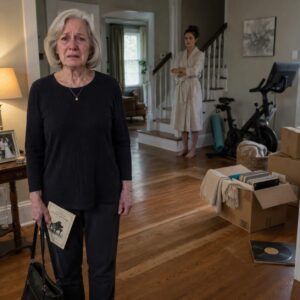
My daughter-in-law sold the rug my husband and I brought home from Marrakech because she thought it was “dated.” My son said nothing. I said nothing too, at first. But two weeks later, he stood on my porch trying a key that no longer worked, while every trace of his wife sat neatly on the lawn. I came home from my granddaughter’s piano recital just after ten on a Sunday night, still carrying the program in my purse, still hearing the soft, careful notes of Chopin in my head. The house was dark. Cyrus’s car was gone. Marisol’s was in the driveway. That alone should have made me uneasy. I was sixty-eight years old, widowed, and living in the little blue Craftsman house in a mountain city that my husband Frederick and I had bought back in 1987. We paid that mortgage for thirty years. We raised our only son there. We had arguments in that kitchen, birthdays in that dining room, Christmas mornings on those creaky floors. And after Frederick died from a stroke nobody saw coming, that house became the only place where I could still feel him. Especially the front parlor. That had been his music room. Frederick collected vinyl from the time he was sixteen. Jazz, mostly. Coltrane. Ella Fitzgerald. Sarah Vaughan. Mingus. More than two thousand records, arranged the way only he understood, alphabetically and then by year, all resting on two shelves he had built with his own hands. On Sunday evenings, he would put on Ella and slow dance me around the rug we bought in Marrakech on our thirtieth anniversary. Even when his knees hurt. Even when we were old enough to know better. So when I walked into the parlor that night and found it empty, my body stopped before my mind caught up. The shelves were gone. The records were gone. Frederick’s chair was gone. The rug was gone. The walls had been painted in one day, some pale gray-beige color Marisol would have called tasteful. In the corner sat her exercise bike. A yoga mat leaned against the wall. A sound machine on the windowsill whispered the noise of a fake ocean. I stood there with my purse in my hand. I did not scream. I did not tear through the house. I just listened to that fake ocean and tried to breathe. Then Marisol came down the stairs in a robe with a face mask on, as calm as if she had only changed a throw pillow. “Oh, you’re home,” she said. “I was going to surprise you. Don’t you love it? It’s so much more functional.” Functional. That was the word she chose for the room where my husband had kept forty years of music. I looked at her and said quietly, “Where are the records?” She smiled like I was being difficult in front of a buyer. “Don’t worry, I didn’t throw them out. They’re in storage. I rented a unit. The space was just so unused with things nobody touched anymore.” Things nobody touched anymore. I asked, “Where is the chair?” “Same place,” she said. “It’s all together. I labeled the boxes.” Then I asked, “Where’s the rug?” That was when she paused. Only for a second. But long enough for me to watch her decide which version of the truth she was going to give me. “I sold the rug,” she said. “I’m sorry, but it honestly looked outdated. I had a buyer through work, and I figured we’d put the money toward the new flooring upstairs. I was going to mention it. I really was.” The rug Frederick had bargained for in three languages he did not speak. The rug we carried home on a plane in a duffel bag. The rug he had pulled me across on Sunday nights when Ella sang through the room. I went upstairs to my bedroom, our bedroom, closed the door, and sat on the edge of the bed in the dark. I want to say that was where it started. But it wasn’t. It started six months after Frederick died, when Cyrus called from a nearby commercial hub and said his apartment lease was ending, rents were insane, and Marisol had had what he called a difficult quarter. “Just for a little while, Mom,” he said. “A few months at most.” I said yes before he even finished asking. The house was too quiet. I was eating cereal for dinner because cooking for one felt lonely. The thought of my son at my kitchen table again made me forget to be careful. They arrived with a moving truck too large for a temporary stay. At first, it almost felt nice. Cyrus made coffee in the mornings. I made Sunday roast. We sat at the dining room table with Frederick’s chair still at the head, exactly where it had always been. Then Marisol looked at that chair and said it felt “energetically heavy.” I said no when she suggested moving it. The next morning, it was in the garage. Cyrus told me, “Mom, she’s just trying to make herself comfortable here. Cut her some slack.” So I did. I kept giving in until very little in the house still felt like mine. My embroidered hand towels disappeared into a drawer. Frederick’s pictures were moved aside for dried pampas grass. My custom doormat went into the trash. Marisol replaced my spice rack, the one Frederick built for our twentieth anniversary, with little glass jars in her handwriting. Then she moved my blood pressure medication into the cabinet over the fridge, a cabinet I had not reached without help since 2009. “They were cluttering the counter,” she said. I dragged over a chair and shook so badly I could barely open the bottle. Still, I stayed quiet. Because Cyrus was my son. Because I was his mother. Because somewhere along the way, I had confused love with constantly stepping aside. A friend from church, Constance, saw it before I admitted it. She came for tea one chilly afternoon, and Marisol asked if we could move our visit to the porch because the living room smelled musty. Constance squeezed my hand before she left. “Honey,” she said, “this is your house, isn’t it?” I said it was. “Then act like it.” But I didn’t. Not yet. The night after Marisol sold my rug, I sat in the dark until my hands stopped trembling. Then I picked up the phone and called Constance. “I think I’m ready now,” I said. She didn’t ask ready for what. She only said, “Thank God. I have someone for you.” That someone was Willamina Cates, an estate lawyer in our city who had been doing this for thirty-five years. I drove to her office Monday morning while Cyrus was at work and Marisol was at a broker open. I told her everything. The chair. The towels. The pills. The records. The rug. The way my house no longer smelled like coffee and lemon oil, but botanical candles I never chose. Willamina listened without interrupting. Then she put down her pen. “Ma’am,” she said, “this is your house. Solely.” Something in my chest went still. “Your son and his wife have no legal claim to anything in that home,” she continued. “Not the kitchen. Not the parlor. Not the garage. Not the rug she sold.” I did not cry. I just folded my hands in my lap and heard Constance’s voice again. Then act like it. Willamina leaned back in her chair. “Do you want to start the formal process of asking them to move out?” I looked out the window at a gray morning, and for the first time since Frederick died, the silence around me did not feel empty. It felt like a door waiting to be opened. (I know you’re curious about the next part, so please be patient and read on in the comments below. Thank you for your understanding of the inconvenience. please leave a ‘YES’ comment below and give us a “Like ” to get full story ) 👇

I came home from my granddaughter’s piano recital just after ten on a Sunday night, still carrying the program in my purse, still hearing Emma’s careful notes…

My sister screamed that I was ruining her $4,200 birthday dinner, my father slapped me in the middle of my own Charleston restaurant and told me to leave, and I probably would have walked straight into the night if the head chef hadn’t stepped out of the kitchen, stopped beside Table 12, and asked one question that made the entire room forget whose birthday it was. Friday night service at Lark and Laurel begins long before the first guest ever walks inside. By 5:15, I was doing what I always do—checking candles, straightening menus, pretending I wasn’t nervous about things I had already controlled. Then I saw the reservation. Table 12. 7:30. Party of six. Carter. Sutton’s birthday. My last name. My sister’s name. In my restaurant. I called my business partner, Nina, and told her my family had somehow booked a dinner at the place they had never once asked about. Not when I moved to Charleston. Not when the feature article was published. Not when the waitlist stretched to six weeks. “Stay in the kitchen,” she said. I didn’t. That was my mistake. I changed into a black dress in my office so I could pass as a guest instead of the woman who had spent three years building that space from a gutted warehouse, sleepless payroll nights, and one recipe my mother had taught me before she passed. My father was already seated at the head of the table when I stepped out. Of course he was. Frank Carter, navy blazer, sitting like the room belonged to him simply because someone had pulled out his chair. Sutton glowed beside him, phone in hand, already posing for pictures that hadn’t even been taken yet. There was one empty seat. At the end. Slightly off to the side. There is always a seat like that—for the daughter no one plans around. The first twenty minutes unfolded the same way they always did. Sutton was the center, everyone else faded into the background, and I was expected to smile like that counted as participation. She ordered champagne “for fun.” My father raised a toast “to the daughter who always makes him proud.” One of Sutton’s friends asked what I was doing these days, and before I could answer, Sutton laughed. “She’s a cook somewhere downtown,” she said. “She’s always had that little food thing.” The food thing. Not the restaurant. Not the business. Not the menu I had rewritten dozens of times. Not the staff whose rent depended on my decisions. Just… the food thing. Then the entrées arrived. Sutton ordered the Laurel—the signature dish, built from my mother’s old crawfish étouffée recipe, refined over years until critics wrote about it like it meant something. She took one bite and closed her eyes. “Oh my God. This is amazing.” My father leaned over, took a forkful, chewed, and nodded. “Not bad.” I should have let it go. Instead, I gave her the birthday gift I had wrapped myself between prep and bad judgment. A leather recipe journal. On the first page, in careful handwriting, I had copied our mother’s recipe so she could have one piece of her that didn’t live only in memory. She opened it. Looked down. “You got me a notebook?” “It’s Mom’s recipe,” I said quietly. “The Sunday one.” She placed it beside her designer bag like it meant nothing. “I don’t cook, Elise.” A minute later, one of her friends said the dish was the best thing she had ever tasted. And before I could stop myself, I said, “It’s a family recipe.” That was enough. Sutton dropped her fork and looked at me like I had crossed a line. “Can you not do this for one night?” she snapped. “It’s my birthday.” “I was just talking about the dish—” “You always do this,” she said, louder now. “You make everything about you.” Nearby tables started to fall quiet. My father’s hand flattened against the table. “Elise,” he said. “Drop it.” I should have. I know that now. But after years of being the daughter at the edge of the frame, I heard myself say, “I just thought she should know where it came from.” That’s when Sutton shouted it. “You’re ruining my birthday!” And before I could even turn toward him, my father stood, leaned across the table, and slapped me hard enough for the whole room to hear. Then he pointed toward the door. “Get out. Now.” No one moved. Not my sister. Not her friends. Not the guests pretending not to stare. I sat there, heat spreading across my cheek, one clear thought cutting through everything: I had been walking into this same room my whole life… and the door had never really been open. Then the kitchen door swung wide. My head chef stepped onto the floor in full whites, crossed the dining room without hesitation, stopped beside my chair… and bowed. Then he said, clearly enough for every table to hear: “Ms. Carter… should I cancel their reservation?” (I know you’re curious about the next part, so please be patient and read on in the comments below. Thank you for your understanding of the inconvenience. please leave a ‘YES’ comment below and give us a “Like ” to get full story ) 👇 Posted onMay 27, 2026 ByadminNo Commentson My sister screamed that I was ruining her $4,200 birthday dinner, my father slapped me in the middle of my own Charleston restaurant and told me to leave, and I probably would have walked straight into the night if the head chef hadn’t stepped out of the kitchen, stopped beside Table 12, and asked one question that made the entire room forget whose birthday it was. Friday night service at Lark and Laurel begins long before the first guest ever walks inside. By 5:15, I was doing what I always do—checking candles, straightening menus, pretending I wasn’t nervous about things I had already controlled. Then I saw the reservation. Table 12. 7:30. Party of six. Carter. Sutton’s birthday. My last name. My sister’s name. In my restaurant. I called my business partner, Nina, and told her my family had somehow booked a dinner at the place they had never once asked about. Not when I moved to Charleston. Not when the feature article was published. Not when the waitlist stretched to six weeks. “Stay in the kitchen,” she said. I didn’t. That was my mistake. I changed into a black dress in my office so I could pass as a guest instead of the woman who had spent three years building that space from a gutted warehouse, sleepless payroll nights, and one recipe my mother had taught me before she passed. My father was already seated at the head of the table when I stepped out. Of course he was. Frank Carter, navy blazer, sitting like the room belonged to him simply because someone had pulled out his chair. Sutton glowed beside him, phone in hand, already posing for pictures that hadn’t even been taken yet. There was one empty seat. At the end. Slightly off to the side. There is always a seat like that—for the daughter no one plans around. The first twenty minutes unfolded the same way they always did. Sutton was the center, everyone else faded into the background, and I was expected to smile like that counted as participation. She ordered champagne “for fun.” My father raised a toast “to the daughter who always makes him proud.” One of Sutton’s friends asked what I was doing these days, and before I could answer, Sutton laughed. “She’s a cook somewhere downtown,” she said. “She’s always had that little food thing.” The food thing. Not the restaurant. Not the business. Not the menu I had rewritten dozens of times. Not the staff whose rent depended on my decisions. Just… the food thing. Then the entrées arrived. Sutton ordered the Laurel—the signature dish, built from my mother’s old crawfish étouffée recipe, refined over years until critics wrote about it like it meant something. She took one bite and closed her eyes. “Oh my God. This is amazing.” My father leaned over, took a forkful, chewed, and nodded. “Not bad.” I should have let it go. Instead, I gave her the birthday gift I had wrapped myself between prep and bad judgment. A leather recipe journal. On the first page, in careful handwriting, I had copied our mother’s recipe so she could have one piece of her that didn’t live only in memory. She opened it. Looked down. “You got me a notebook?” “It’s Mom’s recipe,” I said quietly. “The Sunday one.” She placed it beside her designer bag like it meant nothing. “I don’t cook, Elise.” A minute later, one of her friends said the dish was the best thing she had ever tasted. And before I could stop myself, I said, “It’s a family recipe.” That was enough. Sutton dropped her fork and looked at me like I had crossed a line. “Can you not do this for one night?” she snapped. “It’s my birthday.” “I was just talking about the dish—” “You always do this,” she said, louder now. “You make everything about you.” Nearby tables started to fall quiet. My father’s hand flattened against the table. “Elise,” he said. “Drop it.” I should have. I know that now. But after years of being the daughter at the edge of the frame, I heard myself say, “I just thought she should know where it came from.” That’s when Sutton shouted it. “You’re ruining my birthday!” And before I could even turn toward him, my father stood, leaned across the table, and slapped me hard enough for the whole room to hear. Then he pointed toward the door. “Get out. Now.” No one moved. Not my sister. Not her friends. Not the guests pretending not to stare. I sat there, heat spreading across my cheek, one clear thought cutting through everything: I had been walking into this same room my whole life… and the door had never really been open. Then the kitchen door swung wide. My head chef stepped onto the floor in full whites, crossed the dining room without hesitation, stopped beside my chair… and bowed. Then he said, clearly enough for every table to hear: “Ms. Carter… should I cancel their reservation?” (I know you’re curious about the next part, so please be patient and read on in the comments below. Thank you for your understanding of the inconvenience. please leave a ‘YES’ comment below and give us a “Like ” to get full story ) 👇

Here is something nobody tells you about building a restaurant from nothing: the hardest ingredient is not money, and it is not location, and it is not…

My parents laughed when I walked into Portsmouth Family Court in my Navy dress uniform at exactly 9:03 a.m. over my grandfather’s 84-acre farm—but the moment the judge studied my ribbons and quietly said, “Captain Bates… from Yemen?” the entire room shifted. “There she is,” my father said, loud enough for people nearby to hear. “Still pretending to be a soldier.” My mother adjusted the sleeve of her beige jacket and glanced at their lawyer. “She always needed attention.” They thought the uniform was for show. They didn’t realize it was the most honest thing I had. The courtroom smelled faintly of paper, floor polish, and old heating vents. Air pushed unevenly from above the flag. A clerk typed in short bursts. My knee—the one that always warned me before storms—throbbed under the pressed navy fabric. In my pocket, the brass compass my grandfather gave me when I was ten rested warm against my palm. Across the aisle, my parents looked carefully arranged. My father wore his usual church tie—the blue one with small white dots. My mother had tissues stacked neatly beside her. Their attorney laid out folders in perfect order, adjusting his glasses before giving me one quick, dismissive look. I had one binder. One military ID. And twelve years of proof. It started at 5:12 a.m., just hours after I landed back in Virginia. I was sitting in a Waffle House off I-264, staring at peanut butter waffles gone cold when the email came through. By the time I finished reading the petition, the syrup had hardened on the plate, and my grip on the fork had turned my knuckles white. They claimed I had abandoned the farm. The same farm where I paid $6,480 in property taxes last year. The same farm where I covered an $11,300 roof repair from overseas. The same farm where I sent money to fix a burst pipe while sitting under red lights in places most people only see on the news. I called my brother Ryan—because some part of me still believed he might understand. “They need the money,” he said. Then, after a pause long enough to settle it, “You should just let it go.” So I didn’t come to court in casual clothes. I came in the uniform they had mocked for over a decade. When the hearing began, their attorney stood and built a version of me that barely resembled reality. He spoke about neglect. About family strain. About my “extended voluntary absence,” as if deployment were some kind of choice. Then my father took the stand. “She ran off to play soldier,” he said with a shrug. “My father needed family—not… this.” My mother dabbed her eye carefully. “She changed,” she told the judge softly. “We couldn’t reach her anymore.” A quiet shift moved through the room. Someone cleared their throat. The bailiff remained still. I didn’t interrupt. Didn’t react. Didn’t give them the moment they wanted. When the judge turned to me, I stood, picked up my binder, and walked forward. The sound of it landing on the clerk’s desk was flat and final. “Inside are twelve years of tax records, repair invoices, bank transfers, contractor statements, and maintenance logs,” I said evenly. “I wasn’t physically present for every season. My duty didn’t allow that. But my responsibility never stopped.” The judge nodded for me to continue. “There are also call records,” I added, opening a tab. “Calls made to both of my parents while I was overseas—and later from Landstuhl Regional Medical Center during recovery. The calls were made. They were never answered.” The tension in the room tightened instantly. My father shifted in his seat. My mother’s hand stilled over the tissues. Then I placed one final document on top: My grandfather Edward’s handwritten note, attached to the survey map of the land. Next to my name, in blue ink, he had written: She keeps this land standing. No speech followed. No dramatic pause. Just paper against wood. The judge looked down at the note… then the records… then at me. His eyes settled on my ribbons. He leaned back slightly, then forward again—like something had just clicked into place. The room grew still. Even the clerk stopped typing. “Captain Bates,” he said slowly. The bailiff stepped closer as I handed over my military ID. The judge studied it. Then the ribbons. Then my face. My father’s chair scraped faintly against the floor. The judge lowered his voice. “Captain Bates… from Yemen?” The room didn’t laugh anymore. And for the first time— they understood who they were actually standing against. 👇 Full story continues in the first comment……

The Brass Compass The judge’s voice had dropped so low I almost thought I had imagined it. “Captain Bates, from Yemen?” The courtroom had been full of…

At 71, I won $89 million and kept it completely quiet. Then my son said, “Mom, when are you finally going to move out?” I left without a single argument—and by 7:30 the next morning, I had already purchased their dream home under a name they never even remembered. My son pushed his chair back at exactly 6:18 p.m. and looked at me like I was just another unpaid bill sitting on the table. The roast chicken was cooling in the center, green beans still smelled of garlic, and the polished wood felt cold under my fingers as I passed the rolls. “Mom,” Daniel said, “when are you planning to move out?” The ice in Renee’s glass cracked once. Small. Sharp. Final. For a moment, no one moved. My grandson stopped scrolling. My granddaughter froze with her fork mid-air. A butter knife reflected the chandelier light while the refrigerator hummed softly behind us, as if it hadn’t just heard my son erase me from his home. My name is Margaret Briggs. I’m seventy-one years old. Two years earlier, my husband Harold passed away in Tucson, and Daniel told me I shouldn’t live alone. “Just for a little while,” he had said. So I sold the house with the yellow kitchen, the hallway that creaked every winter, the rose bushes Harold trimmed poorly but proudly, and the porch where he used to set my tea before sunrise. I moved into Daniel and Renee’s Scottsdale home with one suitcase, three photo albums, my Bible, and the quiet gratitude of a woman trying not to become a burden. Their house looked like something out of a magazine no one was allowed to touch. White cabinets. Black fixtures. A covered pool. Three garage doors. A fridge full of almond milk, pre-packed snacks, and routines that didn’t include me. Renee kept calling the spare room “the guest room,” even after months had gone by. She let me fold towels. She let me pack lunches. She let me sign school forms when she was “too busy.” I learned which pan she preferred, which mug Daniel wanted clean, which soccer field had the worst parking, and which piano teacher always ran late. People don’t always throw you out directly. Sometimes they make you useful… until they can call your presence a problem. One Sunday, they left a note by the coffee maker instead of inviting me to brunch. Another afternoon, I overheard Renee speaking behind a closed door, her voice low—but not low enough. “She eats our food, uses our utilities, and contributes what exactly?” Daniel didn’t correct her. Not then. Not ever. In February, after a routine appointment, I bought a lottery ticket at a gas station simply because the clerk was kind and I had a few dollars left in my coat pocket. It sat in my handbag for days, folded beside an old receipt. On Monday morning at 9:42, while the house was empty and my coffee had gone lukewarm, I checked the numbers. $89 million. I didn’t scream. I didn’t call Daniel. I didn’t run downstairs to turn myself into family news. I simply folded the ticket and placed it inside my Bible, between Psalms and an old church bulletin Harold had saved. The money didn’t make me louder. It made me careful. At 2:13 a.m., after Daniel asked when I would leave, I opened the notepad in my drawer and wrote five simple lines: Stay quiet. Hire an attorney. Claim privately. Separate everything. Find a home. Not a room. A home. Before sunrise, I showered, put on my gray blazer, and sat at the same kitchen table where my son had reduced me to an inconvenience. By 7:30 a.m., I had meetings scheduled with three estate attorneys—under my maiden name, the one Renee once misspelled on a holiday card. Renee came downstairs in heels. Her perfume reached me before she did. She saw my laptop, my posture, my steady hands. She expected tears. She got silence. Patricia Holloway, my attorney, was calm, precise, and sharp enough to make panic unnecessary. She asked one question before opening any files. “Have you told anyone?” “No.” “Good. Keep it that way.” Within days, everything was in place. A trust. A private claim. Accounts separated. Ownership secured under a name Daniel had never bothered to learn. Then I found the house. Four bedrooms. East-facing sunroom. Real yard. Quiet street. Shade trees. A porch wide enough for morning tea. It was exactly the kind of place Daniel and Renee always described when they talked about their “next step.” I toured it alone at 10:05 a.m. The entryway smelled faintly of cedar and polish. Sunlight warmed the wooden floors. A brass key rested on the counter, and I touched it gently, like it might remember me before life taught me to ask permission. The next morning, I made a full-price cash offer through the trust. Clean closing. No Daniel. No Renee. No explanations. By the end of that week, everything changed. Breakfast appeared before I asked. Renee smiled too much. Daniel asked if I needed anything from the store. My grandchildren were suddenly encouraged to spend more time with me. Kindness that appears overnight usually has a reason behind it. Saturday at 8:11 a.m., Renee walked into my room without knocking. She closed the door and looked straight at the envelope on my dresser. The brass key was partially visible beneath my Bible. “You bought a house?” she asked. I placed my hand over the key. Then the doorbell rang. Daniel came downstairs barefoot. Renee stopped breathing. On the porch stood a man in a navy suit, holding a folder with Renee’s name printed clearly on the tab. And he lifted it slightly— (I know you’re curious about the next part, so please be patient and read on in the comments below. Thank you for your understanding of the inconvenience. please leave a ‘YES’ comment below and give us a “Like ” to get full story ) 👇

My son pushed his chair back at 6:18 p.m., and I remember the sound before I remember his face. Wood against tile. A short scrape. The kind…

My mother-in-law secretly took a cheek swab from my newborn in the hospital nursery while I was still recovering. Three weeks later, she arrived at Sunday dinner carrying an envelope and a smile she could barely hide. My husband opened it, read it once… then slowly looked up at her. The results said nothing about me. Instead, they exposed a secret she had hidden for thirty years—and what he said next left her unable to explain herself to anyone at that table. I was still wearing my hospital wristband when Marlene walked into our dining room holding a white envelope between two perfectly manicured fingers. The plastic band brushed against my wrist every time I adjusted Noah against my chest. The room smelled like roast beef, rosemary, and warm potatoes—but underneath it all sat something sharper. Tension. The envelope looked too neat for what it carried. Daniel stood at the head of the table, carving knife still in his hand. The roast cooled untouched while Marlene smiled at our three-week-old son like she had brought dessert instead of a weapon. Robert sat beside her gripping his water glass too tightly. Claire had already gone quiet—the way people do when they sense something is wrong before anyone says it out loud. Marlene placed the envelope beside Daniel’s plate. “I think everyone deserves the truth,” she said. No one answered. The knife hovered. The room held its breath. Three weeks earlier, I had been lying in recovery after an emergency C-section—exhausted, numb, trying not to fall apart—when Marlene slipped into the hospital nursery. At 2:14 p.m., she signed in as “grandmother.” At 2:19, a nurse noticed her standing near Noah’s bassinet with a private cheek-swab kit hidden inside her purse. A swab. From my newborn. When I confronted her later, she didn’t deny it. “A mother knows when something isn’t right,” she said. And by “something,” she meant me. That was always her style. Never openly cruel—just careful enough to sound concerned instead of controlling. When we got married, she smiled for photos but criticized everything in private. When I lost a pregnancy, she brought soup—and questions. When I finally carried Noah to term, she counted every week like she was auditing my body. Suspicion disguised as concern. And now she believed she had proof. “Open it, Daniel,” she said. My stomach tightened. I looked down at Noah’s tiny fingers curled against my sweater and hated that his first family dinner had become something like evidence. “Marlene,” I said quietly, “what exactly did you do?” She didn’t look at me. “What any grandmother would do if she thought her son was being deceived.” Daniel’s knife hit the plate with a sharp sound. Robert murmured, “Marlene… stop.” But she continued. “You deserve certainty,” she said to Daniel. “I paid for proper testing. Sealed results. No more doubt.” No more doubt. I stayed seated, even though every part of me wanted to stand up and throw the envelope back at her. Daniel stared at it for a long moment. Then he picked it up. His hands shook slightly as he opened it. Marlene’s smile widened. He read the first page. Then read it again. I braced myself—for hesitation, for suspicion, for the moment everything cracked apart. But Daniel didn’t look at me. He looked past me. Straight at his mother. “Mom,” he said slowly, “why does this report say I’m not related to Dad?” Marlene’s expression didn’t collapse all at once. It came apart piece by piece. First her smile. Then her eyes. Then the certainty she had walked in with. Robert pushed his chair back sharply. Claire whispered, “Oh my God…” Daniel kept reading, slower this time. The report said nothing about me. Nothing about Noah. Nothing about the accusation she had built this entire moment around. The truth was older. Older than our marriage. Older than Noah. Older than Daniel himself. Daniel turned the page toward the center of the table. His finger stopped under one bold line. Marlene’s lips parted like she already knew what it said. And the entire room shifted— Because he was about to read it out loud. (I know you’re curious about the next part, so please be patient and read on in the comments below. Thank you for your understanding of the inconvenience. please leave a ‘YES’ comment below and give us a “Like ” to get full story ) 👇

I was still wearing the hospital wristband when Marlene brought the envelope to Sunday dinner. Three weeks had passed since the emergency C-section, and the plastic band…

My son never knew I had quietly saved $800,000. Then one evening, his wife looked across the room and said, “He needs to leave this house.” I had spent years living simply, letting everyone believe I was just an old retired man surviving on a small pension. I never told Logan about the money I had built quietly. I never mentioned the accounts, the investments, or the safety net I had planned to leave him one day. Then his wife decided I was no longer welcome. And my son said nothing. So I smiled, packed my bags, and walked out without a fight. Three weeks later, I removed my name from every loan, account, and agreement I had been quietly supporting behind the scenes. That was when the panicked calls began. In my son’s house in Dallas, everyone thought I was harmless. Just Albert Higgins, sixty-eight years old, retired after thirty-five years as a senior accountant. I repaired small things, cooked when needed, kept the yard tidy, and tried not to take up too much room. I lived modestly because I wanted to, not because I had nothing. After my wife passed away six years earlier, Logan asked me to move in with him and Chelsea. Their house near Thunderbird Road had a spare room, a big kitchen, and enough light to make grief feel less heavy. I agreed because my old apartment had become too quiet. At first, Chelsea acted kind. Then the small requests began. “Could you eat in the kitchen tonight? We’re having guests.” Later, it became, “Would you mind staying in your room? It’s more of a couples’ dinner.” One Thanksgiving, they put me at a small side table while everyone else laughed together in the dining room. I ate in silence, telling myself I was being reasonable. Over time, Chelsea began treating the house like it had two versions: the family home, and the place where I was allowed to pass through if I stayed invisible. “We have company,” she once said with a polite smile. “Could you use the back door? It’ll be easier.” So I did. I walked around the house like a man whose welcome had run out. The counters were always covered with bills, furniture invoices, takeout receipts, and papers for their new SUV. I noticed everything. Years of accounting make it impossible not to. I never scolded them. I only watched how carelessly money disappeared when people assumed someone else would always keep the lights on. Still, I helped. I cooked. I mowed the lawn. I fixed leaks. I folded towels the way my late wife used to like them—neat edges, sharp corners, perfect stacks. I stayed quiet because Logan seemed relieved whenever the house stayed peaceful. For a while, I convinced myself that was enough. Then came the Monday night dinner party. Logan’s coworkers filled the living room with laughter and clinking glasses. Chelsea moved through the house in an expensive dress, smiling like everything in her life had been earned. I had spent the afternoon making stuffed mushrooms the way Logan loved them as a boy—extra garlic, slow-cooked, careful. Chelsea came up beside me with a tight smile. “Albert, could you stop hovering? People are trying to talk.” So I stepped back. A few minutes later, she returned. This time, she did not bother sounding polite. “Why don’t you stay in your room tonight?” she said. “It’ll be easier for everyone.” I looked at Logan. He stared into his drink. Then Chelsea raised her voice just enough for the nearby guests to hear. “Logan, are you going to handle this?” The room fell quiet. Everyone looked at us. My son looked embarrassed. Guilty. Cornered. Then he made his choice without having the courage to call it a choice. “Dad,” he said softly, “maybe you could just… give us some space.” I nodded once. Because I understood. He was not choosing me. He was allowing someone else to choose for him. “I won’t be in the way,” I said calmly. That night, I sat on the edge of my bed while the party carried on downstairs without me. I did not feel rage. I felt something colder and cleaner. Clarity. The kind that comes when every number finally balances. Before sunrise, I packed two suitcases. I took my documents, a few photographs, my laptop, and the cardigan that still carried the faint scent of my old life. I placed my key on the kitchen counter and left without a note. There was nothing left to explain. I did not leave because I was angry. I left because I finally understood. In the garage, inside storage boxes marked with my name, were the papers I had kept for years: co-signing documents, notarized loan agreements, receipts, signatures, and records Logan and Chelsea had never bothered to read closely. I had not saved those papers as weapons. I had saved them because accountants document reality. The next morning, I took the bus downtown and met with a contract attorney named Fiona Cartwright. She did not waste time with pity. She opened a legal pad and asked, “What exactly do you want?” “I want to separate my finances cleanly,” I said. “And I want to leave with dignity.” She reviewed every document, checking signatures, dates, and obligations. Then she tapped her pen once against the desk. “Then we do this properly,” she said. “Three notices. Same week. Same morning.” For the next few days, I quietly rebuilt the shape of my life. I rented a small room, redirected my mail, and began removing my name from every financial tie that had been holding their lifestyle together. Three weeks later, I finally felt peace settle inside my chest. That morning, I parked down the street from their house just after sunrise. The Texas heat was already rising from the pavement. At exactly 8:30, a delivery truck stopped in front of their driveway. The driver walked up to the door, placed three plain envelopes on the porch, rang the bell, and left. A few minutes later, Chelsea came outside in a robe, coffee still in her hand. She opened the first envelope casually. Then her face changed. She tore open the second one. Her shoulders went stiff. And when she reached for the third envelope… that was when the real story began. (I know you’re curious about the next part, so please be patient and read on in the comments below. Thank you for your understanding of the inconvenience. please leave a ‘YES’ comment below and give us a “Like ” to get full story ) 👇

The porcelain coffee cup slipped from Chelsea’s hand and hit the concrete driveway with a clean, hard crack. Dark coffee spread across her bare ankles and expensive…
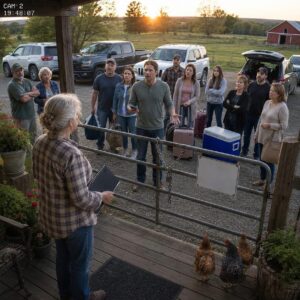
My son removed me from the family group chat because, as he said, “Mom, it was for working adults.” I said nothing. I went back to feeding the chickens, checking the fence line, and writing in the little farm notebook they all used to laugh about. One week later, twelve of them arrived with suitcases, meat, coolers, and weekend plans, certain I would leave the key under the flowerpot again. But this time, the gate was locked. My name is Ruth, and for most of my adult life, my family treated my farm like a place that opened whenever they needed it. Not a home. Not my work. Not the thing that kept me awake during storms, down on my knees in mud, repairing fences with cold hands while everyone else was busy with “real careers.” To them, it was the family farm. To me, it was the place my late husband and I had built one hard season at a time. There was a white porch swing out front, a gravel driveway that dipped near the mailbox, a red barn that needed repainting every few years, and a kitchen window that faced the pasture. In the mornings, I drank coffee from the same chipped mug and watched the sun rise over the back field. It was quiet. It was work. It was mine. But every summer, every long weekend, every holiday when hotel prices got too high or someone wanted “fresh air for the kids,” my phone would start buzzing. “Mom, can we come out this weekend?” “Mom, do you still have the big cooler?” “Mom, can you make potato salad?” “Mom, leave the key under the flowerpot in case we get there late.” And I did. For years, I did. I washed sheets before they came. I stocked the fridge. I made breakfast for people who slept until noon. I cleaned muddy boots from the hallway. I picked up soda cans by the firepit. I smiled when they called it “our little escape,” even though I was the only one who stayed behind to clean up after the escape ended. Then my son Daniel removed me from the family group chat. I found out by accident. My niece mentioned a plan for Labor Day weekend, then stopped mid-sentence when she realized I did not know. I looked at my phone. The chat was gone. So I called Daniel. “Did you remove me from the group?” There was a pause, not guilty enough to be regret. “Mom,” he said, with that careful voice people use when they want disrespect to sound reasonable, “it was for working adults. You don’t understand what we talk about.” I stood in my kitchen with my hand on the counter. Behind me, the old refrigerator hummed. Outside, the wind moved through the corn at the edge of the property. Working adults. I thought about the tractor payment I had made alone. The roof I had patched before a storm. The feed bills. The county forms. The years I kept that farm alive while raising the same son who now thought adulthood began in a group chat without me. “I see,” I said. Daniel sighed like I was being sensitive. “Don’t make it dramatic, Mom. It’s just easier this way.” I almost laughed. Easier. That had always been the word. It was easier when I hosted. Easier when I cooked. Easier when I kept quiet. Easier when I left the key under the flowerpot. Easier when nobody asked whether I was tired. So that week, I did something different. I did not call anyone. I did not argue. I took out the old black notebook from the kitchen drawer. They used to tease me about that notebook. “Mom and her little farm diary.” “What do you write in there, chicken gossip?” “Careful, she’s documenting the potato salad.” I let them laugh. Because yes, I wrote things down. I wrote down who borrowed tools and never returned them. Who promised to split the repair cost for the damaged gate and forgot. Who left trash by the creek. Who brought extra guests without asking. Who used my freezer, my propane, my linens, my pantry, my time. I wrote down dates. I wrote down names. I wrote down promises. Not because I planned to shame anyone. Because when you are the person everyone depends on, people start confusing your kindness with permission. The following Friday evening, I saw headlights turning into the long gravel drive. One truck. Then another. Then two SUVs. Twelve people climbed out with suitcases, grocery bags, coolers, folding chairs, and the confident noise of people who had not considered the possibility of hearing “no.” Daniel walked straight to the flowerpot beside the gate. He lifted it. Nothing. He looked again. Still nothing. Then he saw the chain around the gate. Locked. My daughter-in-law frowned. My brother looked toward the house. The kids started asking why they could not go inside. Someone laughed awkwardly and said, “Maybe she moved the key.” Daniel called me. I answered from the porch. He could see me standing there. “Mom,” he said, forcing a smile into his voice, “the gate’s locked.” “I know.” There was a pause. “We’re here.” “I can see that.” His smile faded. “Can you open it?” I looked at the twelve people waiting behind him, all of them holding pieces of a weekend they had planned without me in the place they expected me to provide. “No,” I said. My sister stepped closer to Daniel, whispering loudly enough for me to hear through the phone. “Is she serious?” Daniel’s voice tightened. “Mom, don’t do this in front of everybody.” That sentence almost made me soft. Almost. Then I remembered the group chat. The little pause before he said I did not understand working adults. The way he had not sounded cruel, only certain. Certain I would still be useful. I nodded toward the gate. “There’s a sign,” I said. Daniel turned. They all turned. Hanging from the fence was a clean white board with neat black letters. Welcome to Ruth’s Farm. Private property. No entry without invitation. No overnight stays without written agreement. No shared meals, equipment, rooms, or storage unless arranged in advance. For questions, see the notebook. Below the sign sat the old black notebook inside a clear plastic box. For the first time all evening, nobody laughed. Daniel stared at it. Then he said, softly, “Mom, what is this?” I looked at him from the porch, my hand resting on the rail my husband had built thirty years earlier. “It’s for working adults,” I said. His face changed. Behind him, someone opened the notebook. (I know you’re curious about the next part, so please be patient and read on in the comments below. Thank you for your understanding of the inconvenience. please leave a ‘YES’ comment below and give us a “Like ” to get full story ) 👇

My son removed me from the family group chat on a Tuesday afternoon. That was the kind of sentence I never imagined I would have to say…